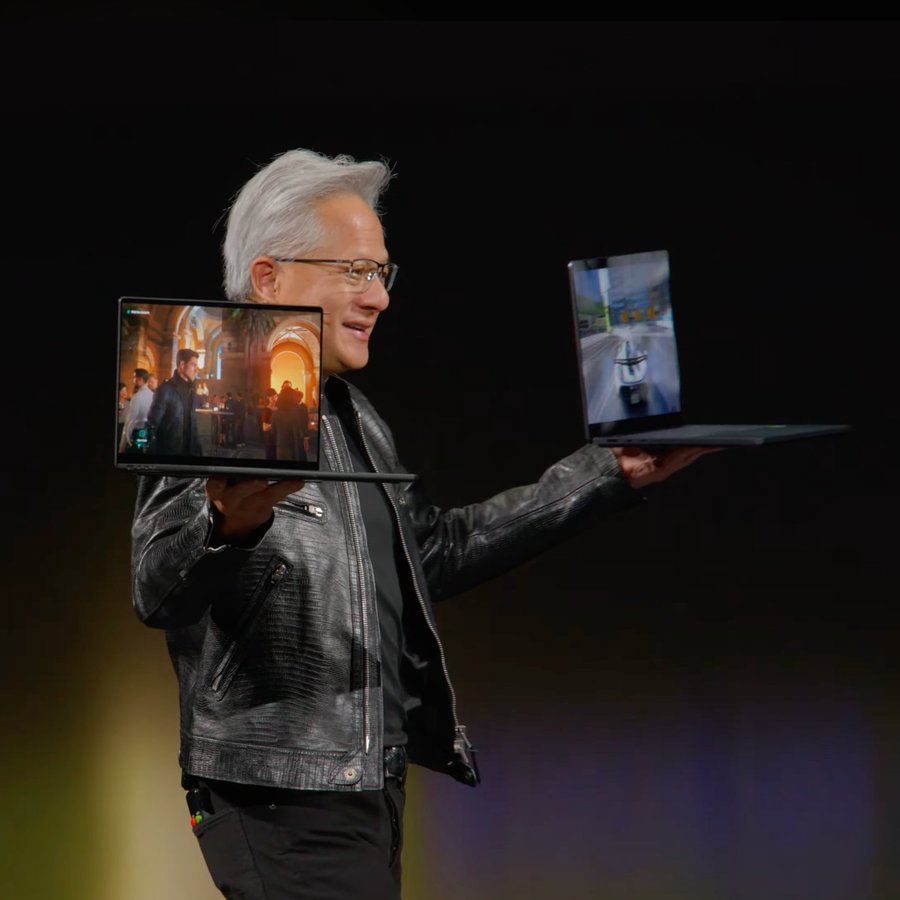
Nvidia announced RTX Spark at Computex 2026 on May 29, its first Arm-based superchip for Windows PCs and laptops, placing the GPU giant in direct competition with Intel, AMD, and Qualcomm simultaneously. Windows 11 had already begun testing Nvidia Arm support while quietly excluding Intel and AMD, and the coordinated “A new era of PC” posts from Nvidia, Windows, and Arm on May 29 confirmed what leaks had suggested for months. First laptops ship this fall from ASUS, Dell, HP, Microsoft, Lenovo, and MSI, with Acer and GIGABYTE following.
What RTX Spark Actually Is
RTX Spark is a system-on-chip pairing a 20-core Nvidia Grace Arm CPU (co-designed with MediaTek) and a Blackwell GPU carrying 6,144 CUDA cores, roughly equivalent to a discrete RTX 5070, connected via NVLink-C2C with up to 128GB of unified LPDDR5X memory at 270-300GB/s bandwidth. The whole package runs at 45-80W depending on configuration.
The unified memory architecture is the headline. By eliminating PCIe bottlenecks and sharing memory between CPU and GPU, RTX Spark delivered roughly 2.5 times the AI inference throughput of a comparable x86 workstation with an RTX 5090, while consuming 40% less power. Nvidia claims 1 petaFLOP of FP4 AI performance, enough to run 120-billion-parameter models locally, render 90GB 3D scenes, and edit 12K video on the built-in Blackwell encoder.
It also games. Nvidia demonstrated Forza Horizon 6 and 007: First Light at 1440p/100fps with ray tracing and DLSS 4.5, a profile no previous Windows-on-Arm chip approaches. Nvidia has been working with 100 Windows software providers including Adobe, Blender, Riot Games, and Xbox to ensure full compatibility. Optimized Photoshop and Premiere versions arrive later this year, reportedly delivering up to twice the speed of current Snapdragon X implementations.
The Competitive Realignment
Qualcomm held a Microsoft exclusivity agreement for Windows-on-Arm that has now lapsed, and RTX Spark is the immediate beneficiary. The Microsoft Surface Laptop Ultra, built on RTX Spark from silicon to OS, is the flagship launch device, signaling Microsoft’s commitment extends beyond vendor diversification into architectural transformation. Microsoft has tuned Windows scheduling to better distribute workloads across RTX Spark’s CPU and GPU cores, a level of OS-hardware integration previously associated only with Apple’s M-series.
That Apple comparison is unavoidable and deliberate. Jensen Huang described RTX Spark as “as big a deal as the reinvention of the phone into what we now know as the smartphone.” The architectural logic mirrors Apple Silicon, unified memory, Arm efficiency, vertically integrated GPU, but at larger scale with 128GB ceiling versus Apple’s current 64GB maximum, and with the Blackwell GPU carrying significantly more raw CUDA throughput than Apple’s GPU clusters.
Where Apple’s M-series remains locked to macOS, RTX Spark runs Windows with full compatibility. Where Qualcomm’s Snapdragon X excels at battery life and thin-and-light formfactors but compromises on gaming and GPU performance, RTX Spark targets all three simultaneously. Intel and AMD, meanwhile, have no competitive Arm-based Windows laptop silicon on the market, with Intel still navigating stability issues in existing Windows 11 deployments.
The AI Positioning and What It Actually Means
Nvidia frames RTX Spark as an “agentic AI” platform first—positioning on-device AI as the primary value proposition over gaming or content creation. The chip can run agents like OpenClaw and Codex locally, which matters in enterprise deployments where sending queries to cloud APIs creates latency, cost, and data privacy concerns. Nvidia is positioning RTX Spark as hardware for an era where Windows becomes an agentic AI OS, one where users ask and the PC does the work rather than launching apps and clicking.
That framing has real implications beyond marketing. Nvidia’s recent Windows 11 driver stability issues demonstrated that tighter OS-hardware integration creates new failure modes. When the GPU and CPU share unified memory and the OS schedules workloads across both, a driver problem isn’t just a graphics issue—it’s a system stability issue. RTX Spark’s NVLink-C2C architecture makes GPU and CPU functionally inseparable, meaning Nvidia’s driver quality and Microsoft’s OS scheduling now share accountability for overall system reliability in ways that discrete GPU + Intel/AMD CPU setups never required.
Nvidia confirmed a two-year RTX Spark release cadence with a Rubin GPU-based successor already on the roadmap. Vera, Nvidia’s data center CPU, is now in full production with early customers including Anthropic, OpenAI, SpaceX’s xAI, Dell, Oracle, and CoreWeave. RTX Spark’s consumer launch and Vera’s data center rollout together confirm Nvidia’s CPU ambitions span the full computing stack, from laptops to hyperscale infrastructure.
The market hasn’t seen a competitor enter the PC CPU space successfully since AMD recovered from near-collapse a decade ago. Nvidia’s advantages, GPU brand recognition, CUDA ecosystem dominance, deep Microsoft partnership, and AI narrative momentum, give it a credible launch position. Whether RTX Spark achieves the MacBook-level integration Apple spent years refining depends on whether that two-year cadence delivers driver maturity and software compatibility before the “new era of PC” promise outpaces what the silicon can actually deliver.
Follow us on Bluesky, LinkedIn, X, and Telegram to Get Instant Updates