This isn’t merely a reseller agreement; it’s a strategic merging of the world’s dominant CRM data layer with the world’s most extensive cloud infrastructure. The underlying narrative is simple: if you want to use generative AI on your most sensitive operational data, you need a guarantee that the models won’t accidentally learn trade secrets or expose customer records.
For the past two years, the biggest friction point in enterprise AI has been trust. When companies push their operational data, customer histories, sales forecasts, and logistics chains, into a third-party LLM, they worry about data residency, governance, and model contamination.
The traditional solution involved complex, bespoke virtual private cloud (VPC) deployments or heavily siloed, on-prem infrastructure. This new collaboration seeks to standardize that high-security environment, making AI adoption less of an engineering feat and more of a configuration choice.
Connecting the Data Cloud to the Foundational Layer
Salesforce’s contribution centers on its Data Cloud, which acts as the centralized, harmonized source for all customer data across the Customer 360 ecosystem. This unified data layer is crucial because LLMs require vast, clean datasets to be effective, and Salesforce already manages that operational truth.
AWS, leveraging its deep bench of services, provides the secure computational backbone. This integration allows Salesforce Data Cloud users to securely access and fine-tune models hosted on Amazon Bedrock or utilize specialized services like Amazon SageMaker, all without the data ever leaving the client’s designated trust boundaries.
“The modern enterprise doesn’t just need AI; it needs responsible AI. This partnership is fundamentally about reducing the security surface area and ensuring data governance is baked into the workflow, not bolted on afterward.”
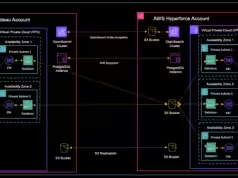
The resulting architecture ensures that proprietary data used for grounding or fine-tuning models remains isolated within the AWS environment controlled by the customer. This is the difference between handing your blueprints to a contractor versus letting them work inside a secured facility you already own.
While the immediate beneficiaries are security-conscious enterprises, the broader impact ripples through the ongoing cloud wars. This unified offering provides a direct counter-punch to Microsoft’s tightly integrated Azure and Copilot ecosystem, which relies heavily on the marriage of Office 365 data and OpenAI models.
By pairing AWS, the largest public cloud provider, with Salesforce, the definitive leader in CRM, the two companies are creating a compelling alternative for organizations wary of single-vendor lock-in, or those whose infrastructure is already heavily invested in the AWS stack.
- Reduced Latency: Keeping the data and the foundational models geographically proximate improves performance.
- Simplified Compliance: Built-in controls help enterprises meet industry-specific regulations (e.g., HIPAA, GDPR).
- Faster Time-to-Value: Abstracting away the complex infrastructure setup allows companies to focus on application and prompt engineering.
The move also validates the “bring your own model” philosophy championed by AWS Bedrock, giving enterprises choice in the underlying LLM, be it Anthropic, Cohere, or an open-source option, while Salesforce handles the data plumbing.
The days of enterprise data existing in one silo and AI computation happening somewhere else are rapidly fading. This collaboration underscores a