The Timeline: From Termination to OpenAI Return in Under an Hour
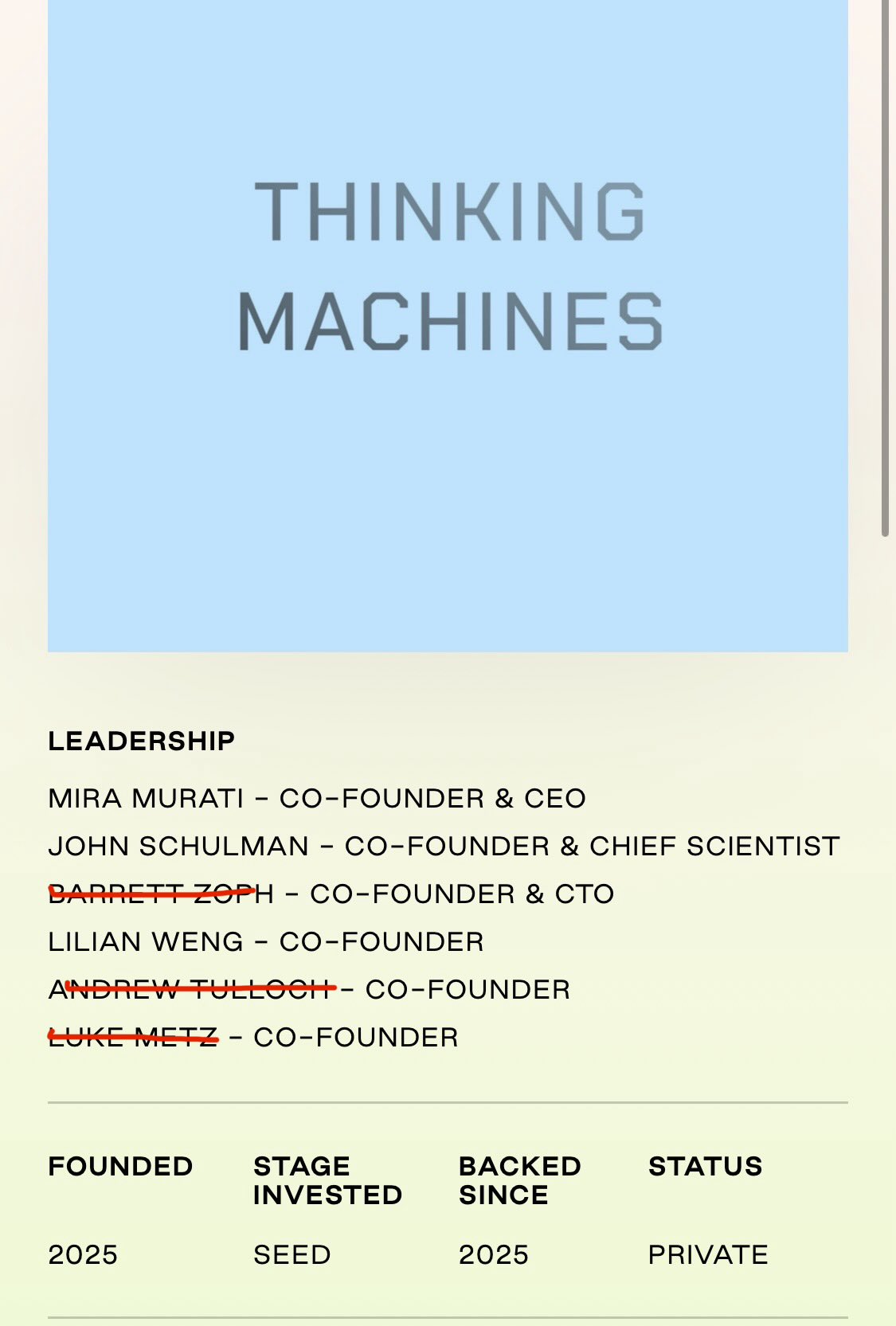
The sequence of events suggests either remarkable coincidence or carefully choreographed corporate manoeuvring. At approximately 3:00 PM EST, Murati posted on X: We have parted ways with Barret Zoph. Soumith Chintala will be the new CTO of Thinking Machines.
The statement made no mention of Luke Metz, Thinking Machines’ other co-founder, or the circumstances surrounding Zoph’s departure. Just 58 minutes later, OpenAI’s CEO of applications Fidji Simo announced: Excited to welcome Barret Zoph, Luke Metz, and Sam Schoenholz back to OpenAI! This has been in the works for several weeks.
The admission that negotiations occurred “for several weeks” while Zoph remained employed as Thinking Machines’ CTO, responsible for the company’s most sensitive technical strategy and competitive positioning, raises immediate conflict-of-interest concerns. Zoph had fiduciary duties to Thinking Machines as both co-founder and C-suite executive, yet was simultaneously negotiating his departure to a direct competitor that would benefit from insider knowledge of the startup’s product roadmap, technical capabilities, and strategic vulnerabilities.
| Time | Event | Party | Public Statement |
|---|---|---|---|
| ~3:00 PM EST | Zoph termination announced | Thinking Machines (Murati) | “We have parted ways with Barret Zoph” |
| 3:58 PM EST | OpenAI hire announced | OpenAI (Simo) | “This has been in the works for several weeks” |
| Oct 2024 | Previous co-founder departure | Andrew Tulloch → Meta | No public statement on circumstances |
| Sept 25, 2024 | Zoph originally left OpenAI | Barret Zoph | “Natural point to explore new opportunities” |
| July 2024 | $2B seed round closed | Thinking Machines | $12B valuation, a16z led |
The Misconduct Allegation: What “Confidential Information” Means
Sources close to Thinking Machines told WIRED that Zoph shared confidential company information with competitors, a violation that in most employment contracts constitutes grounds for immediate termination and potential legal liability. The nature and extent of the leaked information remains undisclosed, but the timing suggests the intelligence sharing occurred during or facilitated the multi-week OpenAI negotiations that Simo confirmed.
If Zoph provided OpenAI with Thinking Machines’ technical architecture, training methodologies, product timelines, or investor materials during recruitment discussions, it would constitute corporate espionage under most legal frameworks. California’s Uniform Trade Secrets Act and federal Defend Trade Secrets Act impose civil and criminal penalties for unauthorized disclosure of proprietary information, particularly when used to benefit a competitor. Whether Thinking Machines pursues legal action remains unclear — public litigation would expose the startup to additional reputational damage while its leadership scrambles to stabilize operations.
Who Is Barret Zoph: The Neural Architecture Search Pioneer
Zoph’s AI research credentials made him among the most valuable hires in the field. After six years at Google Brain pioneering Neural Architecture Search (NAS) — using AI to design better AI architectures — he joined OpenAI in September 2022. He built OpenAI’s post-training team from scratch with John Schulman, leading the groups responsible for making models like GPT-4 useful and safe for public interaction through reinforcement learning from human feedback (RLHF).
As OpenAI’s Vice President of Post-Training before departing in September 2024, Zoph oversaw the technical processes that transform raw foundation models into consumer-facing products. His work directly influenced ChatGPT’s conversational quality, safety guardrails, and instruction-following capabilities—expertise that both Thinking Machines and now OpenAI again consider strategically critical. In OpenAI’s announcement, Simo specified “Barret will report to me”—positioning him directly under applications leadership rather than research, suggesting his returning role focuses on product development rather than foundational model training.
The Soumith Chintala Promotion: PyTorch Creator Steps In
Murati’s announcement positioned Soumith Chintala — PyTorch co-creator and former Meta AI leader — as Thinking Machines’ new CTO. Chintala brings legitimacy and technical depth the startup desperately needs following the co-founder exodus. He spent 11 years at Meta leading PyTorch from inception to 90%+ adoption across AI research and production, powering everything from OpenAI’s models to Meta’s recommendation systems to university classrooms globally.
Chintala left Meta in November 2025 specifically to “do something small again” after leading a project that handles 2 million daily binary downloads and tens of thousands of monthly commits. His decision to join Thinking Machines as a contributor rather than co-founder suggests he preferred technical contributions over equity-driven entrepreneurship. The unexpected CTO promotion 10 weeks into his tenure thrusts him into executive responsibilities he explicitly sought to avoid by leaving Meta’s leadership structure.
| Executive | Previous Role | Key Achievement | Thinking Machines Role |
|---|---|---|---|
| Mira Murati | OpenAI CTO | Led GPT-4, DALL-E development | CEO & Co-founder |
| Barret Zoph (departed) | OpenAI VP Post-Training | Built RLHF pipeline, NAS pioneer | CTO & Co-founder (terminated) |
| Luke Metz (departed) | OpenAI Research Scientist | Optimization algorithms, meta-learning | Co-founder (left for OpenAI) |
| Andrew Tulloch (departed Oct ’24) | OpenAI Infrastructure | Distributed training systems | Co-founder (left for Meta) |
| Soumith Chintala | Meta AI / PyTorch Lead | Co-created PyTorch, 90% AI adoption | New CTO (promoted) |
The Credibility Signal: Why Chintala Matters Beyond Technical Skill
Chintala’s appointment sends critical signals to Thinking Machines’ $2 billion seed round investors—Andreessen Horowitz, Accel, Nvidia, AMD, Jane Street—who backed the company largely on Murati’s reputation and the founding team’s collective OpenAI pedigree. Losing two of three technical co-founders within four months typically triggers investor alarm and down-round concerns. By promoting a figure of Chintala’s stature — someone whose PyTorch work literally powers the AI industry’s infrastructure layer — Murati demonstrates the bench strength remains despite high-profile departures.
However, Chintala’s proven expertise lies in open-source infrastructure and community building rather than frontier model training or product commercialization — Thinking Machines’ core focus. His technical brilliance is unquestioned, but whether he can rapidly master AGI safety research, enterprise product development, and competitive positioning against OpenAI and Anthropic remains untested. The promotion reads as damage control rather than strategic succession planning.
The Broader Pattern: AI Startup Fragility Despite Mega-Rounds
Thinking Machines’ struggles exemplify challenges facing AI startups attempting to compete with incumbents despite massive capital infusions. The company raised one of the largest seed rounds in tech history — $2 billion at a $12 billion valuation — yet lost three of its original co-founders (Tulloch, Zoph, Metz) plus key researcher Schoenholz within six months. This marks the second major personnel loss following Tulloch’s October 2024 departure for Meta.
The exodus reveals uncomfortable truths about competing against organizations with mature infrastructure, established user bases, and deep talent pools. OpenAI offers researchers access to compute clusters Thinking Machines can’t match, datasets accumulated over years of production deployment, and the psychic reward of working on systems billions of people use daily. For someone like Zoph whose post-training expertise directly impacts product quality, returning to OpenAI means seeing his work deployed at unprecedented scale within weeks rather than hoping Thinking Machines’ eventual product achieves market adoption.
The “gravitational pull” metaphor appears repeatedly in coverage. When parent companies want talent back, especially talent that originated there, the attraction proves difficult to resist. Startups must prove they offer something incumbents cannot—breakthrough research directions, equity upside, creative autonomy—that compensates for infrastructure disadvantages. Thinking Machines has yet to articulate that differentiation compellingly enough to retain its own co-founders.
The Investor Dilemma: $12 Billion Valuation, Zero Products
Thinking Machines’ $12 billion valuation in July 2024 represented pure bet on team pedigree and Murati’s leadership rather than demonstrated product-market fit or revenue. The company has not publicly launched any products, published research, or disclosed its technical approach beyond Murati’s stated focus on “safe and beneficial AI.” Investors betting on the team’s ability to execute now face a team that has lost half its founding members and substantial technical leadership.
Andreessen Horowitz, which led the round, built its AI investment thesis around backing elite technical founders from frontier labs. When those founders depart for the very companies they left, it undermines the core investment rationale. Follow-on funding becomes complicated—does the existing team justify continued capital deployment, or do investors press for strategic pivots, M&A, or even returning capital? The typical playbook for handling co-founder departures involves immediate executive searches, retention packages for remaining talent, and public messaging emphasizing mission continuity. Thinking Machines has executed only the last component so far.
The Legal Questions: Non-Competes, Trade Secrets, Fiduciary Duty
California broadly prohibits non-compete agreements except in limited circumstances, making it difficult for Thinking Machines to prevent Zoph, Metz, or Schoenholz from rejoining OpenAI on legal grounds. However, non-disclosure agreements (NDAs) and trade secret protections remain enforceable. If Zoph shared technical architecture details, training methodologies, or strategic plans with OpenAI during recruitment—information that gave OpenAI competitive advantage—Thinking Machines could pursue civil claims for breach of fiduciary duty and misappropriation of trade secrets.
The challenge: litigation exposes Thinking Machines to discovery that reveals its own internal dysfunction, investor disputes, or technical shortcomings. Public legal battles also poison relationships with potential employees who see the startup as litigious rather than focusing on product development. Most AI companies facing similar situations negotiate quiet settlements with non-disparagement clauses rather than courtroom showdowns—trading financial compensation for confidentiality and avoiding prolonged distractions.
For OpenAI, hiring executives under active misconduct investigations creates its own risks. If Thinking Machines can prove OpenAI knowingly solicited confidential information or encouraged breaches of fiduciary duty, tortious interference claims become viable. The “several weeks” negotiation period Simo disclosed suggests OpenAI engaged with Zoph while he remained employed as CTO—timing that raises questions about what information changed hands and when.
What This Means for AI Talent Competition
The incident establishes that AI’s talent wars have entered a more aggressive phase where direct competitive disruption—not just passive recruiting—is acceptable strategy. OpenAI didn’t wait for Thinking Machines to fail organically; it actively recruited two co-founders and a senior researcher during the startup’s formative period when their departure would cause maximum damage. Other incumbents (Anthropic, Google DeepMind, Meta) will likely adopt similar approaches, viewing well-funded startups as talent development programs that can be harvested once individuals gain experience but before companies achieve defensive market positions.
For startup founders, the lesson is sobering: capital alone doesn’t insulate against talent reacquisition by incumbents with superior infrastructure and mission clarity. Founders must offer equity packages large enough to dwarf salary differentials, articulate technical visions sufficiently compelling to retain researchers despite resource constraints, and build cultures so distinctive that returning to corporate labs feels like professional regression rather than advancement.
The irony: Murati, Zoph, and Metz all left OpenAI in September 2024 citing desires to build something new, pursue independent visions, and escape corporate constraints. Four months later, two-thirds of that founding team concluded those aspirations were less compelling than returning to the infrastructure, scale, and mission they left behind. Whether that reflects Thinking Machines’ shortcomings or OpenAI’s gravitational dominance remains ambiguous—but the outcome speaks for itself.
The Bottom Line: Premature Obituary or Strategic Reset?
Losing your CTO and a co-founder simultaneously, four months after another co-founder departed for Meta, typically qualifies as an existential crisis for any startup—let alone one with a $12 billion valuation and zero shipped products. Thinking Machines now faces the challenge of proving Chintala’s leadership can stabilize technical direction, retain remaining talent, and deliver on the ambitious vision that justified the largest seed round in history.
The optimistic interpretation: Thinking Machines is better off without co-founders whose loyalty wavered months into the journey. Chintala brings proven leadership credentials, Murati’s product vision remains intact, and the remaining team can now execute without internal dysfunction. The company still has $2 billion in runway, access to elite researchers beyond the departed trio, and relationships with compute providers (Nvidia, AMD) who invested precisely to ensure alternatives to OpenAI exist.
The pessimistic read: OpenAI just kneecapped a potential competitor by reclaiming its best technical talent, exposing internal conflicts that will make future recruiting difficult, and demonstrating that even $12 billion valuations can’t overcome the gravitational pull of incumbents with production infrastructure and global user bases. If Thinking Machines cannot retain co-founders it recruited from OpenAI just months ago, why would other elite researchers believe the startup offers differentiated career trajectories?
The next six months will determine which narrative proves accurate. If Thinking Machines ships a compelling product, retains its remaining team, and executes additional funding rounds at maintained or increased valuations, the co-founder departures become footnotes in a successful company-building story. If additional defections occur, product launches disappoint, or investors lose confidence, January 14, 2026 will mark the day Thinking Machines’ trajectory fundamentally changed—from potential OpenAI challenger to cautionary tale about AI startup fragility in an incumbent-dominated landscape.
Follow us on Bluesky, LinkedIn, and X to Get Instant Updates