
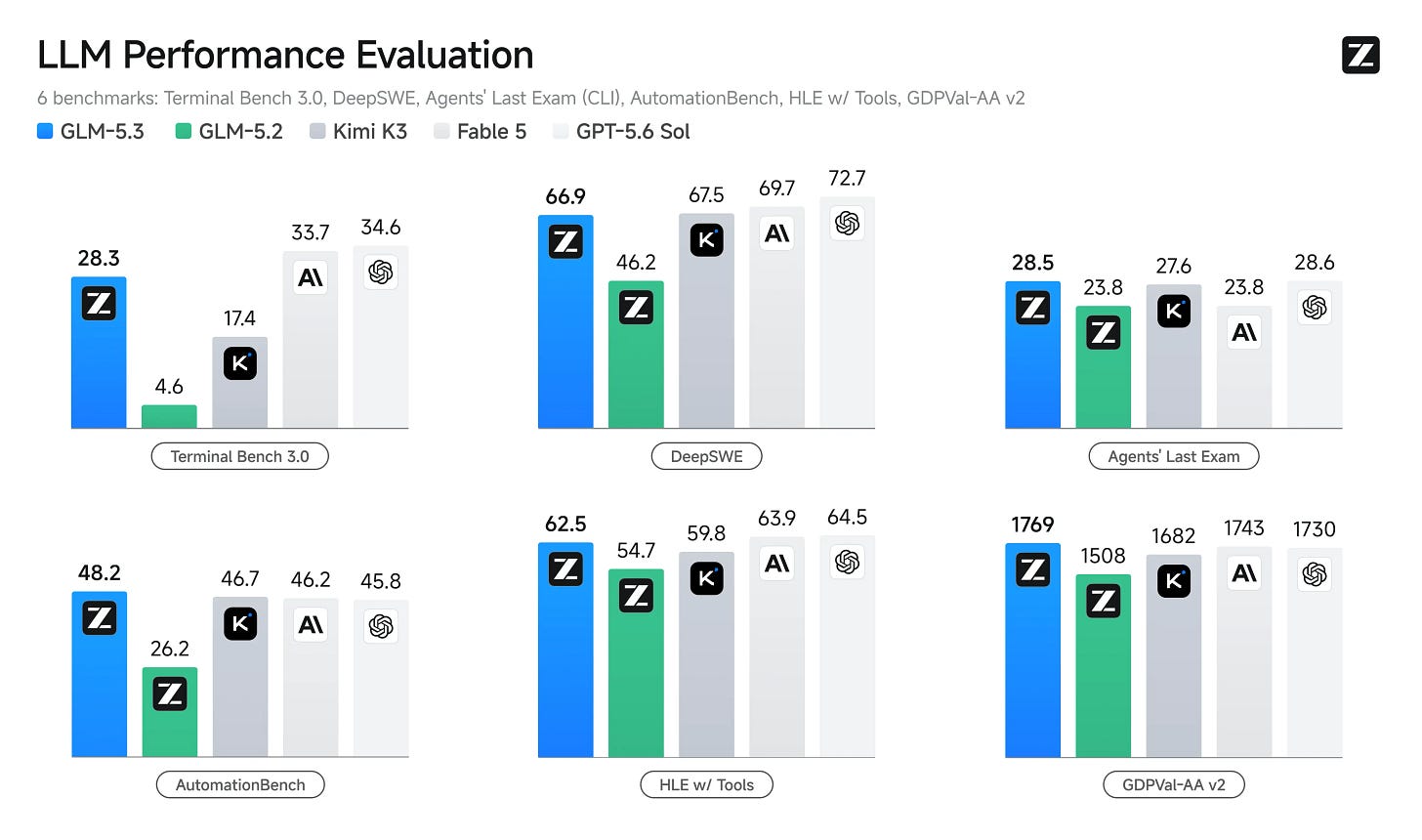
How GLM-5.3 Stacks Up
Benchmarks indicate GLM-5.3 has outpaced Moonshot AI’s Kimi K3 on many tests. It also reportedly surpassed Claude Fable 5 and GPT-5.6-Sol on some metrics. That positions GLM-5.3 at the frontier for agentic coding, at least by the numbers Z.ai is publishing.
The Real Story Is Post-Training
What makes this notable is how Z.ai got here. GLM-5.3 runs on roughly 750 billion parameters, about a third the size of Kimi K3. Yet it competes at the same level or better.
Z.ai’s blog post puts it plainly: “Scaling post-training is all we did for GLM-5.3.” The company says GLM-5.3 shares the same base model as GLM-5.2, with all the gains coming from extended post-training work rather than a bigger foundation model.
This is a meaningfully different bet than what Kimi appears to be doing, which leans harder on pre-training scale. Z.ai has been building GLM models since 2019, tracing back to when Tsinghua University’s THUDM released the original GLM weights in March 2021.
Why Chinese Labs Move Faster
The industry keeps asking the same question: how do Chinese labs match American output with a fraction of the resources? Release speed is a big part of the answer.
- Z.ai ships new releases in days, not months
- OpenAI and Anthropic operate on longer, more cautious release cycles
- Rapid iteration lets Chinese labs continuously optimize against public benchmarks
American labs may well have stronger internal models sitting unreleased. But a slower release schedule effectively flatters Chinese offerings when it comes to frontier adoption. If model self-improvement increasingly depends on live user data, this dynamic could matter even more going forward.
Benchmarks, Incentives, and the “Benchmaxxing” Problem
There is a well known tension in AI development called “benchmaxxing,” where labs optimize for test scores rather than real world usefulness. Z.ai has clear incentives to lean into public benchmarks. High scores affect its valuation and help it raise capital, reinforcing its position as the scrappy underdog matching American giants blow for blow.
Z.ai is not hiding from the sharper edges of what it built. The company calls GLM-5.3 its “most capable model to date for cybersecurity tasks,” with real improvements in vulnerability discovery and exploit analysis. It is rolling out a staged release to security partners first, allowing controlled evaluation of GLM-5.3 before wider availability.
The Open Weight Question
Z.ai plans broader API access and eventual open weight availability once safety evaluations wrap up. But open weight releases carry a structural problem that goes beyond any single company’s intentions.
Models with advanced capabilities keep shrinking in size, which makes them easier to modify and deploy without the safeguards their original developers built in. Z.ai has monitoring in place, but the diffusion of cyber capabilities ultimately depends on the lowest common denominator of safety practice across the entire ecosystem. That is not a problem one company can solve alone.
Hashlytics Take
The benchmark race gets all the headlines, but the more interesting signal here is strategic. Z.ai just proved that post-training optimization can close a capability gap that used to require brute force scale, and it did it with a model a third the size of its closest competitor. If that pattern holds, the next phase of the AI race won’t be won by whoever has the most compute. It will be won by whoever iterates fastest on what they already have, and Chinese labs currently have a structural speed advantage that Western labs seem unwilling or unable to match.
Follow Hashlytics on Bluesky, Facebook, LinkedIn , Telegram and X to Get Instant Updates