What Google’s Chart Shows
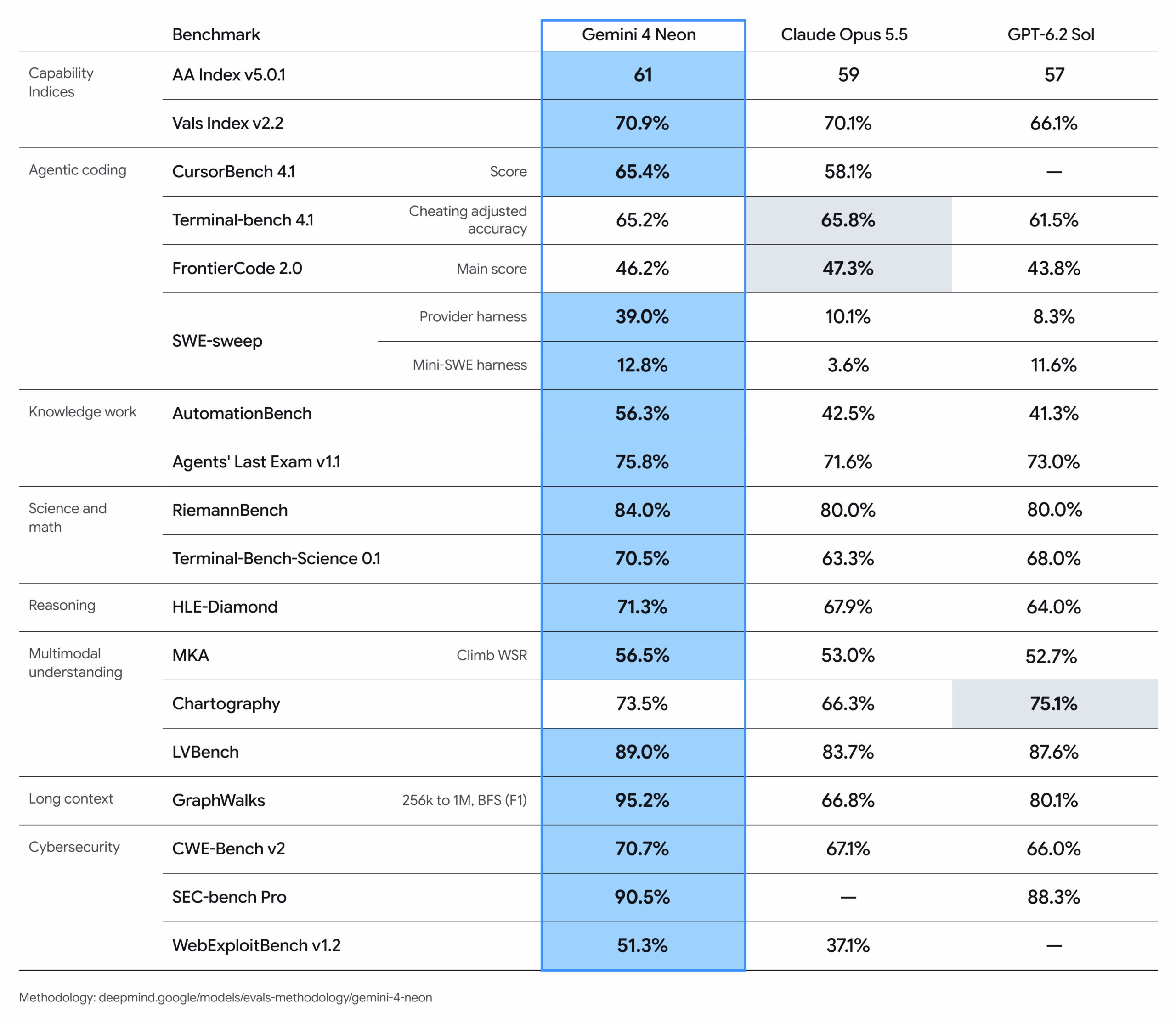
Google’s table pits Neon against Claude Opus 5.5 and GPT-6.2 Sol across 19 rows. Neon leads 16, including the AA Index (61 against 59 and 57) and GraphWalks long context (95.2% against 66.8% and 80.1%). It trails on three:
- Terminal-bench 4.1, cheating adjusted: Opus 5.5 at 65.8%, Neon 65.2%
- FrontierCode 2.0: Opus 5.5 at 47.3%, Neon 46.2%
- Chartography: GPT-6.2 Sol at 75.1%, Neon 73.5%
Read the headline gaps carefully. SWE-sweep shows 39.0% against 10.1% on Google’s provider harness, but only 12.8% against 11.6% for GPT-6.2 Sol on the mini-SWE harness. Each rival has blank cells, and Carbon, which Google earlier said topped the Artificial Analysis index, is absent. Neon itself is third there at 61 points. Several figures come from outside evaluators, including Vals.ai (second, 70.9%) and Artificial Analysis’s coding agent index (first, 58.6), but the SWE-sweep and Chartography runs name none.
Access and Cost
- Where: Gemini API, AI Studio, Gemini Enterprise, Antigravity and the Gemini app for paid Pro and Ultra subscribers. Free access is not addressed, and cyber defenders in Google’s Fairwind program get access over the next few days
- Price: $3 per million input tokens and $15 output, with a 1 million token context. 9to5Google reports Carbon and Argon cost $2 and $10 until November 30, then $4 and $20
- Replaces: Neon displaces Argon in the Gemini app
Our Take
The pricing is easy to misread. Per token, Neon costs 50% more than Carbon’s introductory rate until November 30. Google’s case rests on cost per task, claiming 32% less than Carbon at default settings, which you should test on your own workloads. Nigerian teams paying in dollars with a weak naira should benchmark task cost, not sticker price, and confirm Pro availability locally, since the coverage we saw lists no countries.
The policy angle matters too. Argon went to government and defenders first, minus the usual cyber guardrails, yet Neon, which Google calls state of the art on cyber tests such as SEC-bench Pro (90.5%), is open to paying users with safeguards Google calls comparable to Carbon’s. We did not see whether Fairwind members get those safeguards. Chart-versus-independent gaps are not new: Argon led Google’s own test but ranked third on independent AA-Robotics.
Follow us on Bluesky, LinkedIn, X, and Telegram to Get Instant Updates