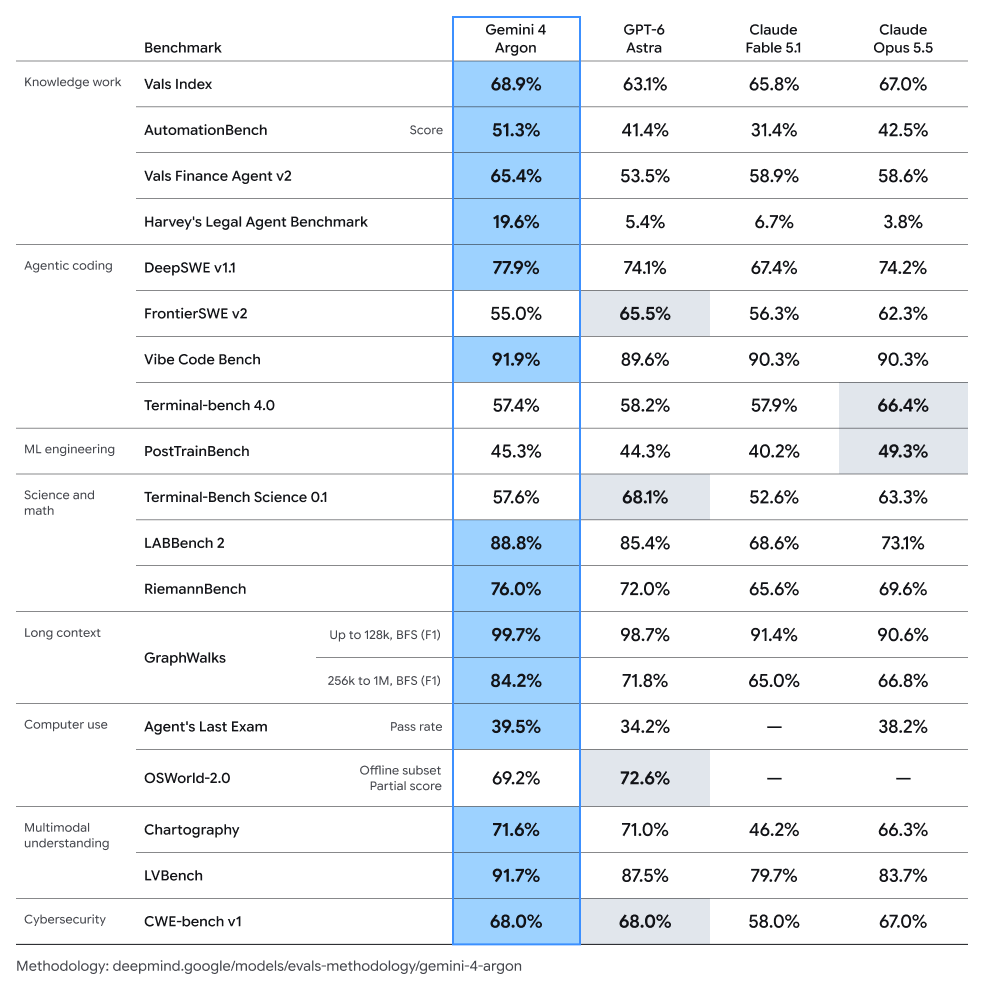
What the Benchmarks Actually Show
Argon leads Fable 5.1, Opus 5.5, and GPT-6 Astra on most of the chart Google published, most notably Harvey’s Legal Agent Benchmark (19.6% against GPT-6 Astra’s 5.4%), LABBench 2 (88.8%), and long-context GraphWalks at the 256k-1M token range (84.2% against Fable 5.1’s 65.0%).
But the chart is not a clean sweep: GPT-6 Astra beats Argon on Terminal-bench Science (68.1% to 57.6%) and OSWorld-2.0 computer use (72.6% to 69.2%), and Google’s own vendor-published benchmarks have faced direct scrutiny for hype before, so the standard rule applies: these are Google’s own numbers, not yet independently reproduced.
The Detail Missing From Pichai’s Announcement
Google’s own Fairwind documentation states plainly that trusted defenders and Google’s internal teams will receive Argon “without the usual cyber guardrails” so they can access its full offensive-grade vulnerability discovery and patching capability.
That is a materially different claim than “frontier safeguards,” it means the safety layer Pichai referenced applies to the general release, not to the version currently running inside the US government and select defender organizations. Given that the US government has already moved to seize direct control over how frontier AI models get released, a guardrail-free model going to that same government first, ahead of any public safety review, is the story underneath the announcement, not a footnote to it.
Google’s Third Model in Two Months
Gemini 3.8 Flash shipped as Google’s third model release in six weeks, and 3.7 Flash’s own launch story was less about its benchmark wins than whether Google’s reliability kept pace with its release cadence. Argon’s benchmark table shows real, credible gains on paper, but the last major Gemini release cycle was defined by leaked claims that flatly contradicted each other before launch, and Google has not yet earned back the benefit of the doubt that its benchmark charts survive contact with independent testing intact.
A gated rollout to cyber defenders and government users first is, functionally, exactly the kind of controlled environment where a model’s real-world performance gap from its benchmark sheet takes longest to surface publicly.
Follow us on Bluesky, LinkedIn, X, and Telegram to Get Instant Updates