OpenAI launched GPT-5.2 on December 11, just weeks after CEO Sam Altman issued an internal “code red” following Google’s Gemini 3 dominance. The three-tiered model: Instant, Thinking, and Pro, rolled out to Plus, Pro, Business, and Enterprise users immediately. Free and Go users receive access tomorrow.
Three Models, Three Use Cases
| Model | Best For | Key Upgrade |
|---|---|---|
| GPT-5.2 Instant | Everyday writing, translation, learning | Clearer explanations, better how-tos, career guidance |
| GPT-5.2 Thinking | Coding, spreadsheets, presentations, long-context reasoning | First model to reach human expert level on GDPval benchmark |
| GPT-5.2 Pro | Complex programming, scientific research | 38% fewer hallucinations than GPT-5.1 |
The Human Expert Milestone
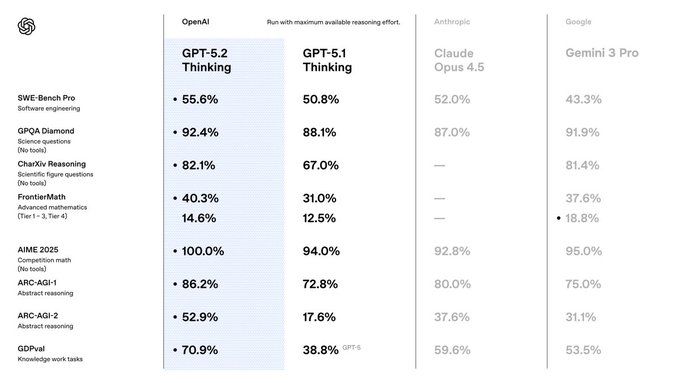
GPT-5.2 Thinking scored above human professionals in 70% of tasks on GDPval, OpenAI‘s benchmark covering 44 occupations from spreadsheet analysis to presentation design. It completed work 11x faster than humans while maintaining quality. This marks the first time an AI model outperforms domain experts in well-specified knowledge work across diverse fields.
What Changed
- Spreadsheets: Major improvements in creation, analysis, formatting, previously weak area
- Presentations: Early gains in slideshow design, though still developing
- Long-context reasoning: State-of-the-art performance on documents over 50,000 words
- Hallucination reduction: 38% fewer factual errors versus GPT-5.1
Microsoft Goes All-In
Microsoft CEO Satya Nadella announced GPT-5.2 integration across the company’s ecosystem immediately. Available today:
- M365 Copilot: GPT-5.2 with Work IQ for market research, strategic planning across emails/meetings/docs
- GitHub Copilot: Enhanced long-context coding and complex codebase investigation
- Microsoft Foundry: GPT-5.2 models added to developer platform
- Copilot Studio: Custom agent building with new model capabilities
Nadella emphasized “model choice”, Copilot automatically selects the right model (GPT-5.2 Instant vs Thinking vs Pro) based on task complexity.
The “Code Red” Context
This release follows Sam Altman’s emergency directive after Google’s Gemini 3 topped benchmarks in November. ChatGPT usage growth slowed while Gemini gained 3 percentage points of market share, with daily user time doubling to 11 minutes. OpenAI shelved advertising plans and reallocated engineering teams to accelerate GPT-5.2’s release from late December to today.
What Insiders Say
OpenAI executives deny rushing the release, claiming GPT-5.2 has been in development for months. However, CEO of Applications Fidji Simo acknowledged the “code red” marshalled additional resources: “We want to signal to the company that we’re focusing resources in one particular area—defining priorities.”
API and Developer Access
GPT-5.2 launched simultaneously in the API and GitHub Copilot, targeting enterprise and developer markets. Pricing matches GPT-5.1 tiers. Rollout is gradual—GitHub users must manually enable the model in settings, while ChatGPT users see it automatically.
Known Issues OpenAI Acknowledged
- Over-refusals: Model sometimes declines legitimate requests unnecessarily
- Latency: Response times slower than GPT-5.1 Instant, especially for Thinking mode
- Warmth calibration: GPT-5 launched “too cold,” prompting user backlash—5.2 Instant aims to match 5.1’s conversational tone
Legacy Model Access
GPT-5.1 remains available to paid users for three months as a legacy option. This echoes the GPT-5 launch, when OpenAI kept GPT-4 available after user complaints about tone changes. Free users cannot access legacy models.
Benchmark Wars Heat Up
GPT-5.2 Thinking edges out Gemini 3 on OpenAI’s internal benchmarks, particularly on SWE-Bench (software engineering), GPQA Diamond (doctoral-level science), and ARC-AGI (abstract reasoning). However, independent verification pending—and Anthropic’s Claude Opus 4.5 still leads on pure coding tasks.
The AI race intensifies: Google announced managed MCP servers this week, Anthropic released Claude Opus 4.5 last month, and DeepSeek’s open-source V3.2 matches proprietary models at 10x lower cost. OpenAI’s rapid iteration signals the frontier model cadence has accelerated from yearly to monthly releases.