
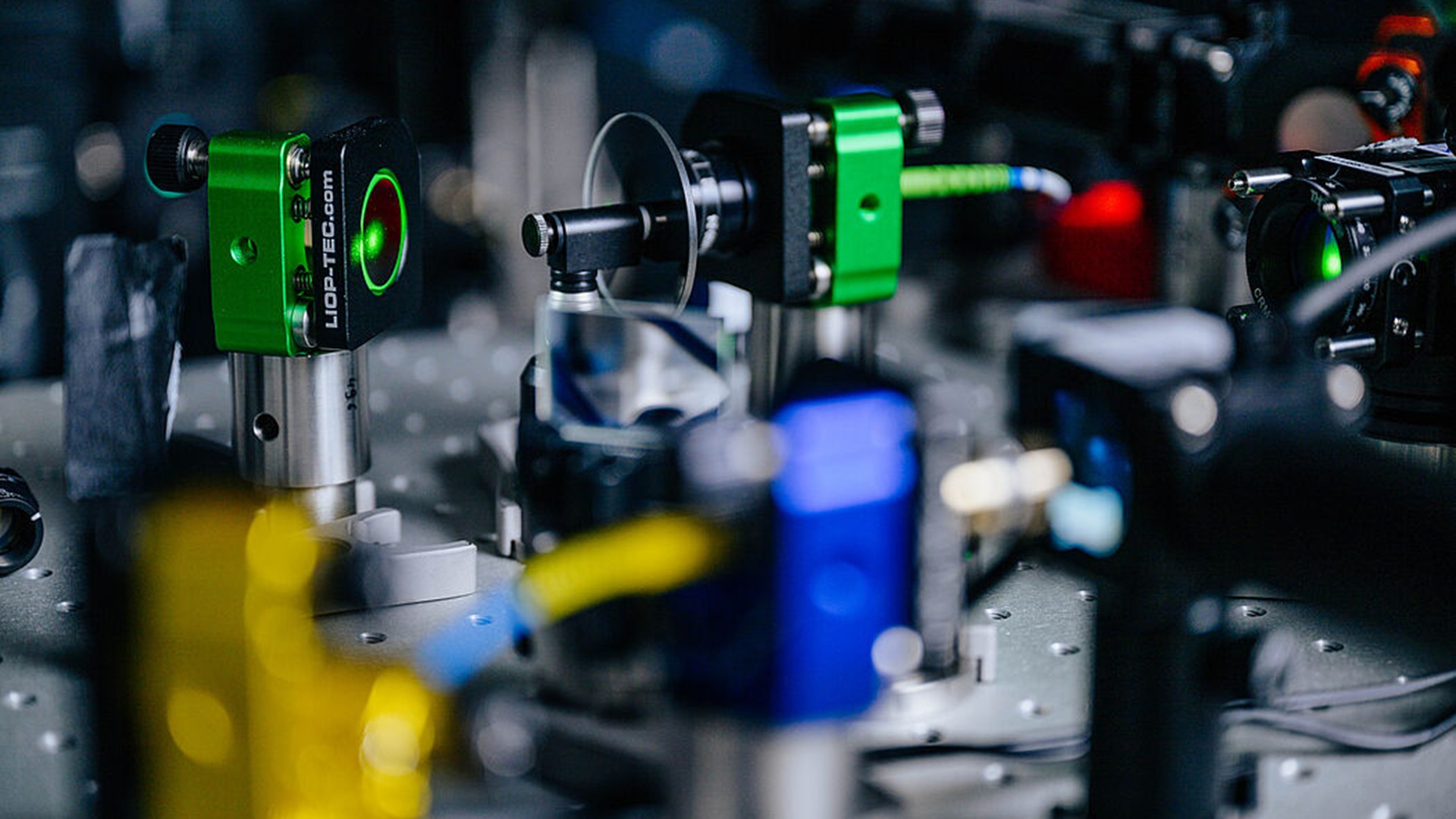
The team used the system to study how different quantum properties affect computing performance. Michael Stefszky, PhD, who leads the Quantum Computing research group and coordinated the initiative, said the results underline a practical point: building a useful quantum system takes far more than adding components.
How a Computer Built on Light Works
Conventional computers store information as bits, each one a 0 or a 1. PaQS works with photons instead. Photons are massless particles that travel at the speed of light in a vacuum, and they belong to the family of boson particles, which carry the fundamental forces of the universe.
That makes PaQS a Gaussian boson sampler. The machine sends photons through a complex optical network and samples the intricate light patterns that come out the other side. Stefszky said the hard part is control: managing photonic interference inside those optical pathways creates distinct physical hurdles that call for specialized optical engineering.
What Comes After the First Results
The team designed the system to be scalable, then used it to see how specific variables change the fidelity of its output. By tracking how light behaves across the network, the controlled tests aim to separate quantum interference from environmental noise.
The researchers expect optimized Gaussian boson samplers to help with molecular chemistry, the optimization of complex energy grids, and secure communications. Those are expectations rather than demonstrated results.
Trials at Paderborn are continuing with higher photon numbers. The team is checking whether incremental hardware adjustments can push the system further before it runs into photon loss limits. How many optical channels the next version can handle has not been settled.
Hashlytics Take
The “supercomputers thousands of years” line is the hook, but the more telling part of this announcement is Stefszky’s own caution that scaling up component count is not the answer by itself. That reframes PaQS as a testbed for learning which quantum properties actually drive performance, not a machine that has already beaten classical computing at something useful. The coverage also gives no photon count, benchmark figure, or fidelity number, which are the details that would show how far the system has really come. Until those appear, treat this as a sound engineering step in photonic quantum computing and not yet a breakthrough in capability.
Follow Hashlytics on Bluesky, Facebook, LinkedIn , Telegram and X to Get Instant Updates