-1.29%
-2.22%
-0.56%
-0.88%
-1.72%
-3.23%
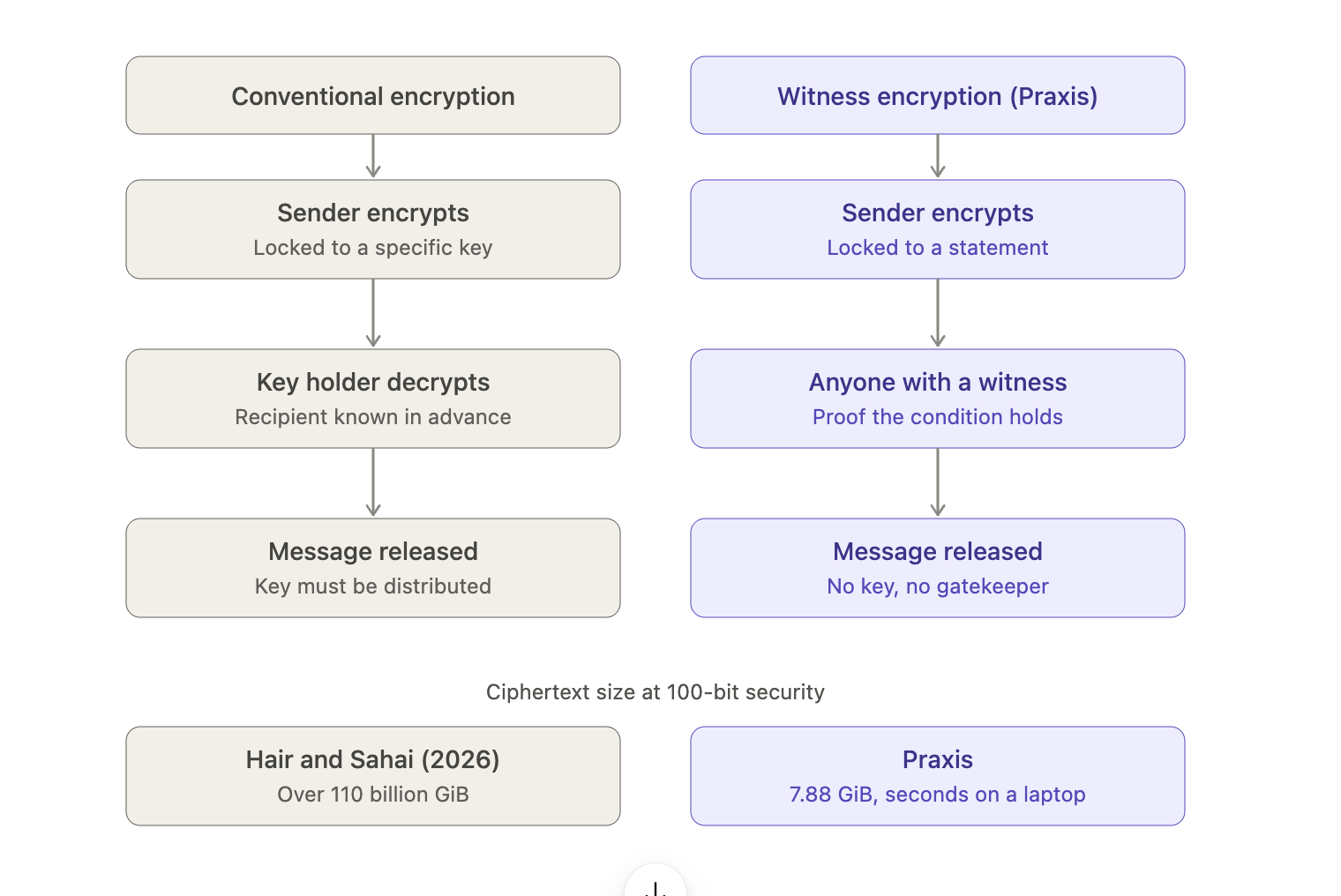
Witness encryption lets a sender lock a message against a mathematical statement instead of a specific key. Anyone who holds evidence satisfying that statement, known as a witness, can unlock it, and the sender does not need to stay online. The authors argue this could enable trust-minimized Bitcoin bridges, conditional payments, and more complex smart contracts without changing the network’s consensus rules.
Shrinking a 110 Billion GiB Problem
The headline gain is scale. An earlier construction from researchers Hair and Sahai, published in 2026, needed more than 110 billion GiB for a comparable task. Praxis cuts ciphertext size and encryption cost by more than ten orders of magnitude. At the 100-bit security level, the figures look like this:
- Ciphertext size: 7.88 GiB
- Encryption: roughly 20 billion base-field multiplications and about 12 GB of memory
- Decryption with a valid proof: an average of 8.6 billion multiplications and about 5 GB of memory when streamed
The researchers estimate both operations can finish within seconds on a laptop. They get there by replacing enormous matrices with smaller components joined through cryptographic pairings, built on Groth16 and the BN254 elliptic curve, with the underlying mathematics checked by machine-verified proofs written in Lean 4.
What It Could Change for Bitcoin Bridges
Bitcoin’s scripting language is deliberately limited, so verifying a complex cryptographic proof directly on the chain is not practical. Developers have leaned on interactive designs such as BitVM, which need at least one honest participant to challenge fraud. Witness encryption offers another route: encrypt spending material against a statement that a computation was carried out correctly off-chain, and the funds become spendable only when a valid proof exists.
Robin Linus, responding to the research, said the scheme would fundamentally improve bridges by removing operators, provided it survives independent peer review. Crypto researcher Eric Wall gave a conditional assessment, suggesting Bitcoin might be saved technologically. Other proposed uses include cross-chain atomic swaps, private auctions, time-locked payments, and covenants.
The limits are real. Praxis is still a research construction, and its Groth16 component requires an honest trusted setup: if the secret randomness from that setup is kept, someone could forge proofs and decrypt ciphertexts. The 7.88 GiB ciphertext also needs dependable off-chain storage and distribution, which rules out placing it directly in BTC or ETH transactions. And because it depends on pairing-based cryptography alongside lattice-based assumptions, it is not quantum-resistant. The paper has not yet been formally peer reviewed.
Hashlytics Take
Praxis does not remove trust from Bitcoin bridges so much as move it. BitVM asks for one honest challenger to be watching; Praxis asks for one honest setup ceremony to have been run properly, and that is a harder promise to audit after the fact. The cost problem has shifted too. Computation is now a laptop-sized job, but a 7.88 GiB ciphertext turns the bottleneck into data availability, which is exactly the kind of off-chain dependency bridge users have been burned by before. The result is worth watching because it makes a theoretical tool testable, not because bridges are solved. The real verdict will come from whether independent reviewers can break the parameters or the setup assumptions.
Follow Hashlytics on Bluesky, Facebook, LinkedIn , Telegram and X to Get Instant Updates