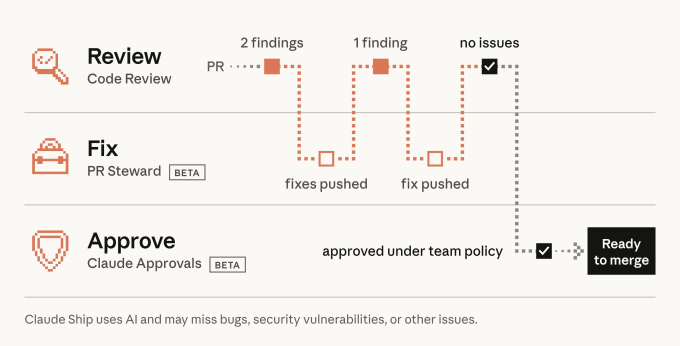
Automated review itself is not new. What is new is the approval step: Claude Ship can authorize merges on its own, within limits set by a policy each team writes for its repository. It is available on Claude Team and Enterprise plans, for GitHub repositories only.
Getting Claude Ship onto a repository
Before any merge authority is handed over, teams need the review layer and the fixer in place. Code Review is already generally available, while PR Steward, the agent that handles merge conflicts and failing CI tests, is still in beta across qualifying repositories.
- Open your repository settings on GitHub.
- Select
Code Review. - Deploy the
PR Stewardagent to fix merge conflicts and failing tests automatically. - Check the comments left after every push. They show what changed and how to roll it back if needed.
Writing the policy that decides what merges
Approval authority comes from a policy file written in plain language and stored in the repository itself. Teams can feed it signals from review findings and internal classifiers, so the rules can depend on how risky a change looks rather than on a fixed checklist.
- Create a natural-language policy file inside the target repository.
- Add signals from review findings and internal classifiers to the policy.
- Switch to observe-only mode, which lets you watch how the agent behaves without executing any live merges.
- Set monthly spending limits and pick a review depth:
Quick
,Standard
, orDeep
.
Teams can start with a single repository. When a change crosses the risk thresholds in the policy, the decision goes back to a human engineer, who has to be escalated to manually.
Hashlytics Take
The review agent is the least interesting part of this launch. The real shift is that the policy file, written in plain English, becomes the control that decides what reaches production. A vague policy produces vague approvals, so the quality of that document now matters as much as the quality of the code it governs. Anthropic seems to know it: observe-only mode is part of the setup rather than an afterthought, which reads as an admission that teams should watch the agent before they trust it. The manual escalation to humans on high-risk changes points the same way. Treat the first few weeks as a test of your policy, not just of the model.
Follow Hashlytics on Bluesky, Facebook, LinkedIn , Telegram and X to Get Instant Updates