-0.28%
-1.30%
+1.47%
-1.24%
+0.80%
-1.97%
Which Exchanges Got Removed
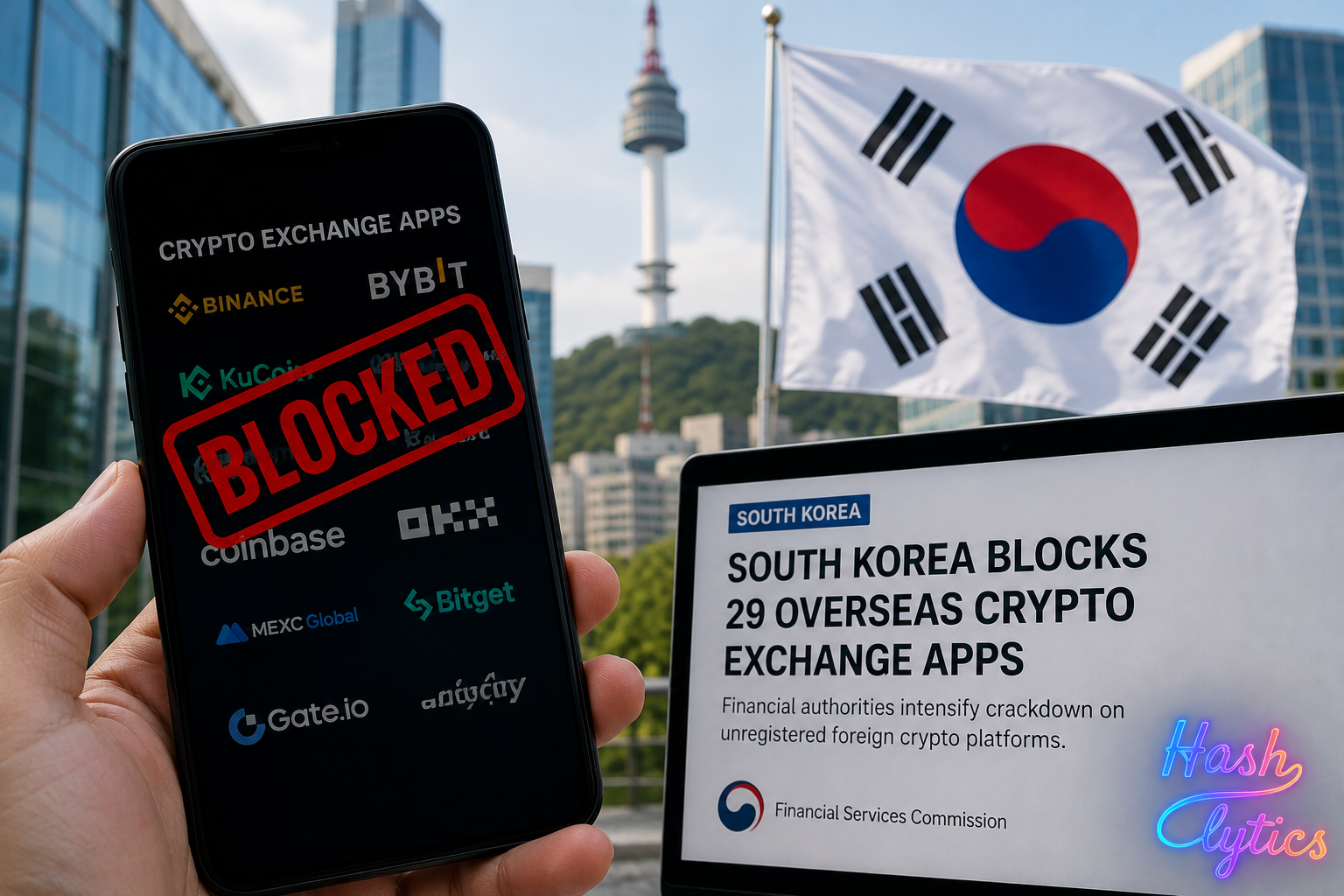
At least 29 overseas crypto exchange apps are no longer available for new installations on Android phones in South Korea. This includes major players like:
- OKX
- Bybit
- MEXC
- KuCoin
- Gemini
- Backpack
- BitMEX
- BingX, Phemex, WhiteBIT, CoinEx, BitMart, Pionex, BTSE, and WEEX
Notably, Binance was not among the 29 exchanges listed in the removal. Digital Asset, a South Korean crypto news outlet, checked the Google Play availability of the top 50 overseas derivatives exchanges and found 17 apps completely absent from search results, six displaying general unavailability messages, and six indicating the app was not available in the region.
How This Happened
The removal didn’t happen overnight. South Korea’s Financial Intelligence Unit (FIU), the country’s anti-money-laundering agency, previously asked Google to block 17 overseas exchanges accused of operating locally without proper registration.
That initial request set the stage for Google’s broader move. Then Google introduced its own policy requiring crypto exchanges targeting South Korea to be registered as virtual asset service providers (VASPs) with the FIU. Platforms lacking this registration must remove South Korea from their target markets.
The timeline tells the story: Bybit disappeared from the Korean Google Play Store on July 10. OKX followed on July 24. Others fell in after that.
What Actually Changed for Users
The restrictions have important limits. New users can’t download these apps from Google Play anymore. But existing users who already have the apps installed can still use them. The block only affects Google Play for Android. Apple’s App Store remains unaffected, and the exchange websites themselves are still accessible.
This is a controlled squeeze, not a total ban.
The Bigger Picture
South Korea’s crypto market was already struggling. Korean crypto trading has collapsed 97% as money moved toward stocks. Some foreign entities like OKX have tried to adapt by investing in local exchanges such as Coinone, but the message from regulators is clear: operate directly from overseas at your own risk.
The question now is whether other app stores will follow Google’s lead. If Apple makes the same move, the isolation of the Korean crypto market will deepen significantly. For foreign platforms, South Korea is increasingly becoming a market you have to work around, not work in.
Follow Hashlytics on Bluesky, LinkedIn, Telegram and X to Get Instant Updates