Seeing Every Step an Agent Takes
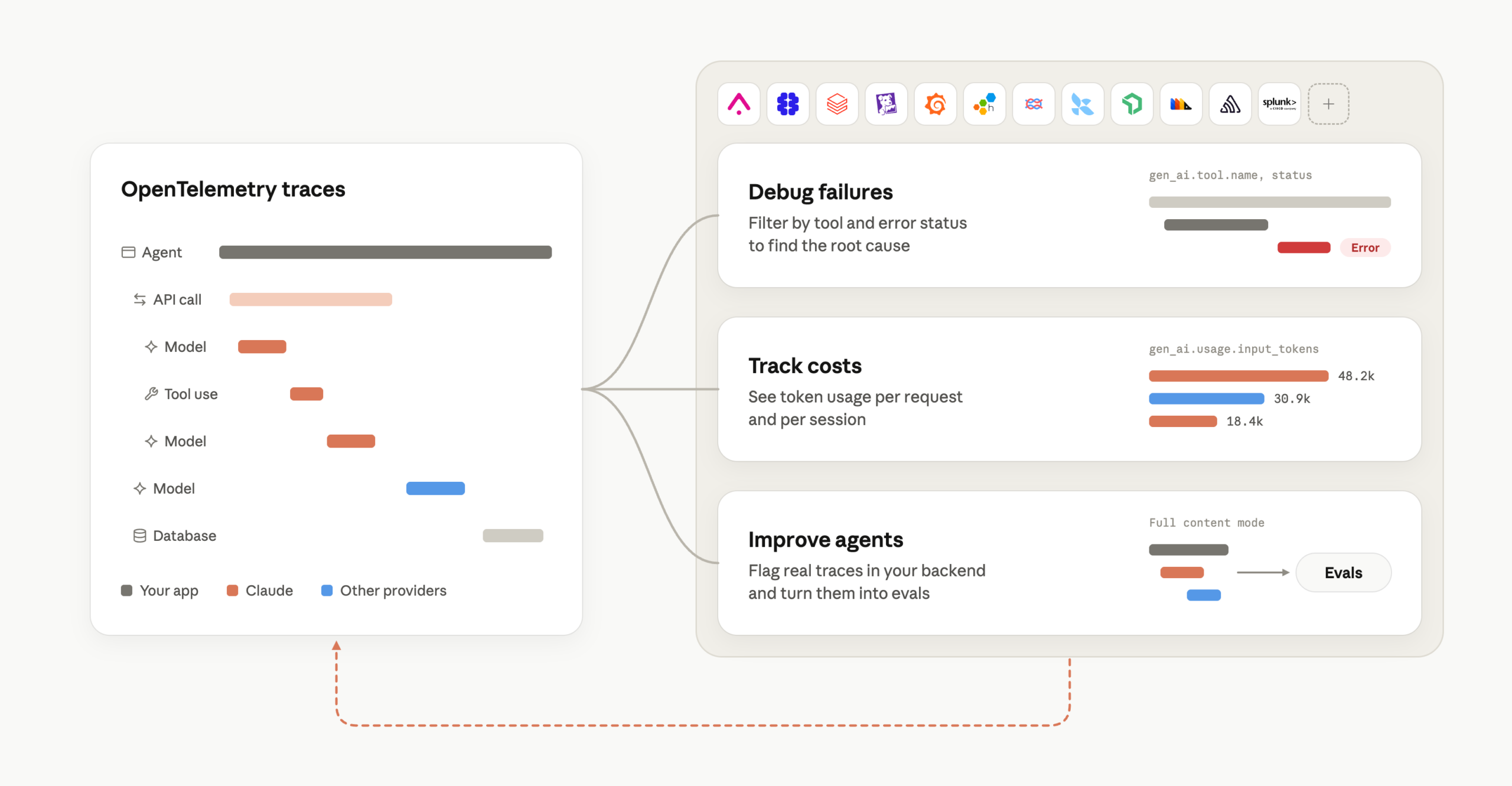
The new tracing covers model calls, tool use, and Managed Control Plane server calls, and it extends to existing Claude Code and Cowork traces as well, folding everything into one observability stream instead of several disconnected ones. For teams giving agents more autonomy, that visibility matters: reviewing traces to see why an agent made a particular call is what lets teams widen an agent’s access with some confidence, rather than just hoping it behaves. Latency, token usage, and request IDs all get captured as standard OpenTelemetry traces once a destination is set in the Claude Console.
Built to Plug Into What Teams Already Use
Because Claude’s traces follow the OpenTelemetry GenAI semantic conventions, they show up in observability dashboards the same way traces from any other provider would, sitting next to logs and metrics instead of living in a separate silo. Supported destinations include:
Arize AI, Braintrust, Datadog, Langfuse, LangSmith, New Relic, and PostHog can all ingest the traces too, which opens the door to turning production data into evaluations and catching quality regressions early.
Early Adopters Are Already Seeing Gains
Ramp’s agentic system, Reflect, uses the traces to score sessions in Langfuse, and the company says that has cut token usage by 10 to 20 percent while speeding up sessions by roughly 30 percent for some agents. Sterling Labs is streaming traces straight into Langfuse for agents that analyze live markets, skipping the custom instrumentation work that would normally take up engineering time. Databricks Unity Catalog is also pulling in traces, which lets platform and security teams watch token usage by team and flag anything unusual.
The feature is in public beta. Managed Agents and the Messages API need a destination configured in the Claude Console, while the SDKs export traces automatically.
A Bet on Interoperability Over Lock-In
Building tracing on an open standard rather than a proprietary dashboard is a telling choice. It means Anthropic isn’t trying to pull enterprise customers into its own observability product, it’s betting that being the easiest model to monitor inside tools teams already trust matters more than owning that layer itself. That’s a sound read of where enterprise AI spend actually goes: toward whichever platform creates the least friction with existing infrastructure, not the one asking teams to rip out their stack.
Follow Hashlytics on Bluesky, Facebook, LinkedIn, Telegram and X to Get Instant Updates