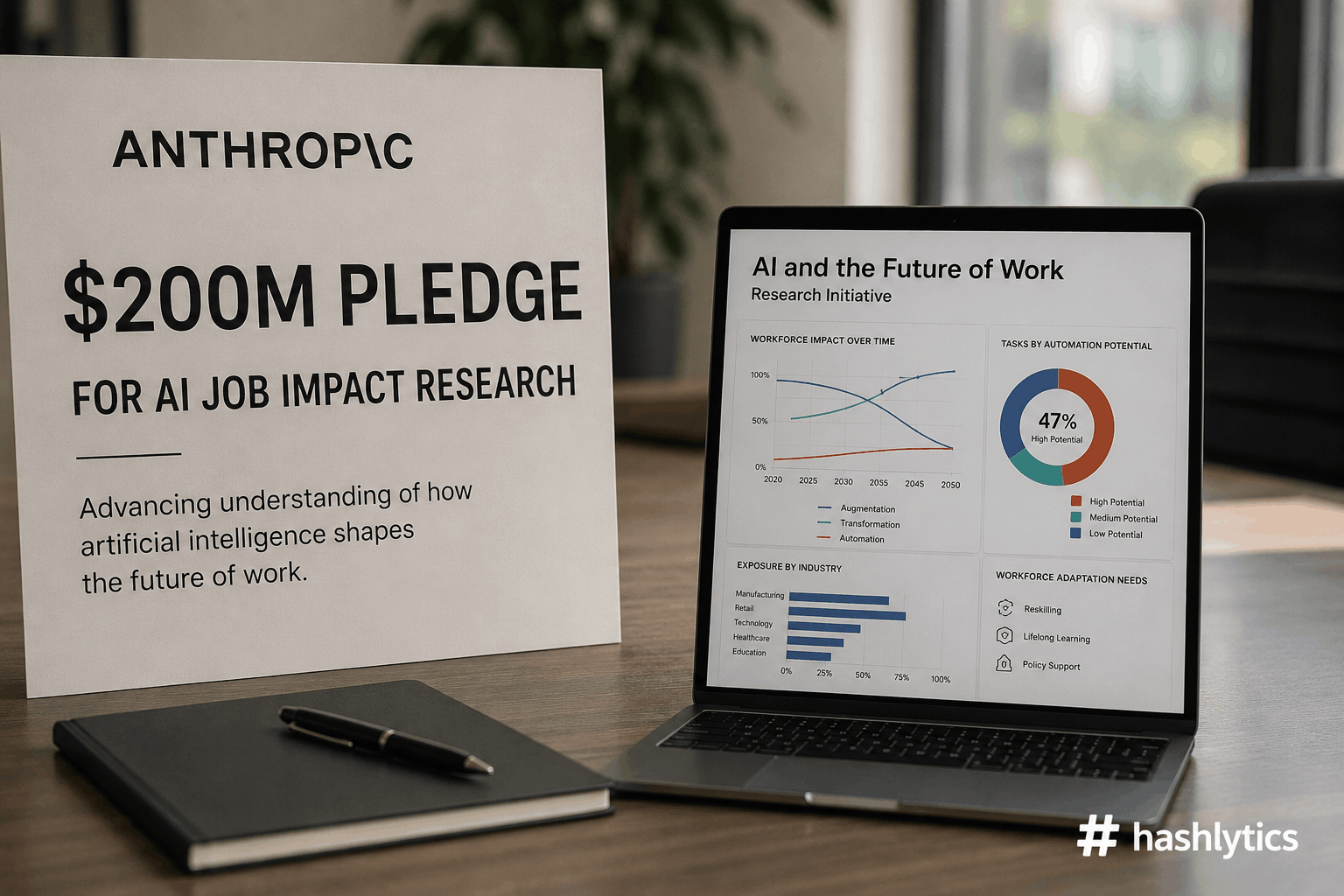
Leading artificial intelligence firm Anthropic announced on June 10, 2026 that it will commit an initial $200 million to research how advanced AI affects the economy and labor markets. The announcement reflects growing pressure on AI companies to address the societal disruptions their technology may cause. Dario Amodei, Anthropic’s CEO, also published detailed policy proposals outlining how government and private industry could respond to potential job displacement.
How Anthropic Is Spending the Money
The investment will establish two major initiatives. First, an Economic Futures Research Fund worth $200 million will support research trials and evaluations of public policies designed to cushion AI’s economic impact. Second, a $150 million national fellowship program will help early-career professionals bring AI’s benefits to communities across America.
Together, these commitments signal that Anthropic, maker of the Claude chatbot, is betting that managing AI’s downsides is just as important as developing the technology itself.
The Broader Industry Conversation
Anthropic is not alone in this discussion. OpenAI recently outlined goals to ensure AI’s gains are widely shared.
OpenAI CEO Sam Altman reportedly met with Senator Bernie Sanders to explore creating a public wealth fund that would use AI company stock to distribute generated wealth more broadly. President Donald Trump signaled plans to meet with AI executives about giving back
to the public, suggesting it could make people very rich.
The coordinated push from multiple AI leaders suggests this is becoming a central concern as these companies prepare for public offerings.
What Amodei Thinks Will Happen
In an essay published on his personal website, Amodei warned that AI could cause greater and longer-lasting labor market disruptions than any previous technological shift. The key challenge in such a world won’t be incentivizing growth, but finding a way for everyone to share in the benefits,
he wrote.
Amodei’s concern reflects a real economic reality. The current national unemployment rate sits at 4.3%, but his policy framework outlines how the government could respond if joblessness reached 5%, 10%, or even unprecedented levels.
The Policy Proposals
Amodei’s framework suggests several concrete steps. The U.S. government should improve data collection to track AI’s employment impact. Policymakers should also create pro-employment incentives to slow or reduce job displacement. If labor demand permanently declines, Amodei proposes mechanisms such as universal basic income.
He suggests financing UBI through taxes on relevant companies
or by increasing capital gains taxes.
These aren’t abstract ideas. They represent Anthropic’s serious attempt to shape how society adapts to rapid AI advancement.
As both Anthropic and OpenAI move toward initial public offerings, the conversation around sharing AI’s benefits and mitigating job losses will likely intensify. Industry leaders are essentially betting that proactive, transparent engagement with these economic challenges will serve them better long-term than waiting for government mandates.
Whether these voluntary commitments prove sufficient or whether they become pressure points for future regulation remains to be seen. But for now, the message is clear: major AI companies are acknowledging that their technology’s success will depend not just on capability, but on ensuring broad prosperity.
Follow Hashlytics on Bluesky, LinkedIn , Telegram and X to Get Instant Updates