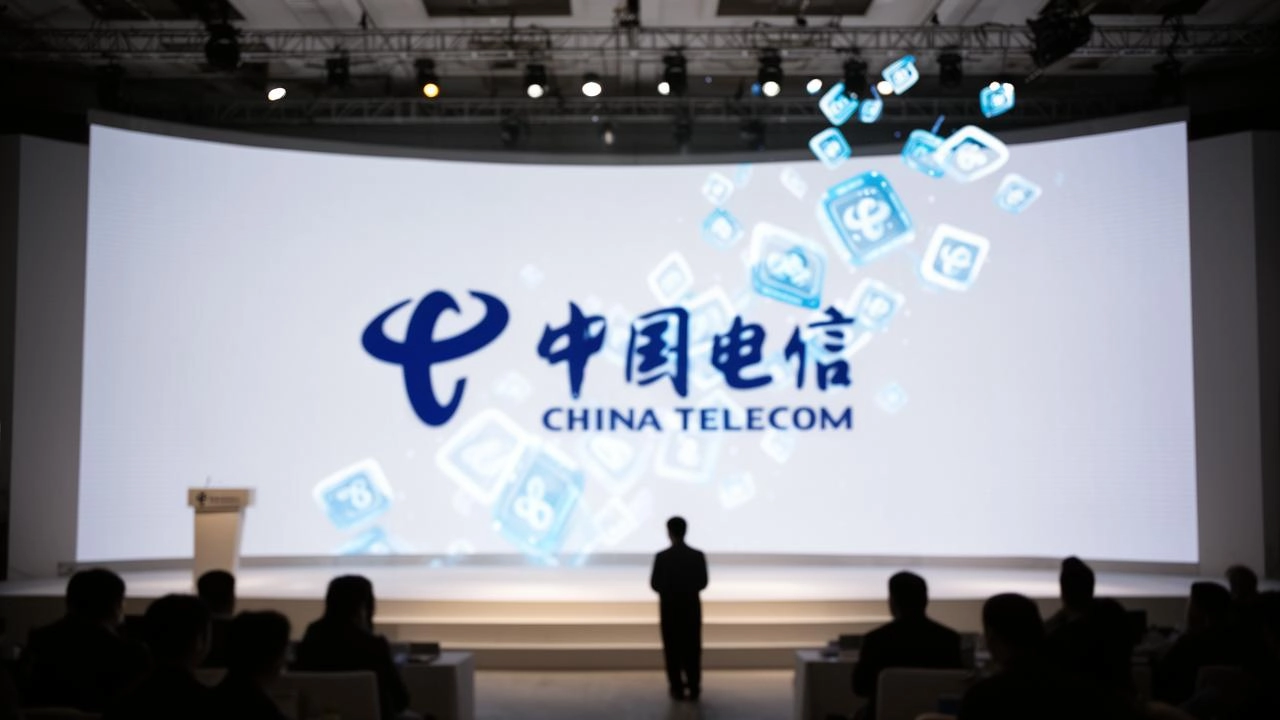
Ke Ruiwen, Chairman of China Telecom, announced the strategy at WAIC, repositioning the state-owned telecom giant. Following previous Fiber Reform
and Cloud Reform
initiatives, this new strategy focuses on embedding AI capabilities into enterprise workflows, transforming AI into an on-demand commodity priced and sold by token consumption.
The Three Pillars of Intelligence Reform
| Component | Function | Status |
|---|---|---|
| Xirang Computing Platform | Schedules over 100 EFLOPS of computing power across 21 provinces | Operational, supports 12 domestic AI chips |
| AI Flow Network | Transmits semantic tokens instead of raw data, achieves 97% bandwidth compression | Deployed in emergency rescue scenarios |
| TeleAgent | Consumer-facing AI agent that routes requests to optimal models and consumes tokens | 300,000+ internal users in trials |
AI Flow Wins Industry Recognition
The centerpiece of China Telecom’s announcement is AI Flow, an intelligent transmission network developed by Professor Li Xuelong’s team at the China Telecom AI Research Institute. The technology won WAIC‘s prestigious 2026 SAIL Award, beating over 5,000 competing projects.
AI Flow achieves this by transmitting semantic tokens instead of raw data. Real-world tests demonstrate the compression gains:
- Video transmission: Near-lossless quality at just 3% of original bandwidth
- Voice transmission: Down to 0.266 kilobits per second
- Already deployed in emergency rescue and extreme environment scenarios
TeleAgent Brings AI to Mass Market
China Telecom also launched Xingchen Super AI Agent, or TeleAgent, designed to democratize access to AI services at scale. According to He Zhongjiang, Chairman of China Telecom AI Technology Co., Ltd., the platform features an intelligent ModelRouter
that directs requests to the most suitable AI model based on the task.
Early internal trials show compelling results:
- Task completion rate 20% higher than competitors
- Token consumption only 50 to 80% of competing systems
- 300,000 registered users in internal trials
- Up to 80,000 daily active users among China Telecom employees
- 5,500 custom skills built, over 90% created by users themselves
TeleAgent can develop derivative functions based on user needs, allowing teams to build specialized AI agents without coding expertise.
Tokens Become the Currency of AI
The Intelligence Reform establishes tokens as the hard currency
across China Telecom’s entire AI service ecosystem. The company has built a closed loop where computing power flows through Xirang, tokens transmit via AI Flow, and TeleAgent consumes those tokens. Token security routers manage the entire process.
Supporting infrastructure includes the Mole Community, an open-source ecosystem that serves over one million users and aggregates more than 25,000 open-source projects. This positions China Telecom not just as a service provider but as a platform operator in the AI economy.
The Road Ahead
China Telecom plans three core implementation directions. The company will upgrade cloud middle platforms to AI middle platforms, strengthen internal workforce capabilities through Smart Engineer
training, and open production scenarios and government-enterprise applications to external partners.
Industry observers expect a concentrated release of pilot projects within three to six months of the strategy announcement. However, significant challenges remain. Organizational coordination across a state-owned enterprise of this scale, restructuring frontline personnel capabilities, and establishing ecosystem mechanisms represent deep operational shifts.
China Telecom becomes the first major telecom operator to elevate AI to company-wide strategic priority. The move signals a broader industry transition away from connectivity services toward AI service provision as the core business model.
Follow Hashlytics on Bluesky, LinkedIn, Telegram and X to Get Instant Updates