Pricing Undercuts Rivals, With Caveats
Meta priced the Meta Model API at $1.25 per million input tokens and $4.25 per million output tokens, roughly a quarter of typical OpenAI and Anthropic pricing. That sits above OpenAI’s entry-level GPT-5 mini and Anthropic’s Claude Haiku 4.5, but below Anthropic’s Sonnet 4.6. New developer accounts get $20 in free credits before paid billing begins, and access is currently limited to the US.
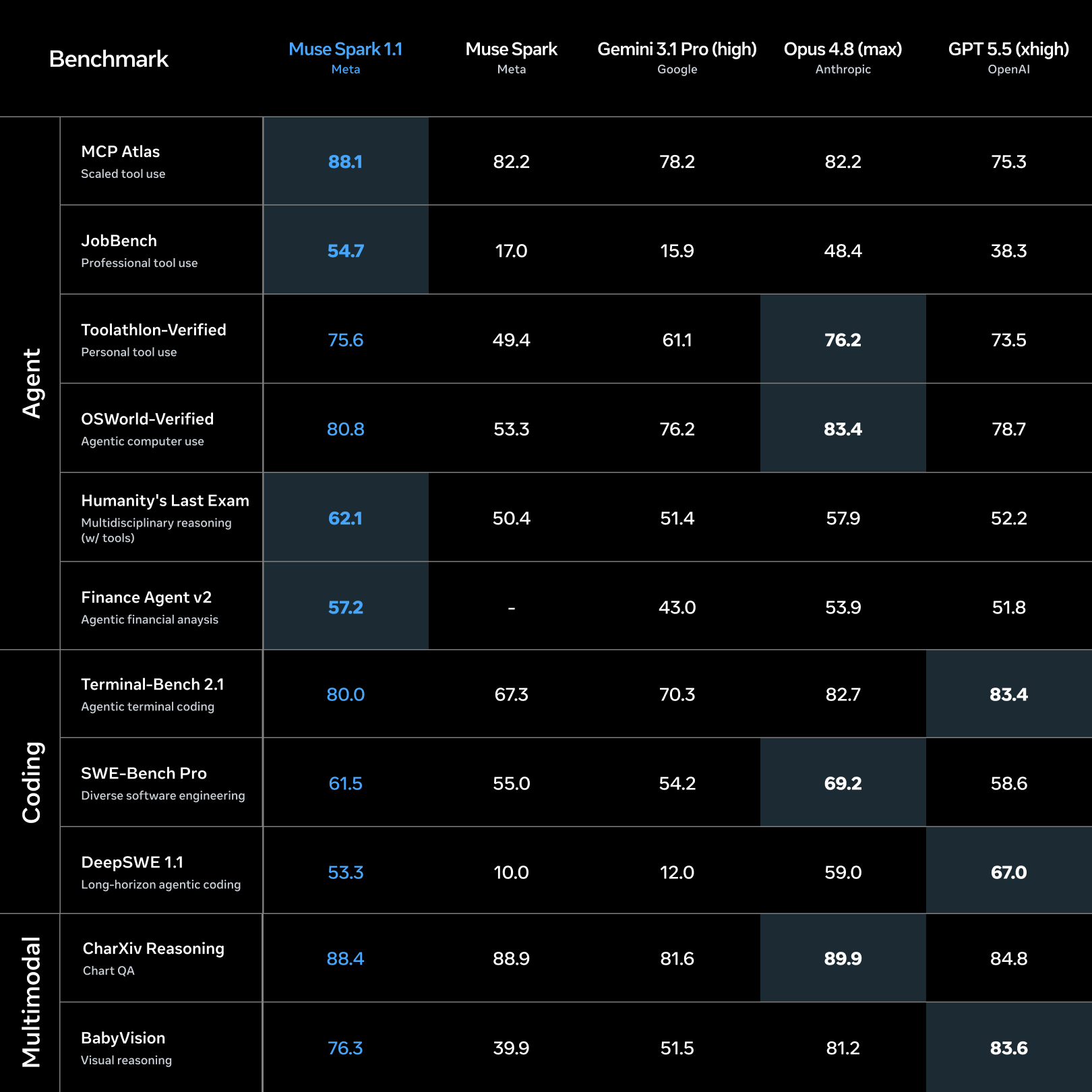
The benchmark chart circulating alongside launch shows Muse Spark 1.1 leading on MCP Atlas (88.1), JobBench (54.7), and Humanity’s Last Exam with tools (62.1), ahead of Opus 4.8 and GPT-5.5. But it trails Opus 4.8 on OSWorld-Verified computer use (80.8 vs 83.4) and both Opus 4.8 and GPT-5.5 on coding-heavy benchmarks like SWE-Bench Pro and DeepSWE 1.1. Fortune’s reporting notes the comparison chart Meta circulated omits Anthropic’s Mythos 5, Fable 5, and OpenAI’s GPT-5.6, the actual current flagships, comparing instead against the prior generation.
Why Meta Is Doing This Now
Zuckerberg is under pressure from Wall Street to show returns on Meta’s AI infrastructure spending, and the company lacks the cloud business that lets Google and Microsoft monetize AI investment through infrastructure sales. AI chief Alexandr Wang told CNBC the pricing is designed to scale with high-volume consumption rather than compete purely on capability. Meta is separately training a more powerful model code-named Watermelon, with no release timeline disclosed.
What Changes for Regular Users
Muse Spark 1.1 already powers Thinking mode in the Meta AI app and website, and will progressively replace Llama models across WhatsApp, Instagram, Facebook, and Meta’s smart glasses. For developers, this is Meta’s first genuine entry into the commercial model API business Anthropic and OpenAI have run for years. Whether Meta’s aggressive pricing pulls meaningful developer share away from established players depends less on the benchmark chart than on how the model performs on tasks outside Meta’s own cherry-picked comparisons, and whether the promised replacement of Llama across consumer apps ships without the reliability issues that dogged earlier Meta AI rollouts.
Follow us on Bluesky, LinkedIn, X, and Telegram to Get Instant Updates