
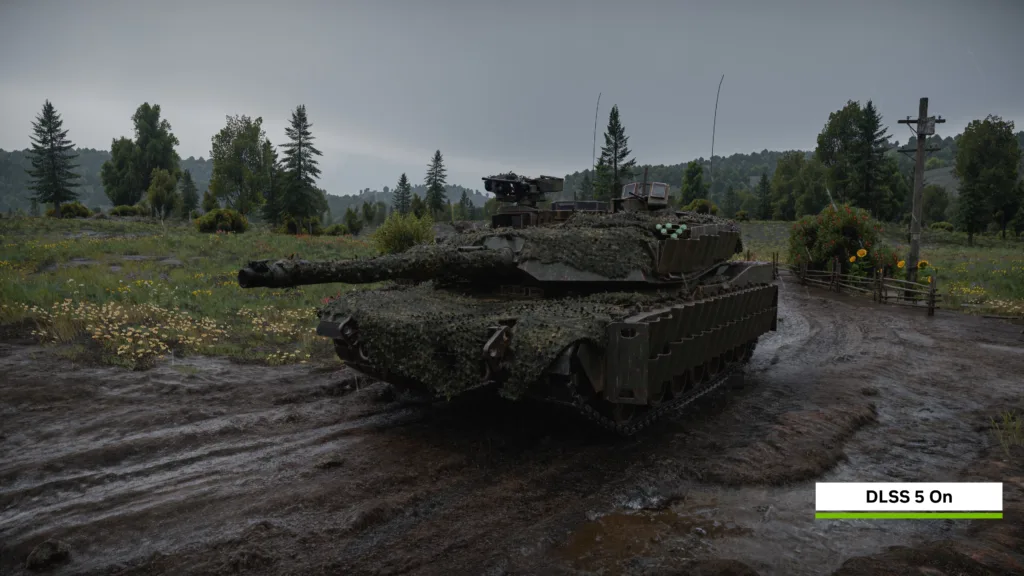
Some of this is already reaching shipping games. Gaijin Entertainment has integrated DLSS 5 with 3D-Guided Neural Rendering into the Dagor Engine for War Thunder. The team says the system evaluates improvements in sRGB before post-processing, then maps the results back to linear HDR, which produces stronger microcontrast and more natural highlights.
Kimodo Generates Character Motion Inside Sequencer
The headline addition is NVIDIA Kimodo, the first AI motion-generation model built into the guided animation framework in Epic Games’ Unreal Engine 5.9 Preview. Animators can generate motion directly in Sequencer from text prompts, spline paths, and target poses, with each input constraining the output on the timeline.
The design keeps traditional authoring in the loop. GPU-accelerated generation handles the heavy lifting, while animators still set exact character positions at key frames, so existing production pipelines do not have to change.
On the rendering side, RTX Path Tracing 1.9 adds a nine-step introductory sample that builds up from ReSTIR DI and SHaRC radiance caching to DLSS Ray Reconstruction. It also brings real-time subsampling, GPU-side acceleration-structure instance generation, and support for up to two million lights through NEE-AT light sampling. RTX Dynamic Illumination 3.2 is now on GitHub with stratified low-discrepancy sampling for ReSTIR DI spatial resampling, plus better reservoir visualization.
For inspecting what the renderer is actually doing, NVIDIA Real-Time BVH Viewer 1.0 shows live ray-tracing acceleration structures for D3D12 and Vulkan applications in a separate window. It offers modes for primitive IDs, trace time heatmaps, and geometry filters to track down performance bottlenecks. Because it runs independently of the in-game camera, developers can validate Top-Level and Bottom-Level Acceleration Structures while a scene is rendering.
Local AI Inference and Frame Generation Profiling
The NVIDIA In-Game Inferencing SDK 1.8 expands on-device conversational AI with updated inference backends. It adds hardened RTX Spark platform support, newer llama.cpp and whisper.cpp versions, Parakeet automatic speech recognition, and Vulkan priority API compatibility. The result is one interface for running local AI workloads next to a demanding graphics pipeline.
Debugging gets two upgrades. Nsight Graphics 2026.4 and Nsight Systems 2026.6 can now analyze applications that use DLSS Frame Generation and Multi-Frame Generation. When paired with Streamline SDK 2.12 or newer, GPU Trace places application frames and presented frames on separate timeline rows. NVIDIA has also added an Nsight Graphics Model Context Protocol server, which lets compatible AI agents capture applications, inspect debugging data, and analyze GPU traces without manual steps.
| Tool or SDK | Version | Key Integration or Feature |
|---|---|---|
| In-Game Inferencing SDK | 1.8 | Parakeet ASR, llama.cpp, Vulkan priority API |
| RTX Path Tracing | 1.9 | SHaRC radiance caching, nine-step intro sample |
| Real-Time BVH Viewer | 1.0 | D3D12 and Vulkan live acceleration inspection |
| RTX Global Illumination | 2.9 | Shader Execution Reordering, IndirectDiffuse sample |
| Nsight Graphics / Systems | 2026.4 / 2026.6 | DLSS Frame Generation analysis, agentic AI MCP server |
Follow Hashlytics on Bluesky, Facebook, LinkedIn , Telegram and X to Get Instant Updates