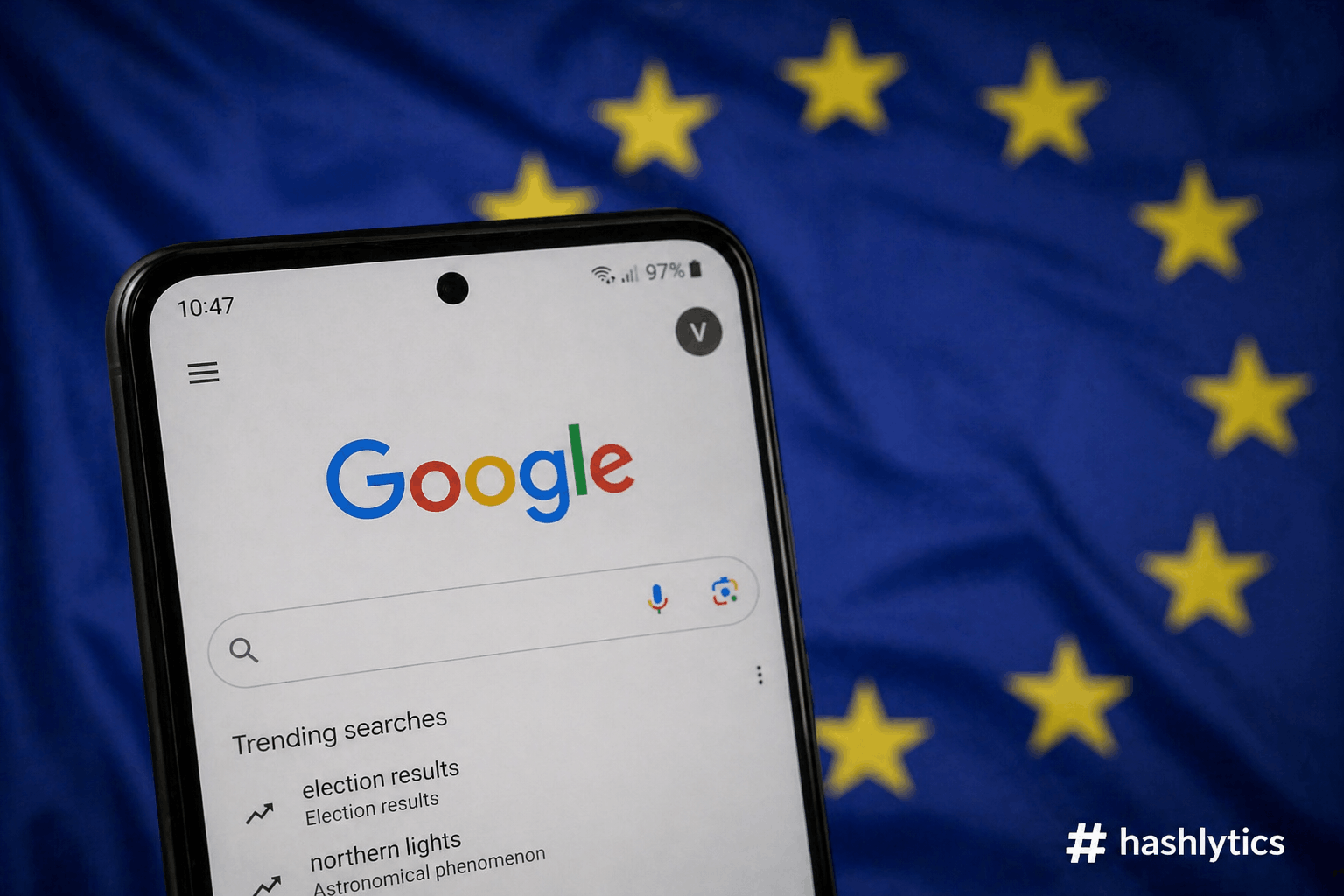
The European Commission issued preliminary findings on April 16, 2026 requiring Google to provide third-party search engines and AI chatbots access to anonymized ranking, query, click, and view data under Article 6(11) of the Digital Markets Act.
The proposed measures would create daily API feeds delivering five years of Europe’s collective search behavior to any approved competitor, with a public consultation closing May 1, 2026 and final binding decision scheduled for July 27, 2026. What Brussels frames as competition enforcement represents one of the largest mandated transfers of behavioral data in regulatory history—and the privacy implications extend far beyond what “anonymization” can protect.
What Data Google Must Share Under DMA Article 6(11)
The Commission’s 29-page specification document defines data-sharing obligations at the field level, creating enforceable technical requirements rather than broad principles. Google would be required to finalize the “Search Dataset” within three months of the final decision and prepare template licensing agreements within two months. According to the preliminary findings, qualifying beneficiaries would receive:
Query data: Every search term users type into Google, including text queries, voice searches, and image-based searches. This captures autocomplete selections, query reformulations, language variations, and the chronological sequence of searches within sessions. The data reveals intent patterns, topic demand, and how users refine questions when initial results don’t satisfy.
Ranking data: The order in which Google presented results for each query, including which URLs appeared in which positions, what snippets were displayed, and how results changed based on personalization signals. This exposes the algorithmic decision-making that determines visibility.
Click and view data: Which search results users clicked, which they hovered over without clicking, how long they spent on result pages, and whether they returned to search after visiting a link. This behavioral feedback loop trains ranking algorithms to understand relevance.
Geolocation data: User country pinned to approximate 3-kilometer grid squares, creating location context without street-level precision. Combined with query content, this enables inference about local events, regional interests, and mobility patterns.
Device and interface data: Whether searches occurred on mobile or desktop, which Google interface was used (standard search, images, news, shopping), and technical parameters like screen resolution and browser type.
Paid search interaction data: Not individual sponsored URLs, but interaction and ranking data at the paid block level—whether users engaged with advertisements, how sponsored content performed relative to organic results, and what commercial queries generated ad impressions.
The temporal scope is equally significant. Beneficiaries would receive five years of historical access from the date data sharing begins, plus ongoing daily updates. For a search engine or AI chatbot approved in August 2026, that means access to European search behavior stretching back to August 2021, refreshed every 24 hours with the previous day’s activity.
Who Qualifies as a Data Beneficiary
The Commission explicitly included AI chatbots with search functionality among qualifying beneficiaries, signaling that conversational systems like ChatGPT, Claude, Gemini, Perplexity, and any future entrant that answers queries directly competes in the same market as traditional search engines. This expansive definition means approval doesn’t require operating a standalone search website—any service that retrieves information in response to user questions could potentially qualify.
The preliminary findings don’t specify minimum market share thresholds, revenue requirements, or technical infrastructure standards that would limit the beneficiary pool. A startup AI company with 50 employees, a European price comparison website, or an academic research institution could theoretically apply for access if they meet whatever eligibility criteria the July decision establishes.
FRAND (fair, reasonable, and non-discriminatory) pricing applies, with licensing terms valid for five years from when each beneficiary begins receiving data. The Commission’s specification includes governance and auditing regimes, but the document doesn’t detail how frequently beneficiaries would be audited, what security standards they must maintain, or what happens if a beneficiary experiences a data breach after receiving years of search history.
Why “Anonymization” Cannot Protect Search Behavior
Brussels describes the data as “anonymised,” implying privacy protections remain intact once names and email addresses are stripped. The academic literature on re-identification attacks tells a different story. Search behavior is a behavioral fingerprint—removing explicit identifiers doesn’t eliminate the ability to determine who performed the searches.
The 2006 AOL search data release demonstrated this conclusively. AOL published 20 million queries from 650,000 users over three months, replacing usernames with arbitrary numerical IDs. Journalists at The New York Times identified 62-year-old widow Thelma Arnold within days by examining her search patterns. She had searched for landscapers in her town, information about her friends, and details about her dog—queries that, when combined, pointed unambiguously to her identity despite the absence of her name in the dataset.
Research published in the International Journal of Information Management found re-identification success rates of 86-100% across multiple studies examining anonymized datasets. A systematic review of re-identification attacks on health data documented that 72.7% of successful attacks occurred after 2009, indicating the problem is accelerating as cross-referencing techniques improve and public data sources proliferate.
Netflix faced similar exposure in 2007 when it released anonymized movie ratings for a recommendation algorithm competition. Researchers at the University of Texas demonstrated they could re-identify users by correlating Netflix viewing patterns with public IMDB reviews, revealing not just movie preferences but potentially sensitive information about sexual orientation and political views that users had shared in public reviews under pseudonyms.
The technical challenge with search query anonymization is dimensionality. Each user generates a unique constellation of queries over time. Someone searching for “IVF clinics Berlin,” “early pregnancy symptoms,” “maternity leave Germany,” and “Kinderwagen recommendations” creates a behavioral signature that narrows to a small population—potentially a single individual—when combined with location data, device fingerprints, and temporal patterns.
The Future of Privacy Forum’s analysis of highly dimensional datasets explains that search histories are often unique to individual users even with limited data points. The combination of high dimensionality (thousands of possible query terms), sparsity (most users search for a small subset of all possible queries), embedded quasi-identifiers (searches mentioning names, places, medical conditions), and temporal dynamics (when searches occur) makes robust anonymization nearly impossible.
Differential privacy—a mathematical approach that adds controlled noise to datasets—offers stronger protections than traditional anonymization, but the Commission’s preliminary findings don’t specify whether Google must implement differential privacy or simply apply conventional de-identification techniques. The absence of technical standards for anonymization quality is a critical gap.
Attack Surfaces Multiply With Each New Beneficiary
Every organization receiving search data becomes a potential breach point. The 2025 Discord vendor breach exposed 70,000 government-issued IDs through a single compromised contractor. Discord didn’t suffer the breach directly—a third-party verification service they relied on did. That pattern repeats constantly in modern data security incidents. The breach surface isn’t limited to the primary custodian; it extends to every entity with access.
Google maintains infrastructure hardened by decades of nation-state attack attempts, billion-dollar security budgets, and expertise accumulated defending the world’s most targeted services. A startup search engine receiving DMA data likely employs a security team of 2-5 people, uses cloud infrastructure from AWS or Google Cloud, and hasn’t faced sophisticated adversaries. The weakest link in the beneficiary chain defines the security posture of the entire dataset.
Intelligence services don’t need to breach Google anymore. They can compromise, acquire, or infiltrate a qualifying beneficiary. One insolvent startup desperate for acquisition. One AI company quietly purchased by a state-linked investment vehicle. One academic research project with lax access controls. The search history flows regardless, and once data leaves Google’s infrastructure, Google cannot revoke access, audit usage, or detect unauthorized sharing.
The Commission’s proposal includes governance and auditing requirements, but annual audits create 365-day windows of undetected exposure. A beneficiary breached on August 2, 2026 might not face audit until August 2027. During that year, adversaries could exfiltrate the entire five-year historical dataset plus daily updates—approximately 1.8 billion days of European search behavior—before the breach surfaces.
What Europe’s Search History Reveals
The data categories Google must share don’t just reveal what people search for—they expose who people are, what they’re experiencing, and what they’re hiding. Consider what five years of queries, clicks, and geolocation data would reveal:
Medical conditions before diagnosis: Sequences like “persistent cough,” “coughing up blood,” “lung cancer symptoms,” “oncologist near me” document health deterioration in real time, often before users have sought medical care or shared their situation with family.
Pregnancies and fertility struggles: “Pregnancy test positive,” “abortion clinics open Sunday,” “IVF success rates age 38,” “adoption agencies Germany” create intimate medical and personal timelines that users may not have disclosed to employers, family, or partners.
Sexual orientation and gender identity: Queries like “coming out to parents,” “testosterone therapy trans men,” “gay bars Amsterdam,” “how to tell wife I’m gay” document identity exploration and disclosure decisions, often years before users live openly.
Religious deconversion: “Leaving Islam safely,” “ex-Muslim support groups,” “atheist arguments against Christianity,” “how to stop believing in God” reveal faith transitions that, in some communities or countries, carry severe social or legal consequences.
Financial distress: “Payday loans no credit check,” “how to file bankruptcy,” “eviction notice what to do,” “sell car fast cash” document economic crises with temporal precision—including the moment someone realizes they’re in trouble and when they start seeking solutions.
Legal exposure: “Can employer see deleted emails,” “statute of limitations tax evasion,” “DUI lawyer free consultation,” “whistleblower protection EU” indicate potential legal jeopardy and the user’s awareness of it, creating blackmail leverage or prosecution evidence.
Affairs and relationship breakdown: “Hotels near office discreet,” “how to delete Facebook messages,” “divorce lawyer consultation free,” “STD testing confidential” chronicle relationship deterioration and infidelity with geographic and temporal markers.
Addiction and mental health crises: “Cocaine withdrawal timeline,” “how many pills overdose,” “suicide methods painless,” “rehab centers accept Medicaid” document struggles users may not have disclosed to anyone, creating profiles of vulnerable individuals.
The geolocation component adds context that amplifies sensitivity. A search for “abortion clinics” from a 3-kilometer grid in rural Poland—where abortion is heavily restricted—carries different implications than the same search in Amsterdam. Queries for “LGBT support groups” from areas with known anti-LGBTQ violence patterns identify users at physical risk.
Device and temporal data reveal behavioral patterns. Someone searching for affair-related content exclusively during work hours on desktop, then switching to health symptom queries late at night on mobile, creates a routine that enables prediction of future behavior and identification through correlation with other datasets.
The Consent Fiction
Hundreds of millions of Europeans never consented to having their queries packaged and distributed to third parties. They agreed to Google’s privacy policy when creating accounts or using services, but that policy didn’t contemplate mandatory regulatory sharing with an open-ended list of competitors, startups, and AI chatbots scattered across 27 member states.
The DMA is competition regulation, not data protection law, though it intersects heavily with GDPR. Article 6(11) requirements don’t include user consent mechanisms. The Commission treats anonymization as sufficient to bypass consent requirements, relying on the legal theory that anonymized data no longer constitutes personal data under GDPR definitions.
That theory crumbles when anonymization fails, which academic literature demonstrates happens reliably with behavioral datasets. If re-identification is possible—and research shows it is—then the data remains personal data, and distributing it without consent violates GDPR’s core principles. The Commission is constructing a regulatory framework based on a privacy protection mechanism that doesn’t work.
Users cannot opt out. There’s no checkbox to exclude your searches from DMA data sharing. No notification that your queries will flow to dozens or hundreds of third parties you’ve never heard of. The system operates on the assumption that competition benefits justify involuntary mass data collection and distribution.
How This Compares to Other EU Data Initiatives
The DMA search data mandate sits uneasily alongside Europe’s stated commitment to data protection and sovereignty. Ireland’s investigation into X’s Grok AI over data privacy concerns centered on whether training AI models on user posts without explicit consent violated GDPR. The European Parliament halted built-in AI tools over data risks, citing fears that Microsoft’s Copilot might access sensitive legislative documents.
Those interventions protected data from flowing to AI systems operated by single, identifiable companies. The DMA proposal mandates data flow to any qualifying search engine or AI chatbot, creating distributed custody across entities Europe’s data regulators have never audited. The contradiction is stark: Brussels blocks Microsoft’s Copilot from Parliament over data access concerns while simultaneously requiring Google to ship search behavior to an open-ended list of AI chatbots.
Europe’s launch of the W Platform with mandatory ID verification demonstrates regulatory comfort with expanding data collection when framed as safety or competition enhancement. Critics note the pattern: strict enforcement against American tech giants for data practices, simultaneous mandates requiring those same companies to share data more widely.
MiCA compliance requirements for crypto firms include customer data reporting and transaction monitoring obligations that crypto advocates describe as surveillance infrastructure. The DMA search mandate follows similar logic—regulators identify a competition problem, determine that solving it requires access to behavioral data, and override privacy objections by labeling the intervention as anonymized or necessary for market function.
What Google Says and Why It Matters
Clare Kelly, Google’s senior competition counsel, warned in January 2026 that the Commission’s proposal would force Google to hand over data from “hundreds of millions of Europeans who trust Google with their most sensitive searches” to third parties with “dangerously ineffective privacy protections.” Google argues it already licenses search data to competitors under DMA requirements and that further mandates are driven by competitor complaints rather than consumer interests.
Google’s response carries self-interest, but the privacy argument isn’t automatically wrong because Google makes it. The company’s infrastructure does provide stronger security than most potential beneficiaries could replicate. Google’s financial incentives align with protecting user data from breaches that would damage trust and trigger GDPR fines. Competitors receiving mandated data access have different incentive structures—they gain competitive advantage from the data but don’t bear reputational costs if it leaks, since they didn’t collect it originally.
The Commission’s preliminary findings don’t engage substantively with privacy risks beyond requiring “anonymization.” The 29-page specification includes detailed pricing parameters and technical data formats but minimal discussion of security standards, breach notification protocols, or what happens when (not if) re-identification occurs.
What Happens After July 27, 2026
If the Commission adopts the proposed measures, Google would face binding obligations by late July 2026. Non-compliance carries fines up to 10% of Alphabet’s global annual turnover—potentially exceeding $35 billion based on current revenue. Google would likely comply under legal protest while pursuing appeals through EU courts, a process that could take years.
During that appellate window, data sharing begins. The first beneficiaries start receiving daily feeds. Five years of European search history enters distributed custody. Each month adds 30 new days of queries, clicks, and behavioral patterns. The dataset grows, the number of entities with access multiplies, and the attack surface expands.
The public consultation closing May 1, 2026 represents the last opportunity for stakeholders to influence the final decision. Privacy advocates, digital rights organizations, and EU citizens can submit feedback through the Commission’s EU Survey platform. After May 1, the regulatory process moves to finalization. After July 27, the door doesn’t close again—Article 6(11) obligations become permanent features of operating search services in Europe.
What This Means for Digital Sovereignty and Surveillance
The DMA search mandate creates infrastructure that didn’t exist before—a legal framework requiring centralized behavioral data to be distributed to decentralized entities. Intelligence services traditionally needed to compromise individual targets or breach centralized repositories. Now they can acquire, infiltrate, or create qualifying beneficiaries.
A state intelligence service couldn’t openly apply for DMA data access, but it could fund a startup search engine through layered shell companies, acquire a struggling AI chatbot via seemingly legitimate investment vehicles, or compromise personnel at approved beneficiaries through traditional espionage methods. The data flows regardless, refreshed daily, covering hundreds of millions of Europeans.
Brussels presents this as competition enforcement. From a signals intelligence perspective, it’s a distribution mechanism that eliminates single points of failure. Breach Google and you get caught—Google’s security teams detect intrusions, investigate attribution, and notify authorities. Breach the weakest beneficiary on a list of 50 and you’re one compromised startup among many, possibly undetected for years, accessing the same data.
The mandate also sets precedent. If regulators can require search data sharing for competition purposes, what prevents future mandates requiring social media graph sharing, messaging metadata sharing, or location history sharing? The legal theory—anonymization permits distribution despite privacy laws—applies equally to those domains.
What Users and Advocates Should Do
The consultation deadline is Friday, May 1, 2026 at 23:59 CEST. EU citizens, privacy organizations, and digital rights groups can submit feedback through the Commission’s official portal. Effective responses should address specific technical failures in the proposed anonymization approach, cite academic literature on re-identification attacks, and demand differential privacy standards with mathematical guarantees rather than conventional de-identification.
Contact Members of European Parliament directly, particularly those serving on the Committee on the Internal Market and Consumer Protection (IMCO) and the Committee on Civil Liberties, Justice and Home Affairs (LIBE). These committees have jurisdiction over DMA implementation and GDPR enforcement respectively. MEPs respond to constituent pressure, especially when framed around concrete privacy harms rather than abstract policy debates.
Document opposition publicly. The 2013 Xbox One DRM reversal happened because consumers made backlash visible through social media, pre-order cancellations, and press coverage. Regulatory agencies monitor public sentiment, particularly when controversial policies generate sustained attention. Silence signals consent.
For those with technical expertise, submit detailed analysis of re-identification risks to the consultation. The Commission’s preliminary findings lack substantive engagement with anonymization failure modes. Technical submissions from security researchers, cryptographers, and privacy engineers carry weight in final decision-making.
Most importantly, recognize that this isn’t just about search competition or Google’s market power. It’s about whether European regulators can mandate the distribution of behavioral surveillance data to dozens of entities in the name of market fairness, using privacy protections that academic literature has repeatedly demonstrated don’t work.
After July 27, 2026, that question is answered. The dataset exists, the infrastructure is built, and the door doesn’t close. Prevention requires intervention now, before the framework becomes binding law.
Follow us on Bluesky, LinkedIn, X, and Telegram to Get Instant Updates