The goal is ambitious: create robots capable of doing anything a human can do. Google DeepMind calls this physical AGI
, and this update moves the needle meaningfully closer to that vision.
What’s New in This Release
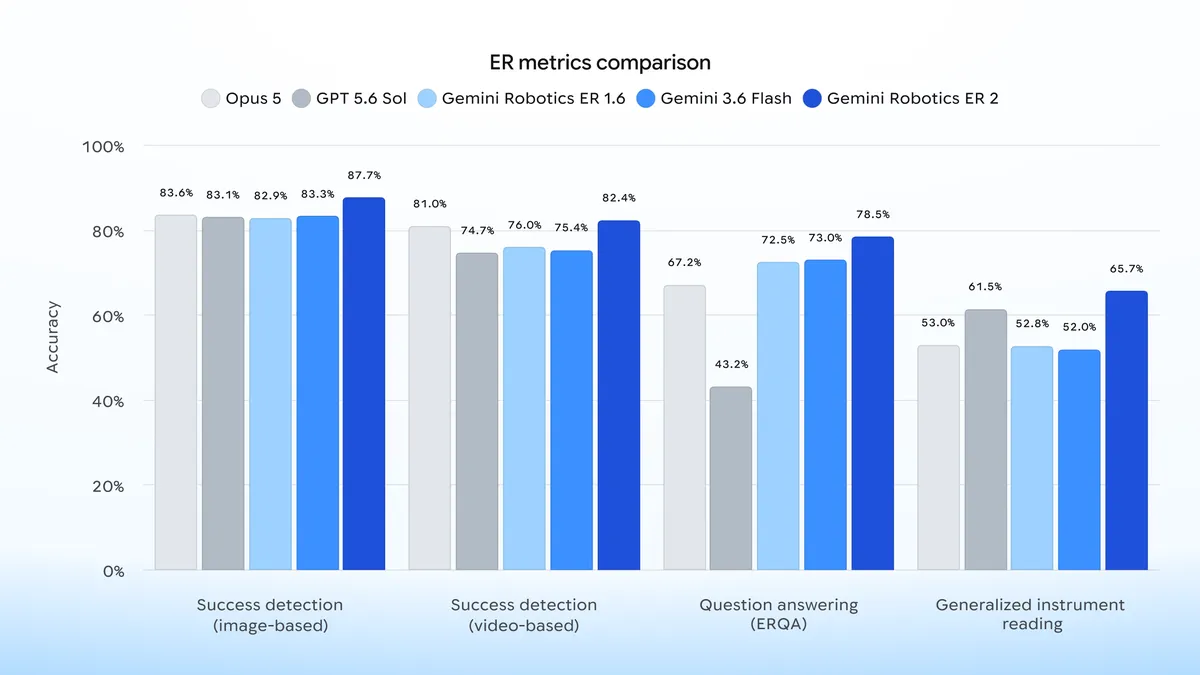
Gemini Robotics 2.0 introduces three new sub-models. The publicly available one, Gemini Robotics ER 2, is an embodied reasoning model that works like a vision language model. It understands instructions and environmental context, allowing robots to see what they’re doing and adapt in real time.
Key improvements over the previous 1.6 release:
- Processes live video feeds from robot cameras, enabling multi-step task tracking
- Classifies video frame completeness with 60% accuracy
- Identifies critical moments like knowing when to stop pouring with 90% accuracy
- Understands failures in real time and adjusts single steps without restarting entire tasks
How Robots Learn and Adapt
The embodied reasoning model allows robots to recover from mistakes on the fly. If a ball rolls away mid-task, the robot readjusts its hand and motion to retry just that step instead of abandoning the entire sequence.
The upgrade also enables multi-robot collaboration. Video demonstrations show Apptronik’s Apollo 2 and the Franka F3 Duo working together seamlessly, completing shared tasks without interfering with each other.
Translating understanding into movement is handled by the upgraded Gemini Robotics 2, a vision-language-action model that generates robot movements from instructions. Google is also testing a low-latency offline version called Gemini Robotics On-Device 2, which is more accurate and efficient. The smaller on-device version can adapt to new robot designs with just 200 examples of movement data and a few hours of training.
Safety as a Foundation
AI hallucinations pose real risks when robots are physically embodied. A mistake could have serious consequences. Google DeepMind emphasizes safety throughout this release, combining traditional physical safety measures with robust AI safety frameworks
.
The 2.0 release introduces ASIMOV-Agentic, a new safety benchmark that tests models across multiple factors:
- Does the model refuse unsafe tool calls?
- Can it determine if a task is safely completable?
- Does it call for human assistance when uncertain?
Google DeepMind reports that Gemini Robotics ER 2 is their safest model yet, showing robust ability to understand safety constraints and halt actions when humans are too close. The safety benchmark is publicly available on Hugging Face.
What Developers Get Today
Gemini Robotics ER 2 is available now to developers via the Gemini Live API. Google is also testing Gemini Robotics 2 on Boston Dynamics hardware, signaling broader deployment in the coming months.
This release represents a meaningful step toward robots that can genuinely understand their environments and adapt to unexpected situations without constant human supervision. The combination of improved dexterity, real-time learning, and multi-robot collaboration suggests the robotics industry is moving beyond narrow, task-specific machines toward systems that can handle genuine complexity.
Follow Hashlytics on Bluesky, LinkedIn, Telegram and X to Get Instant Updates