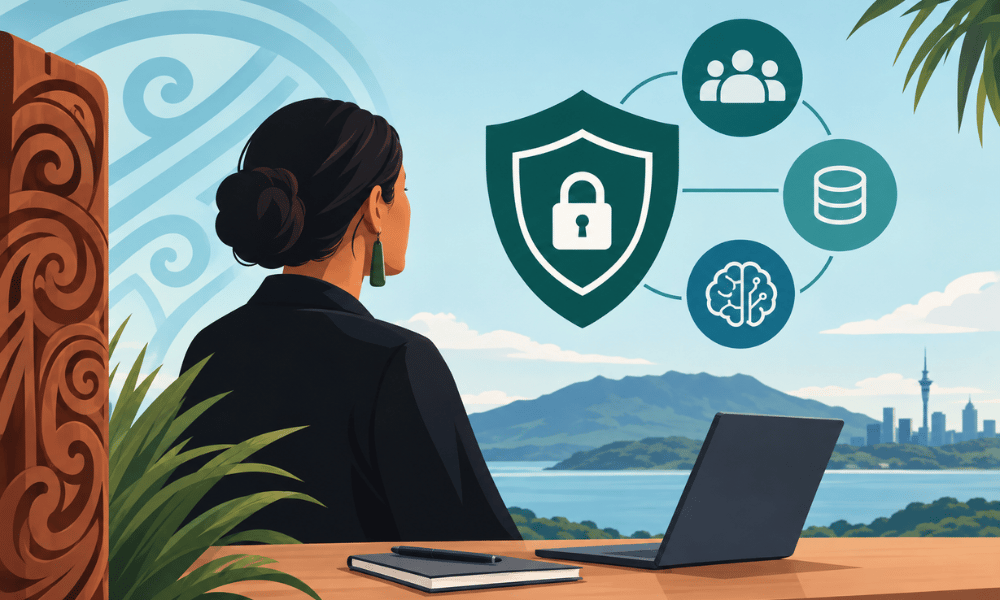
Ember Korowai Takitini, an Auckland-based NGO, is actively working through what Māori data sovereignty should look like inside workplace AI policy. Gil Sewell, their Chief People and Culture Officer, leads the effort alongside Peti Deed, Ember’s Kaiwhakahaere Hononga ā-Iwi, who guides the organization’s bicultural approach.
Data Carries Whakapapa, Not Just Information
Sewell opened her thinking on this with a whakataukī, a Māori proverb: He rei ngā niho, he paraoa ngā kauae,
which translates to right principles for important endeavors. Collecting personal information is exactly that kind of endeavor, she said, one that must align with Te Tiriti o Waitangi principles of partnership, participation, and protection.
For Māori, data is more than information. It holds whakapapa, identity, and the stories of a people. Data sovereignty, in this framing, is about ensuring those stories are protected with care, respect, and rangatiratanga. The question Ember keeps returning to is who actually carries the responsibility to protect it.
That principle shows up in practical decisions too. Ember avoids using AI note-takers in meetings with new referrals, reflecting an internal standard of being efficient with things but effective with people. Note-taking, in this context, is part of the therapeutic relationship itself. Deed emphasized that relationships are the intervention in te ao Māori, and technology should never displace human presence or listening.
Why Trust Has to Be Rebuilt First
Māori often hesitate to share personal data, and that hesitation has a clear history behind it. Information has historically been used to justify harmful state actions, including the removal of children from their families. Rebuilding trust after that kind of misuse takes sustained effort, not a policy update.
Ember’s response has been to involve its Māori team in major projects from the start, including leadership frameworks and system procurement, rather than seeking approval after decisions are already made.
- Co-design builds trust, seeking buy-in later does not
- Communities share data more readily when they see respect, genuine partnership, and real benefit
- This approach aligns with Dr. Carla Houkamau’s research on collective decision-making
Treating AI Like a New Graduate
Ember grants AI access to staff selectively, drawing a clear line between efficiency and effectiveness. Sewell compares AI to a new graduate: capable, but needing oversight, and never left to operate without a human checking its output.
Sewell, recognized as a top HR leader, warns against rushing AI adoption without weighing long-term impacts. Automating entry-level tasks might solve a short-term efficiency problem while quietly narrowing future employment pathways. Ember’s leadership asks a more specific question before adopting any AI tool: does it strengthen human connection, support critical thinking, or increase agency.
Deed referenced Bill Gates’ description of AI as society’s potential greatest equaliser
or greatest source of injustice.
Her advice to HR leaders is to center human dignity, whakapapa, whānau, and rangatiratanga in AI governance decisions, rather than treating those as afterthoughts to a rollout plan.
Sewell’s closing point reframes the whole debate. The question isn’t whether AI can perform a given task. It’s whether performing that task strips away the human, cultural, and relational elements that gave the work meaning in the first place.
Follow Hashlytics on Bluesky, Facebook, LinkedIn , Telegram and X to Get Instant Updates