-0.76%
-1.85%
-0.42%
+0.76%
+0.67%
+1.02%
What Are Equity Perpetuals, Really
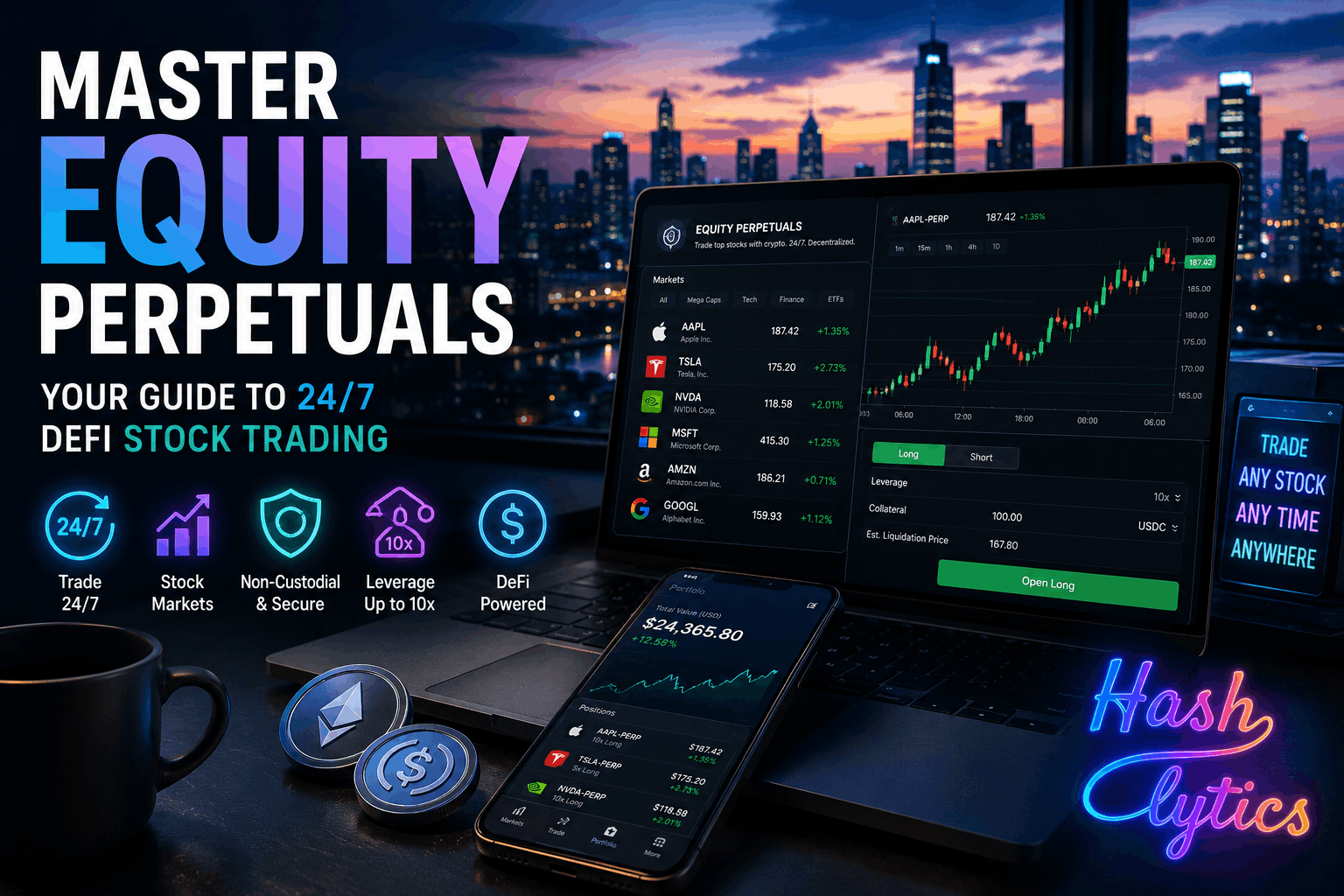
Think of equity perpetuals as leveraged bets on stock prices. They’re synthetic derivatives that track companies like Apple, Tesla, or Nvidia without you ever owning the underlying shares. The contract price stays tied to the real stock price through a mechanism called the funding rate. Traders on one side periodically pay traders on the other side, keeping the perpetual price in sync with the actual market.
Unlike traditional stock futures that expire on a specific date, equity perpetuals never expire. You can hold a position for days, weeks, or months. You never need to “roll” your contract to the next expiration date. You just keep it open as long as you maintain sufficient collateral and meet margin requirements.
How the Funding Rate Keeps Prices Honest
The funding rate is the self-correcting mechanism that makes perpetuals work. Here’s the simple version:
- If the perpetual is trading above the real stock price, long traders pay short traders to incentivize selling
- If the perpetual is trading below the real stock price, short traders pay long traders to incentivize buying
- These periodic payments happen automatically and keep the contract price anchored to reality
Funding rates typically run daily or every eight hours depending on the platform. As a trader, you need to factor this cost into your strategy. A high funding rate can eat into profits on long positions, but it also means you’re getting paid if you’re shorting.
The Real Advantages vs. Traditional Stock Trading
Equity perpetuals offer four compelling reasons why traders are flocking to them:
- 24/7 access: Trade during lunch breaks, late nights, weekends. React to global news immediately without waiting for market open
- Short selling built in: Betting against a stock is as easy as betting for it. No hard-to-borrow stocks, no restrictions
- Leverage available: Control larger positions with less capital. Most platforms offer up to 10x leverage, some go higher. This amplifies both gains and losses
- Low barriers to entry: No brokerage account required. Just a crypto wallet and stablecoins. Global traders can access US markets instantly
Platforms like Hyperliquid and Ostium have processed billions in volume. In May 2026, Ostium became the first to use live Nasdaq data for equity perpetuals, signaling Wall Street’s growing acceptance of these instruments.
How to Trade Equity Perpetuals: Step by Step
The process is straightforward, but order matters. Start here:
- Pick a platform. Look for reputable exchanges like Hyperliquid, dYdX, or Ostium. Check liquidity on your target stocks, trading fees, and security audits
- Connect your wallet. Link a supported Web3 wallet (MetaMask, Ledger, etc.). This authorizes trades and manages your funds without a middleman
- Deposit collateral. Transfer stablecoins (usually USDC or USDT) into your trading account. This serves as your margin. You’ll typically need 5-10% of your position size as collateral if using leverage
- Choose your stock. Select the perpetual market you want. Apple, Tesla, SPY index funds, many options available on major platforms
- Set leverage and position size. Decide if you want 1x (no leverage), 2x, 5x, or more. Beginners should start with 1-2x leverage. 10x+ is for experienced traders who understand margin calls
- Open your position. Click long to bet the price rises, short to bet it falls. Set stop losses to limit potential losses
- Monitor actively. Watch your margin level, unrealized gains/losses, and funding payments. Most platforms show you everything in real time
- Close when ready. Exit when you hit your profit target, your stop loss triggers, or market conditions change
Critical Risks You Cannot Ignore
Leverage cuts both ways. A 5x leverage position that gains 20% gives you 100% profit. But a 5x leverage position that drops 20% liquidates you completely and you lose your collateral. This happens faster than you think.
Other risks include:
- Liquidation: Your position is forcibly closed if collateral drops below maintenance margin. On volatile days, this can trigger in minutes
- Funding rate volatility: High funding rates eat into profits on long positions. Negative funding can swing fast
- Oracle risk: The price feed that determines your contract value could be stale or attacked. Smart contract bugs have drained perpetual platforms
- Slippage on close: If you need to exit quickly but liquidity is thin, you’ll take a worse price than expected
The explosive growth of equity perpetuals is real. Volume has grown 5,756% in the first quarter of 2026 alone. But growth doesn’t equal safety. Treat leverage like a loaded gun. Start small, learn the mechanics, and scale up only after you understand your risk tolerance.
Follow Hashlytics on Bluesky, LinkedIn, Telegram and X to Get Instant Updates