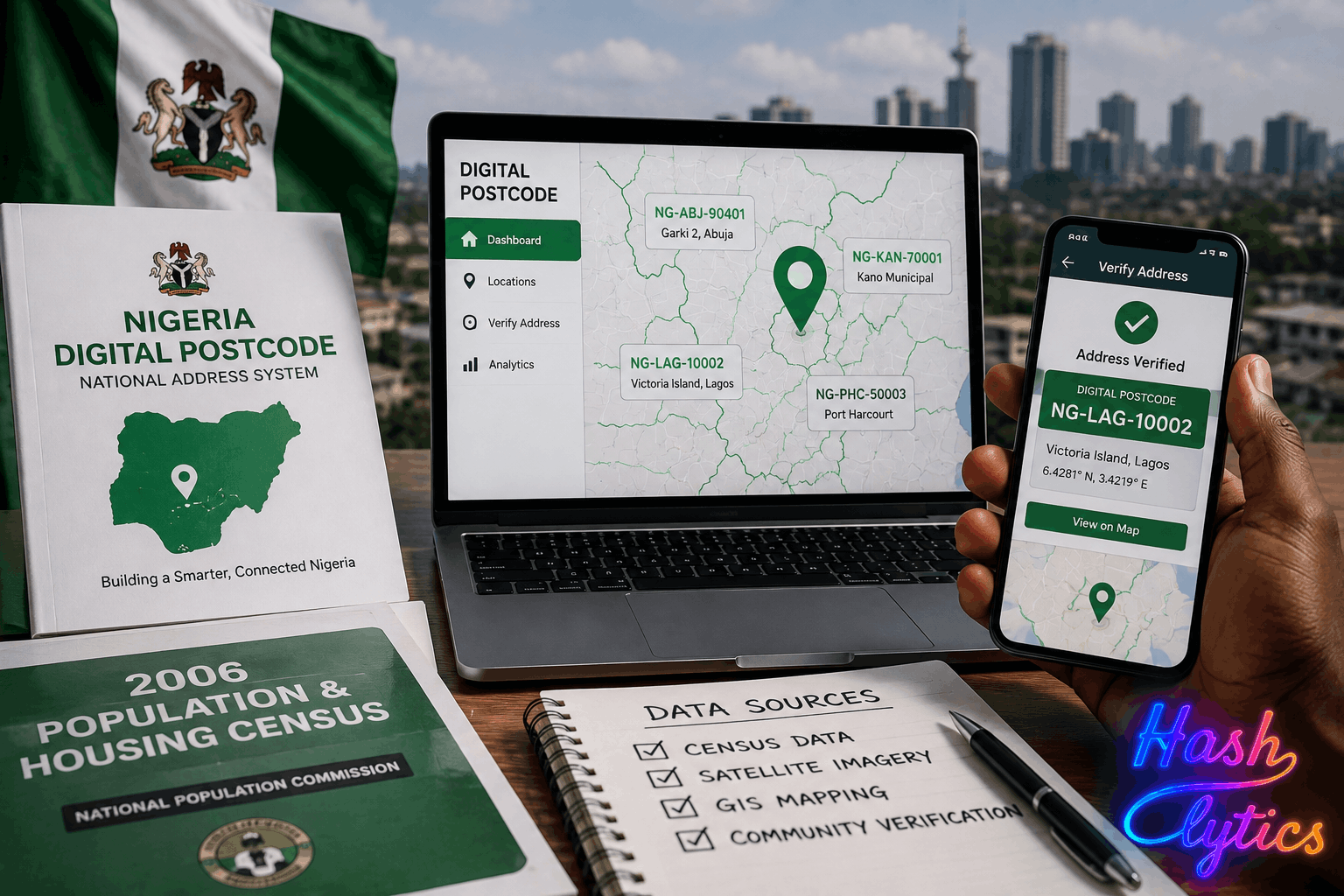
What the Code Actually Looks Like
The format follows a strict hierarchy: State → LGA → District → Area → Building, producing codes like FC02A09DB09. Unlike the old six-digit system that only identified a broad area, this one narrows all the way down to a specific structure, and works offline once a location is mapped, which matters for the roughly 40% of Nigerians in rural areas with unreliable internet. NIPOST estimates Nigeria’s addressing gap currently costs the economy N50-80 billion annually in failed deliveries alone, the immediate economic case for the system.
Reusing Census Data Is the Real Story
Feeding 2022 census geodata into a new government infrastructure project is efficient, and it is also the third major instance this year of Nigerian agencies linking previously separate datasets into a single interoperable layer. The NIMC Act 2026 already made NIN the master identifier that banks, telecoms, and government services must all link to. A building-level postcode tied to census geodata is the physical-location equivalent: once your NIN, your bank account, your tax ID, and now your home address all sit inside interoperable government systems, cross-referencing any one of them against the others becomes a database query, not an investigation.
That is not automatically sinister. Emergency responders reaching the correct building during a medical crisis, or a logistics company confirming a delivery address without calling three times for directions, are genuine wins. But the same convenience-versus-collection tension we raised with GovGuide applies here with a physical dimension GovGuide never had: a postcode does not just reveal what you asked government for, it fixes exactly where you sleep at night, tied to a permanent, machine-readable code.
NIPOST’s Access Controls, and Their Limits
NIPOST Postmaster General Tola Odeyemi has said access to postcode-linked data will be tiered, with only authorised institutions able to retrieve information relevant to their mandate, and that NIPOST is working with the Nigeria Data Protection Commission on safeguards. That framing echoes the exact language of Nigeria’s data protection framework, which requires purpose limitation and access controls on paper but has no strong public record of enforcement against government agencies specifically, only private companies. Whether “tiered access” means a genuine technical permission system or a policy promise with no audit trail is precisely the kind of detail that determines whether this becomes useful infrastructure or another entry in Nigeria’s growing list of interoperable government databases with unclear oversight.
A public search tool is already live at postcode.gov.ng, though the developer portal businesses need to integrate the system into logistics and e-commerce platforms is still being finalised. For ordinary Nigerians, the practical task before October 1 is straightforward: generate your postcode when the tool opens for your area, and watch whether NIPOST’s tiered-access promise survives contact with the same interoperability pressure that shaped NIMC and the tax ID rollout before it.
Follow us on Bluesky, LinkedIn, X, and Telegram to Get Instant Updates