
+0.96%
+1.00%
+0.36%
-0.53%
+16.48%
-0.35%
That is a step above what the rest of the market faces:
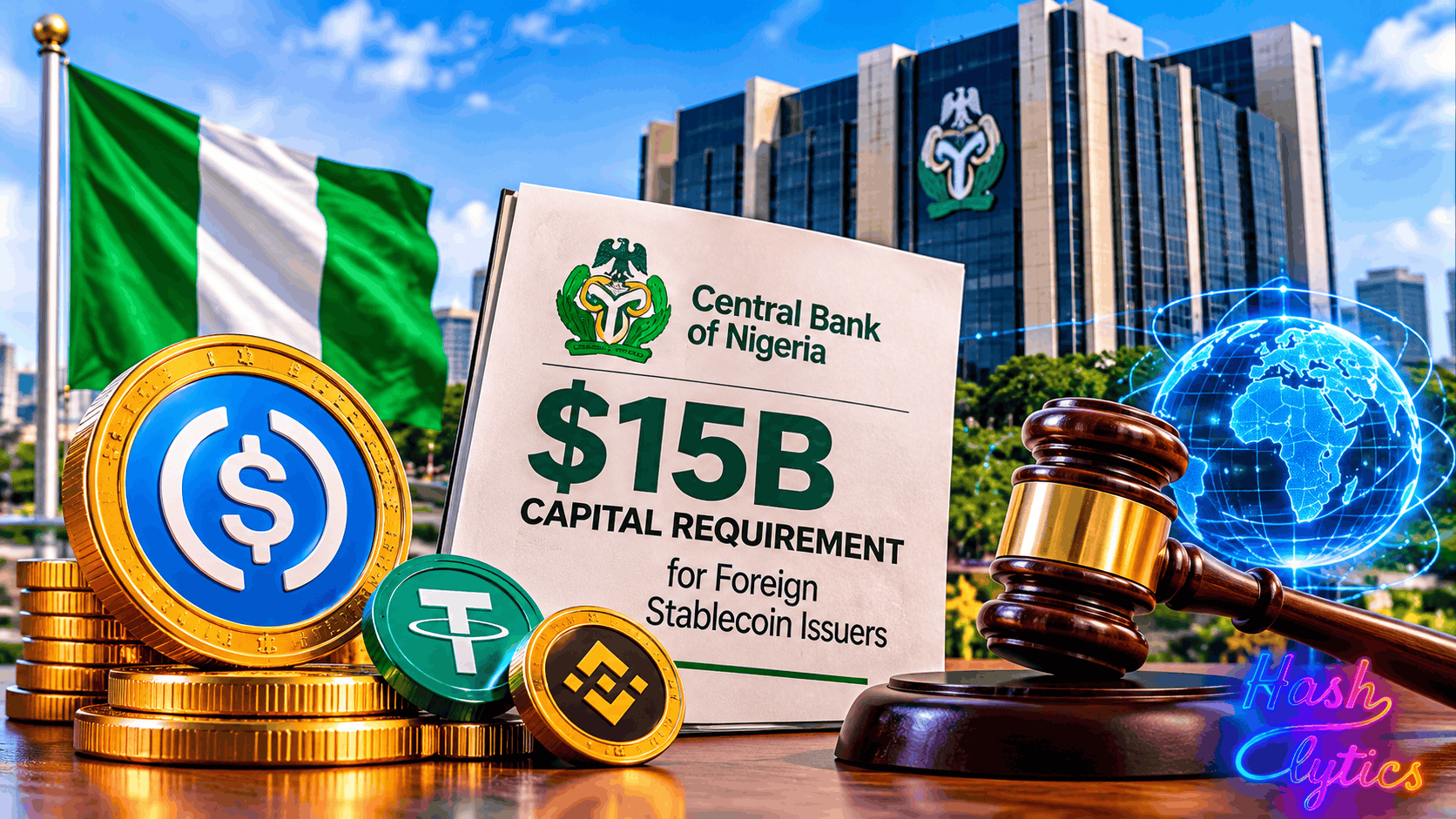
- Foreign currency-backed stablecoins (Class 2): ₦15 billion
- Naira-referenced stablecoins: ₦10 billion
- Other non-security virtual asset service providers: ₦1 billion
The gap signals how closely the regulator is watching dollar-pegged instruments.
Paid-Up Capital, a 2% Reserve Buffer and a Resident Compliance Officer
The capital has to be real money. It must be paid-up, not borrowed funds or contingent assets, and it must sit in a CBN-designated account or in Federal Government securities. An issuer whose capital drops below the minimum must notify the CBN immediately and can face limits on new token issuance or customer onboarding until it submits a restoration plan.
Reserves follow a similar logic. Issuers must hold at least 100% of outstanding obligations plus a 2% buffer, in cash at a designated CBN account or in Federal Government securities. Holders also get a firm redemption right: tokens must be redeemable at face value, typically within one business day and at no charge.
The operating rules put the issuer within the regulator’s reach:
- A staffed physical office in Nigeria with effective local management
- A resident Chief Compliance Officer
- Unrestricted supervisory access to books, records, systems and group information
Algorithmic Models Are Out, and Size Brings Extra Oversight
The CBN bans algorithmic stablecoins outright, along with tokens that are linked to fiat but backed mainly by other cryptocurrencies. Permissible backing is limited to cash and government securities, which rules out the hybrid models that have gained ground elsewhere and forces issuers to keep reserves that can be audited. The rules apply equally to domestic and foreign operators serving Nigerian customers, with the stated aims of fighting financial crime and tightening identity verification across peer-to-peer crypto transactions.
A stablecoin will be treated as systemically important if its circulating value exceeds ₦500 billion for 30 consecutive days or if more than 5 million people use it. That designation brings enhanced oversight.
The rules land alongside other moves. President Bola Tinubu’s Presidential Executive Order on Virtual Assets Coordination dates from , the Nigeria Revenue Service has issued virtual asset taxation guidelines, and the Securities and Exchange Commission has admitted 14 crypto firms into its Accelerated Regulatory Incubation Programme. Together they point to a coordinated push, though the capital requirements will likely slow foreign stablecoin deployment in West Africa’s largest economy.
Hashlytics Take
The ₦15 billion figure gets the attention, but it is probably not the hardest requirement to meet. A Nigerian-incorporated entity, a resident compliance officer, a physical office and reserves held at the CBN or in government securities do something more useful for the regulator: they make the issuer reachable. Capital can be raised. Being answerable to a local supervisor is a bigger change for a global issuer. Two things are worth watching. The threshold is fixed in naira, so its dollar cost moves with the exchange rate. And the reserve rules, as reported, name cash at a CBN account or Federal Government securities without saying how that works for a token backed by a foreign currency. How the CBN answers that will tell us whether this is a workable licensing regime or a wall.
Follow Hashlytics on Bluesky, Facebook, LinkedIn , Telegram and X to Get Instant Updates