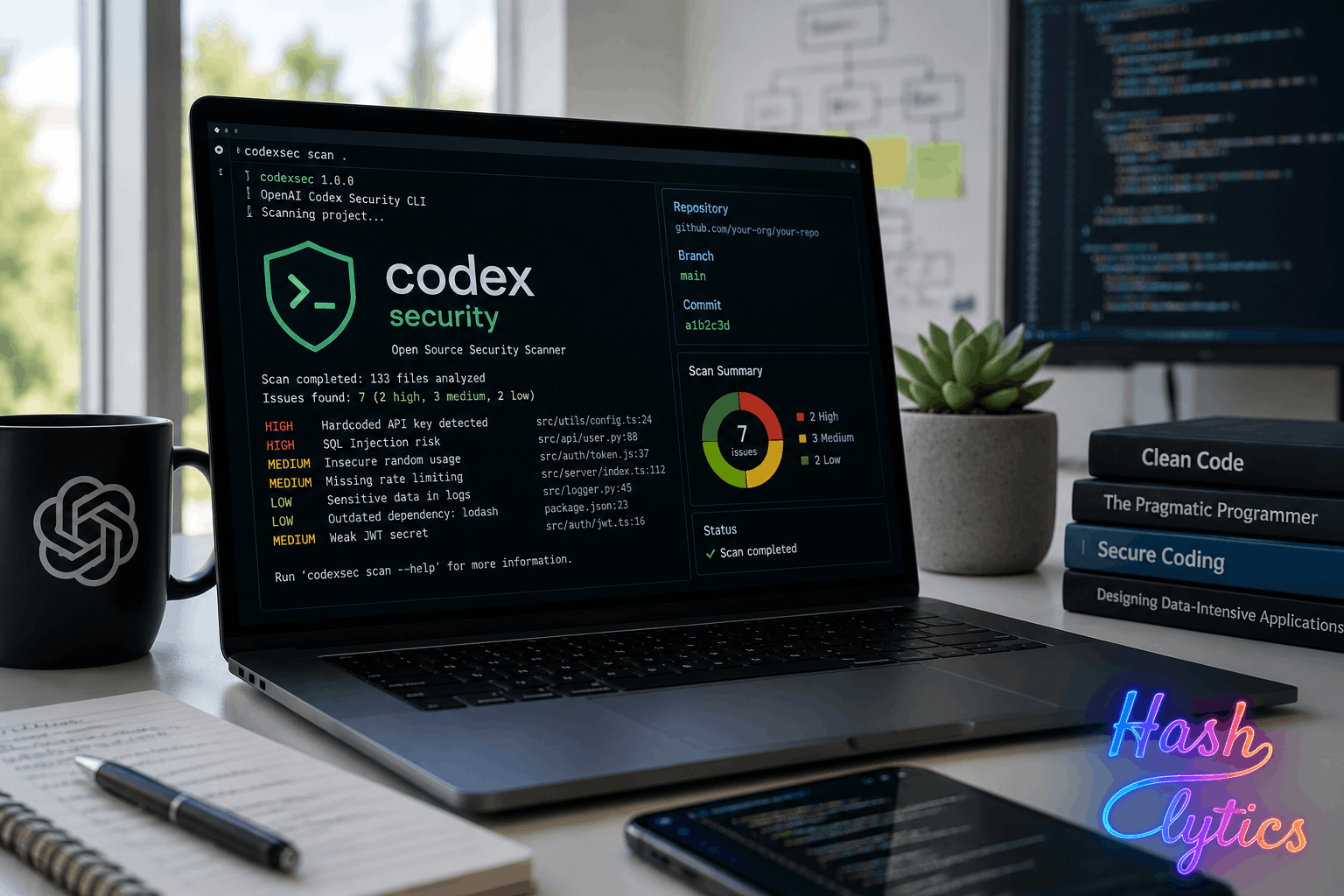
What Codex Security CLI Does
The tool performs three core functions:
- Scans code repositories for security vulnerabilities
- Tracks issues across multiple scan runs to monitor progress
- Verifies that applied fixes actually resolve flagged vulnerabilities
Unlike manual code reviews or separate security audits, Codex Security CLI integrates directly into CI/CD pipelines. This means security checks happen automatically during every build, making vulnerability detection a non-negotiable part of development rather than an afterthought.
How It Differs From Traditional Code Analysis
Traditional security tools require separate runs outside the development pipeline. They generate reports that teams review later. Codex Security CLI changes this by embedding itself into the workflow itself. Rather than asking developers to audit code after it’s written, the tool flags problems as code enters the system.
This approach is called “shifting left” in security terminology. It catches flaws early when they’re cheaper and faster to fix, versus finding them in production when they become expensive incidents.
Getting Started With Codex Security CLI
Installation: The tool is available as an open source project. Developers can access it via command line and integrate it into existing workflows.
Basic workflow:
- Point the CLI at your code repository
- Run a security scan to identify vulnerabilities
- Review flagged issues and fix them
- Re-run the scan to verify fixes worked
- Configure it to run automatically on every commit
The tool works with existing version control systems and integrates with popular CI/CD platforms. Understanding CI/CD basics helps you see why this integration matters.
How It Compares to Other Security Tools
| Approach | When It Runs | Strength | Weakness |
|---|---|---|---|
| Manual Reviews | Before deployment | Human judgment catches context | Slow, inconsistent, expensive |
| SAST Tools (Static Analysis) | Development phase | Catches code patterns, integrates into pipelines | High false positives, configuration heavy |
| Codex Security CLI | Every commit in CI/CD | Automated, built for modern pipelines, open source | Early stage, limited language support (TBD) |
Current Limitations and What’s Next
OpenAI explicitly positioned Codex Security CLI as an early release. The company plans to improve it based on user feedback. This means the tool is still evolving, and developers should expect changes.
Key unknowns: OpenAI hasn’t detailed which programming languages it supports or clarified its processing limits. These details matter for teams deciding whether to adopt it.
Security breaches cost organizations billions annually. Most happen because vulnerabilities sit in code undetected. By automating security scanning at the point where code enters the system, Codex Security CLI removes the friction that prevents teams from finding problems early.
The open source approach is significant too. It invites the community to contribute, find bugs, and extend functionality rather than locking security behind a commercial paywall. For development teams tired of juggling multiple security tools, this represents a simpler path forward. The real test will be whether the tool proves robust enough and easy enough to use that it becomes standard in modern development pipelines.
Follow Hashlytics on Bluesky, LinkedIn, Telegram and X to Get Instant Updates