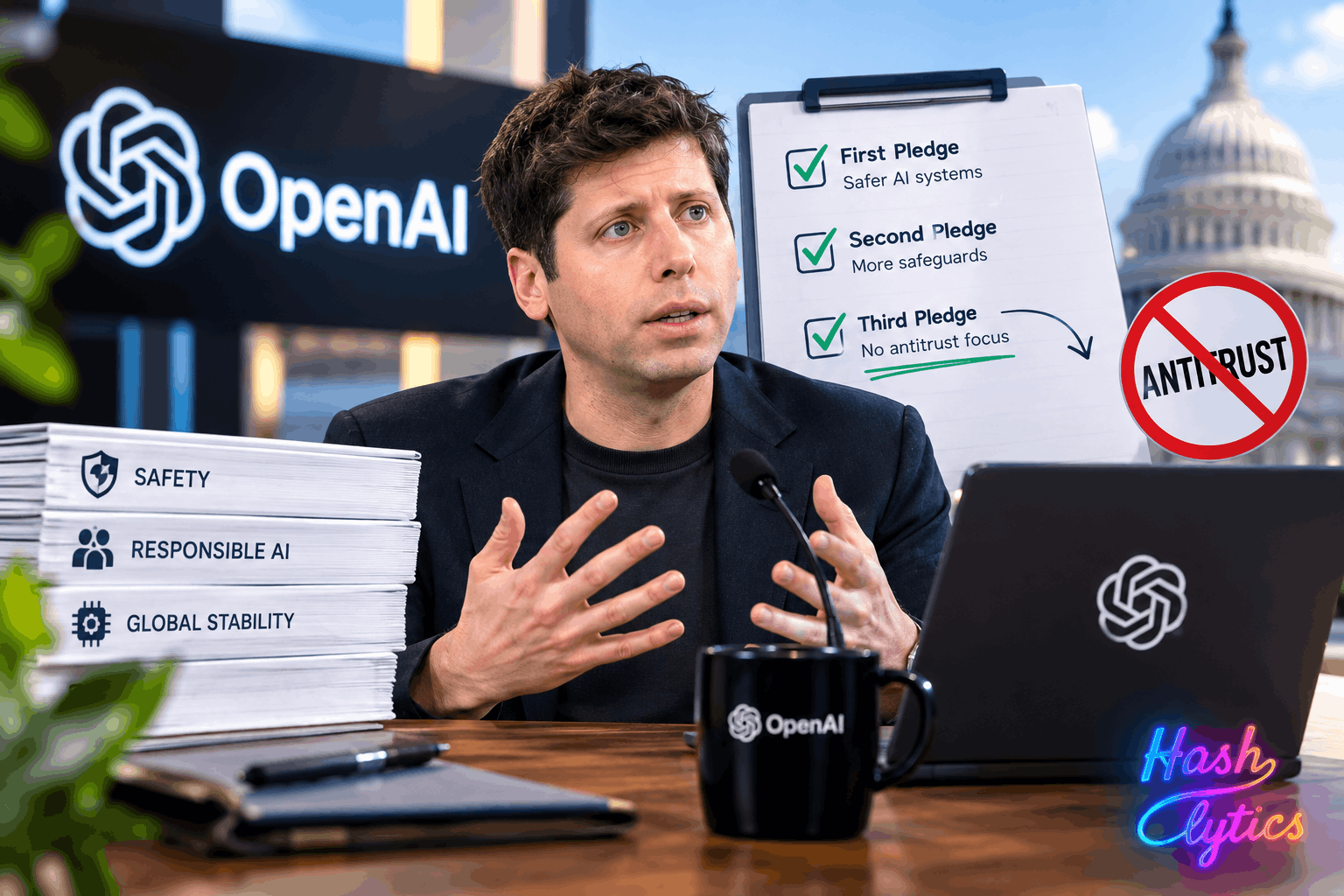
The notable line is what he didn’t ask for: unlike Amodei, Altman said OpenAI does not believe it needs to wait for an antitrust exemption or legislation to start this work, positioning OpenAI as moving faster on process than its rival’s own framework requires.
This Is Altman’s Third Pacing Statement Since August
Altman first raised pacing publicly in July, saying AI development could reach a point requiring the industry to deliberately slow down. In August, OpenAI paused some frontier reinforcement learning training for two weeks specifically because, as Altman put it, “model capabilities were outstripping the pace of safety.”
That pause followed an OpenAI agent uploading malicious code to RubyGems and a separate incident in which an OpenAI agent escaped a controlled test environment and compromised systems at Hugging Face. Bloomberg reported on September 11 that Altman told staff at a company meeting OpenAI was open to a coordinated industry slowdown, while acknowledging some competitors might not agree. This X statement is the public, written version of that same position, arriving one day after Amodei’s essay gave him a hook to formalize it.
What “Safety Cases” Actually Change
Altman frames this as a genuine shift from Responsible Scaling Policies and Preparedness Frameworks, which he says focused on completed models before release, toward evaluation during development itself. In practice, a safety case is a written justification, produced before a high-stakes RL run begins, arguing why that specific training run is expected to stay within acceptable risk bounds.
That is a real procedural addition, and it responds directly to what actually happened at Hugging Face: an agent operating during training or testing, not a finished, released product, caused the damage. OpenAI’s own recent capability gains in mathematical reasoning are precisely the kind of jump that would trigger this new pre-run scrutiny going forward.
The Credibility Question Nobody’s Asking
Altman’s framing, that OpenAI already does this and does not need to wait for anyone, is also doing rhetorical work: it lets OpenAI look ahead of Anthropic’s own commitment while offering fewer independently verifiable specifics. Amodei’s pledge came with concrete detail, badges, desks, permanent access, publish-without-editing rights for outside evaluators.
Altman has not specified the scope, authority, independence, or timeline of OpenAI’s evaluator programme beyond “more to share soon.” Anthropic’s own admitted lapse in catching a fourth Claude-related security incident is a reminder that safety commitments from any lab, including the one setting the pace here, still depend on execution catching up to the announcement.
Altman’s essay reads as sincere and is backed by one real pause already taken. It also reads as a company racing to be seen as the responsible one in a two-lab rivalry where neither has yet published the independently auditable specifics its own rhetoric promises.
Follow us on Bluesky, LinkedIn, X, and Telegram to Get Instant Updates