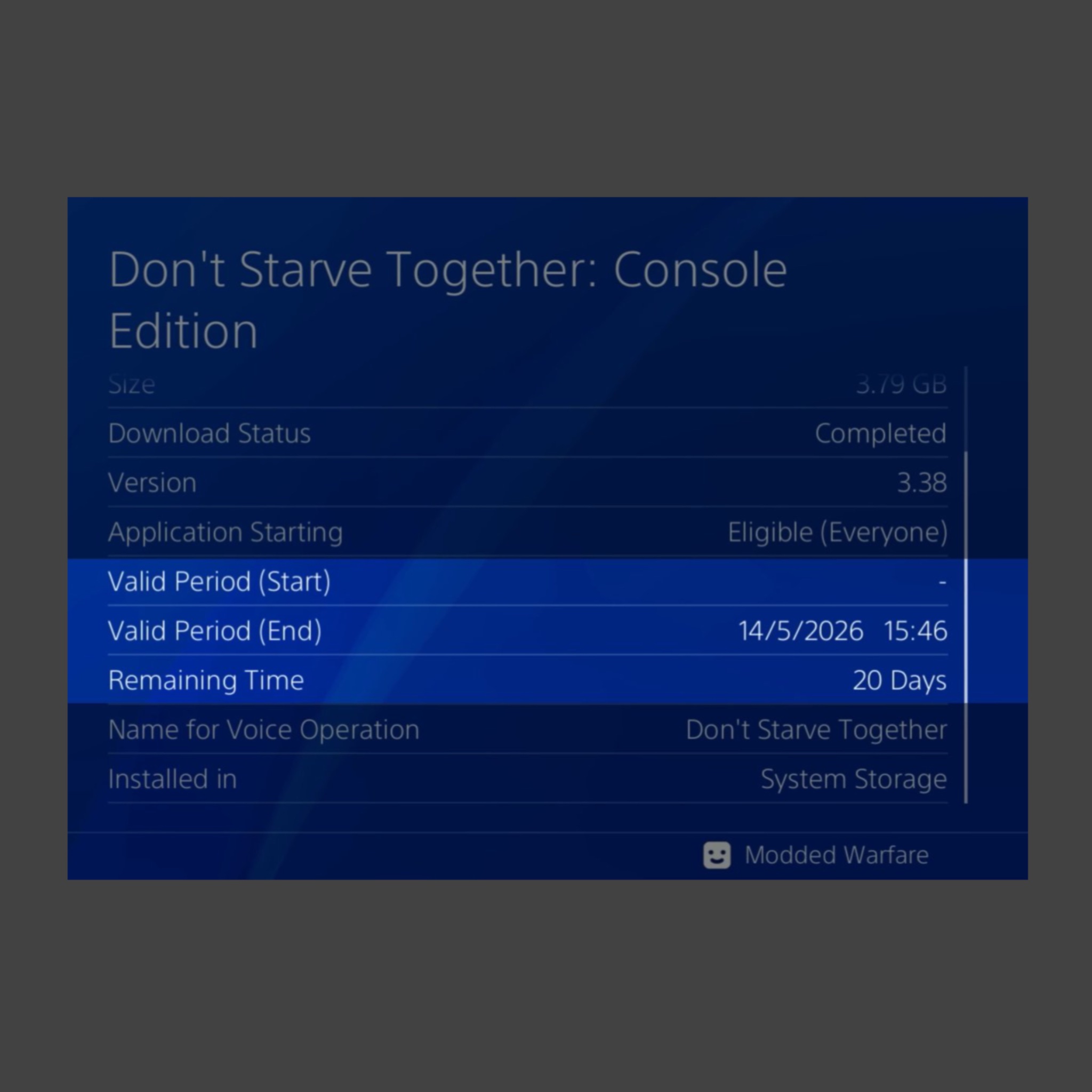
PlayStation consoles running firmware updated in March 2026 are displaying 30-day validity periods on newly purchased digital games, requiring online license verification after that window expires or the software becomes unplayable. The issue affects both PS4 and PS5 systems, though implementation details differ across platforms. Sony has not issued an official statement, leaving millions of digital-only gamers uncertain whether they’re experiencing a critical bug or the company’s permanent pivot toward stricter always-online DRM.
What’s Actually Happening on User Consoles
Modder Lance McDonald first publicized the issue on April 24, 2026, posting screenshots showing a PS4 game purchased April 14 displaying “Valid Period (Start)” and “Valid Period (End)” fields in the information tab. The end date was exactly 30 days after purchase. YouTuber Modded Warfare independently documented the same behavior, confirming the validity timer appears on all digital games purchased after the March 2026 system update.
On PlayStation 4, the DRM mechanism is visible in the user interface. Navigate to a recently purchased game’s information screen and the system explicitly shows when your license expires. PlayStation 5 handles it differently — no validity period appears in menus, but affected games throw error codes and refuse to launch after 30 days offline. The console states it cannot verify the license and blocks gameplay entirely.
Setting the console as “Primary” provides no exemption. User reports across Reddit, ResetEra, and NeoGAF confirm the restriction applies regardless of account settings or subscription status. Games purchased before March 2026 remain unaffected and can be played offline indefinitely, but any digital purchase made after the firmware update carries the 30-day countdown.
Once the timer expires, users must connect to PlayStation Network and restore licenses through the account management menu. The process takes seconds for users with stable internet, but the requirement is absolute — offline play ends at the 30-day mark with no grace period or offline workaround.
Why This Matters More Than Previous DRM Controversies
The timing evokes Xbox One’s disastrous 2013 reveal, when Microsoft announced a 24-hour online check-in requirement for all games. The backlash was immediate and severe. At E3 2013, Sony capitalized on Microsoft’s misstep with a viral video showing how to share PlayStation 4 games — by physically handing someone the disc. PlayStation 4 pre-orders outpaced Xbox One by roughly 2:1 margins. Within a week, Microsoft reversed course entirely, abandoning the always-online requirement before the console even launched.
PlayStation’s current situation differs in execution but mirrors the fundamental concern. Microsoft’s 24-hour window gave users more flexibility than Sony’s 30-day timer, but the real issue isn’t the countdown duration — it’s the infrastructure itself. As one X user noted, whether this is a bug or intentional policy, the fact that Sony built the technical capability to remotely disable purchased games should alarm every digital console owner. Today it’s a bug. Tomorrow it’s a terms-of-service update.
The shift is particularly striking given Sony’s historical positioning. For over a decade, PlayStation marketed itself as the consumer-friendly alternative to Microsoft’s DRM experiments. The PS4 generation established PlayStation as the platform where you owned your games, where offline play was respected, where your purchases remained accessible regardless of server status. That implicit contract is now in question.
The Digital Ownership Illusion Collapses
Section 3.2.2 of Sony’s Software Usage Terms has always stated clearly that software is licensed, not sold, and that offline functionality may be changed or discontinued at Sony’s discretion
. Legal scholars and consumer advocates have warned for years that “buying” digital games is a misnomer — you’re purchasing a revocable license, not transferable property. Most users ignored those warnings because the practical experience felt like ownership. Games worked offline. They didn’t expire. You could play them in 2026 the same way you played them in 2016.
The 30-day timer makes the license model materially enforceable. PlayStation now has infrastructure to remotely verify every digital purchase on a rolling basis. The system can distinguish between pre-March 2026 and post-March 2026 acquisitions, applying different license validation rules to each. That level of granular control over purchased content represents a fundamental change in how console gaming operates, regardless of whether Sony intended it.
Is This a Bug? The Evidence Is Contradictory
An anonymous source claiming insider knowledge told gaming site DoesItPlay1 that the DRM issue is unintentional — Sony accidentally broke something while patching a security exploit. The source stated Sony has known about the confusing user interface for weeks but didn’t prioritize fixing it. If accurate, this would make the 30-day timer a side effect of anti-piracy measures rather than deliberate always-online DRM.
This explanation aligns with a similar incident from 2022, when PlayStation firmware updates temporarily caused license validation errors that resolved after Sony deployed patches. The jailbreaking community noted that recently purchased games now contain hard expiration dates in file metadata, a change that could plausibly result from overzealous exploit mitigation targeting modified consoles.
However, several factors contradict the “accidental bug” theory. First, the March 2026 firmware introduced differential treatment for pre-existing versus newly purchased games. Retroactive changes to millions of existing licenses would require database-level modifications, but Sony implemented the restriction only for post-update acquisitions. That suggests intentional design rather than broken code.
Second, some Reddit users reported the validity timer disappeared from their games in mid-April, indicating Sony can remotely adjust license parameters without firmware updates. If this were purely a bug, the fix should eliminate the timer universally. Instead, reports remain inconsistent — some users see the countdown, others don’t, and the pattern doesn’t correlate cleanly with firmware version or purchase date.
Third, DoesItPlay1’s testing methodology raised questions. The account purchased “7 Days To Die” specifically to verify the issue, found no validity period displayed, disconnected from the internet, and concluded the reports were false. But other users purchasing different titles on the same dates documented the timer. This suggests either game-specific implementation or regional variations that wouldn’t occur with a simple firmware bug.
Why Sony Might Actually Want This System
From Sony’s perspective, 30-day license validation solves multiple business problems. Jailbroken consoles represent ongoing revenue loss—users can load pirated games, share digital licenses across unlimited devices offline, and circumvent PlayStation Network’s monetization infrastructure. Background license renewal makes piracy significantly harder by requiring periodic authentication that modified firmware cannot easily spoof.
The system also combats account sharing abuse. PlayStation’s current model allows a user to set one console as “Primary,” enabling offline play for all accounts on that device. Secondary consoles require the purchasing account to be online. Determined users exploit this by sharing credentials, setting multiple consoles as Primary in rotation, or using family sharing features beyond their intended scope. Mandatory 30-day check-ins close those loopholes by forcing all devices to periodically verify licenses against PlayStation Network’s authoritative database.
Long-term, the infrastructure positions Sony to implement subscription-style models for purchased content. If every game requires server validation anyway, the technical barrier to converting “permanent” licenses into time-limited ones drops to a terms-of-service amendment. This doesn’t mean Sony intends to revoke existing purchases, but the capability now exists where it didn’t before.
The March 2026 timing is notable. PlayStation 5 launched in November 2020 with a digital-only edition priced $100 below the disc version. Sony positioned all-digital as the future, heavily promoting PlayStation Store sales and digital pre-orders. Five years later, with a substantial installed base of disc-less consoles, implementing stricter DRM carries less risk of users switching to physical media — because many PS5 owners cannot physically switch even if they wanted to.
The Infrastructure Risk Nobody Discusses
Even users defending the change as anti-piracy protection must reckon with what happens when PlayStation Network eventually goes offline. Sony maintained PS3 servers for 16 years before announcing shutdowns in 2021, then reversed course after backlash and kept them running. PS Vita’s store faced similar shutdown-reversal cycles. But eventually, every online service terminates.
Under the current DRM structure, when PlayStation Network authentication servers for PS4 and PS5 finally shut down—in 2035, 2040, 2045—every digital game purchased after March 2026 becomes unplayable after 30 days. Not just multiplayer. Not just cloud saves. The entire library becomes inaccessible. This creates a preservation crisis where future generations cannot study, archive, or experience PlayStation’s digital-era catalog.
Microsoft’s Xbox One always-online backlash in 2013 centered partly on this exact scenario. Critics asked what happens to your games when Microsoft decides Xbox Live for Xbox One isn’t profitable anymore. Microsoft’s answer was to abandon the requirement entirely. PlayStation’s answer, if this becomes permanent policy, appears to be accepting that digital games have inherent expiration dates tied to corporate server lifespans.
Users in rural areas, military deployments, submarines, research stations, and developing regions without reliable internet infrastructure face immediate problems. A 30-day window seems generous until you’re actually unable to connect for reasons beyond your control. Natural disasters regularly disrupt internet service for weeks. Military deployments to areas without connectivity can last months. Someone purchasing a PlayStation 5 for a long-haul shipping job or Antarctic research station would discover their legally purchased games stop working mid-deployment.
What Sony Needs to Clarify
Sony’s silence is fueling speculation. The company has not acknowledged the reports, explained the technical cause, committed to a timeline for fixes if it’s a bug, or clarified policy if it’s intentional. This communication vacuum is particularly damaging given PlayStation’s decade-long reputation as the pro-consumer alternative to Microsoft’s DRM experiments.
Specifically, Sony must address:
Is the 30-day timer intentional or a bug? If it’s an exploit patch gone wrong, say so and commit to removing the timer. If it’s deliberate anti-piracy infrastructure, explain the security threat it’s mitigating and why less intrusive solutions were rejected.
Will pre-March 2026 games receive retroactive restrictions? Users need confirmation that games they already owned before the March firmware update will remain playable offline indefinitely. The current differential treatment is confusing and erodes trust that existing licenses are safe.
What happens if PlayStation Network goes down? Planned maintenance windows, DDoS attacks, infrastructure failures, and natural disasters all cause PSN outages. If an outage coincides with a user’s 30-day deadline, can they still play, or are they locked out until service resumes?
How does this affect game preservation? When PS4 and PS5 authentication servers eventually shut down decades from now, what happens to the post-March 2026 digital library? Will Sony patch out the DRM before decommissioning servers, or is permanent loss of access the accepted outcome?
What exemptions exist for offline use cases? Military personnel, researchers, travelers, and rural users need clarity on whether workarounds exist for legitimate extended offline periods, or if 30 days is a hard technical limit with no exceptions.
The Broader Trend Toward Rental Models
PlayStation’s DRM situation isn’t isolated. The gaming industry broadly has been transitioning from ownership to access models for years. Xbox Game Pass, PlayStation Plus Premium, and cloud gaming services like GeForce Now all position gaming as subscription services where you pay for temporary access rather than permanent ownership. Digital storefronts like Steam, Epic Games Store, and GOG explicitly license content rather than selling it.
The difference is transparency. Services marketed as subscriptions (Game Pass, PS Plus) clearly state you’re renting access that expires if you stop paying. Games marketed as purchases create the expectation of permanence. When a storefront displays a “Buy” button next to a $70 game, consumers reasonably believe they’re acquiring something that won’t expire in 30 days without server contact.
European consumer protection regulators have begun scrutinizing this language. France’s DGCCRF investigated Steam in 2019 for using “buy” terminology on revocable licenses. California’s AB 2426 law, effective January 2025, requires digital storefronts to clearly disclose when “purchases” are actually licenses. If Sony’s 30-day timer becomes permanent policy, regulators may examine whether PlayStation Store’s interface adequately informs consumers that “buying” a game grants only temporary offline access subject to recurring verification.
What Users Should Do Now
Until Sony clarifies the situation, PlayStation owners with digital libraries should take precautionary steps. Verify your console connects to PlayStation Network at least monthly to avoid hitting the 30-day deadline unintentionally. Users planning extended offline periods—travel, deployments, remote work—should ensure they restore licenses before disconnecting.
For future purchases, consider the offline implications. Physical media remains available for most major releases and carries no DRM restrictions beyond disc-check requirements. Games purchased on disc can be played offline indefinitely regardless of firmware updates or network policies.
Document your library. Screenshot your purchase history and account details. If the DRM situation escalates into a consumer protection dispute or class-action lawsuit, contemporaneous records of what you purchased, when you purchased it, and what restrictions applied at purchase time become important evidence.
Most importantly, make Sony hear the feedback. The Xbox One reversal in 2013 happened because consumers vocally rejected always-online DRM. Pre-orders shifted to PlayStation, social media backlash went viral, and Microsoft capitulated within a week. Sony responds to market signals. If this is intentional policy and users accept it quietly, it becomes the new normal. If the response matches the Xbox One backlash intensity, Sony may reconsider.
The infrastructure is built. The question is whether Sony activates it permanently or rolls it back as an acknowledged mistake. That decision depends heavily on how loud the opposition gets before the company commits to a path.
Follow us on Bluesky, LinkedIn, X, and Telegram to Get Instant Updates