Anthropic Pushes Claude Into Creative Workflows
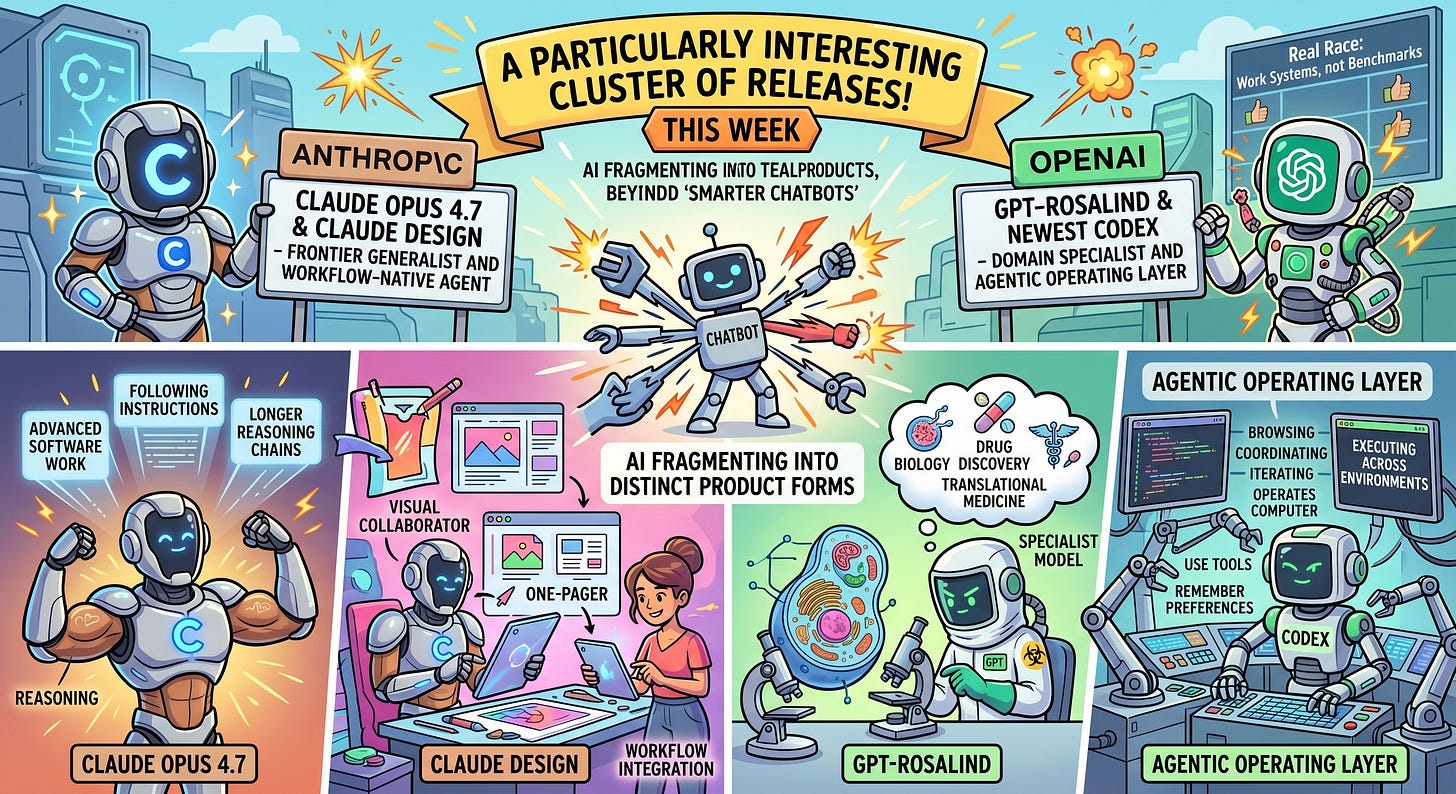
Anthropic launched two major products this week that reveal its strategic direction. Claude Opus 4.7 represents a refinement of the frontier generalist model, delivering stronger performance for advanced software work, better instruction-following, and more reliable reasoning chains. But Claude Design is the more revealing signal.
Claude Design packages Claude not merely as a model that describes visual work, but as an active collaborator for producing it. The tool generates designs, prototypes, slides, and one-pagers by turning design from a prompting exercise into a structured workflow. This matters because it merges reasoning and visual production into a single interface category.
OpenAI Splits Strategy Into Specialization and Agency
OpenAI’s releases follow a parallel but distinct trajectory. The company introduced GPT-Rosalind, a specialist model built explicitly for biology, drug discovery, and translational medicine rather than a general model stretched to fit scientific work. This represents a meaningful shift in AI advantage: the next wave will come from systems deeply adapted to the language, tools, and constraints of high-value domains.
Codex, OpenAI’s newest release, extends further into agentic territory. It no longer just generates code. It operates computers, uses tools and apps, remembers preferences, connects to remote environments, and handles ongoing work over time. Codex is becoming an agentic operating layer for software and knowledge work, participating in surrounding workflows rather than waiting passively for prompts.
The Bigger Picture: AI Fragmenting Into Real Products
Across both companies, frontier AI is crystallizing into distinct product forms: the general-purpose reasoning model, the domain specialist, and the workflow-native agent. Anthropic is pushing the frontier generalist into adjacent creative workflows. OpenAI is simultaneously advancing specialization and agentic execution.
The competitive landscape has become far more interesting because the real race is no longer about who has the smartest model on a benchmark. It is about who can turn intelligence into the most compelling system for actual work.
What Comes Next
This fragmentation will likely accelerate across the industry. The winners will be companies that can tailor AI systems to specific workflows rather than trying to stretch general models into every domain. Science, design, and software development are becoming the first proving grounds for this specialization strategy.
Follow Hashlytics on Bluesky, LinkedIn , Telegram and X to Get Instant Updates