+2.25%
+2.75%
+23.50%
+0.44%
+5.40%
+2.01%
The Numbers Tell a Clear Story
According to a Bearingpoint study released July 30, 23% of Swiss adults use cryptocurrency at least occasionally. Germany trails at 11%, while Austria sits in the middle at 18%. The survey, conducted by YouGov between June 18 and June 29, polled over 4,000 adults across all three countries.
The investment perspective widens the gap even more. In Switzerland, 37% view crypto as a worthwhile investment. Austria reaches 28%, while Germany lags at 23%. Swiss respondents also showed significantly more openness to central bank digital currencies (CBDCs), with 44% willing to use a digital franc in daily transactions.
Dr. Robert Bosch, Bearingpoint’s global head of financial services, captured the contrast plainly: Germany discusses risks, while the neighbors are already using and investing more strongly.
Regulation Created the Opening
Switzerland didn’t stumble into this lead by accident. The country approved its Distributed Ledger Technology Act in September 2020, with full implementation by August 1, 2021. Rather than creating entirely new laws, Switzerland took a smarter approach: it updated existing financial and civil legislation to clarify how tokenized assets fit into legal structures.
This clarity mattered enormously. Bankruptcy treatment was addressed. Specialized DLT trading facilities could be licensed. Early certainty meant companies could establish operations and refine products without constantly second-guessing the regulatory ground beneath them.
Crypto Valley Is Still Growing
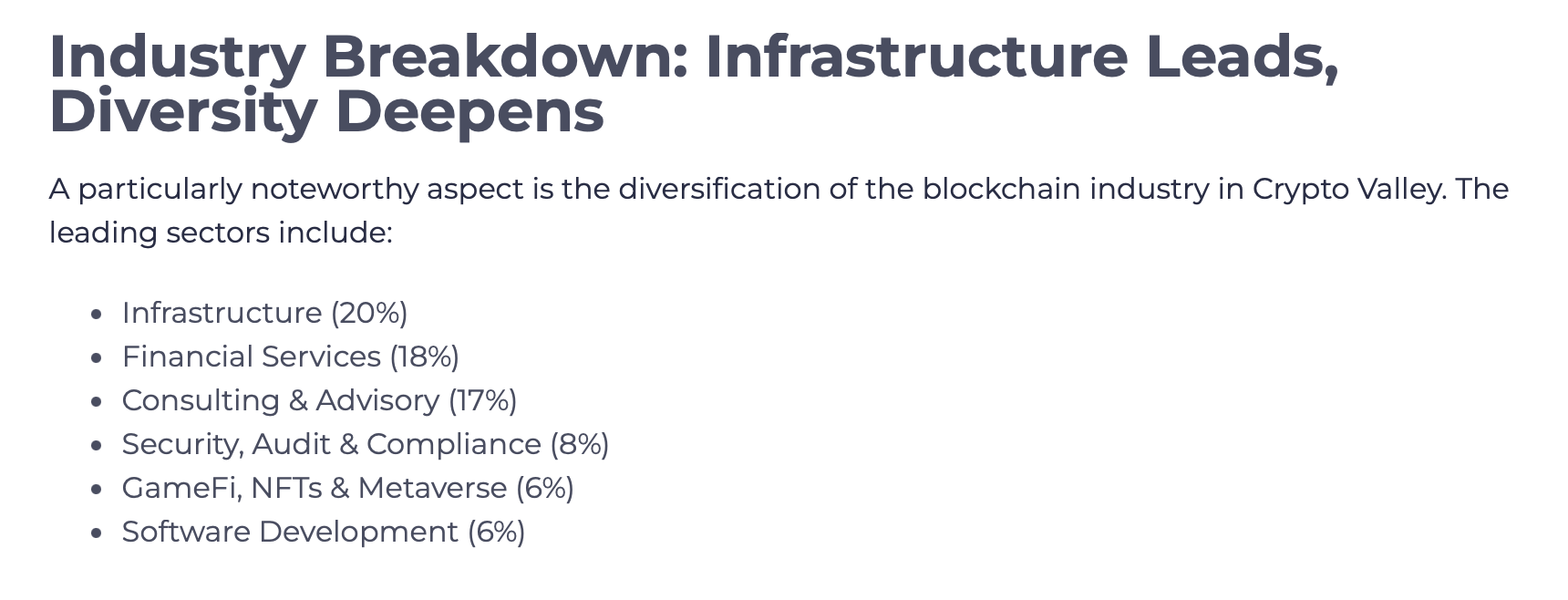
That early regulatory confidence built something real. Crypto Valley, spanning Switzerland and Liechtenstein, now hosts 1,749 active blockchain and DLT companies as of 2024. That’s a 14% annual increase and a 132% jump since 2020. Zug remains the epicenter, home to roughly 719 companies.
This concentration creates a powerful flywheel. Specialized financial services cluster there. Compliance expertise concentrates there. Investment capital follows. Companies connected with Ethereum, Cardano, and Solana maintain strong presence here. It’s the difference between having a crypto industry and having a crypto ecosystem.
Integration, Not Replacement
An important nuance from the survey: crypto is augmenting traditional finance, not replacing it. Most respondents still trust government-issued currencies for payments. About 64% of Swiss respondents continue to view gold as the better inflation hedge. This matters because it means crypto is becoming another tool in the financial toolkit. Banks can expand their digital offerings without abandoning their core business.
Germany’s Banks Could Change the Game
Germany’s retail adoption lags, but its banking infrastructure is massive. Cooperative banks served by DZ Bank and savings banks served by Dekabank collectively reach roughly 80 million customers.
DZ Bank received authorization in late 2025 for its “meinkrypto” platform, integrated directly into the VR Banking App. It launched with Bitcoin, Ether, Litecoin, and Cardano. Dekabank is building a comparable platform for the Sparkassen network, serving 50 million customers, with rollout expected through 2026, initially supporting Bitcoin and Ether.
This is the key difference between Switzerland’s and Germany’s strategies. Switzerland built ecosystem depth first. Germany is leveraging installed banking relationships to achieve scale. Integrating crypto into the banking apps millions of Germans already use removes a major friction point for new adoption.
The Question Now Is Timing
Switzerland built its lead through early regulatory clarity and ecosystem development. Germany now has a different advantage: the ability to reach millions of banking customers instantly. Whether Germany can close the adoption gap depends on how quickly its banking platforms gain traction and whether new users actually use these services beyond curiosity.
Future Bearingpoint surveys and customer adoption figures from German banks will reveal whether the gap narrows or widens. Switzerland’s head start was real, but Germany’s scale might matter more.
Follow Hashlytics on Bluesky, LinkedIn, Telegram and X to Get Instant Updates