Here is how the numbers compare per CCD:
- Cores: up to 12 on Zen 6, versus 8 on Zen 5
- Shared L3 cache: 48 MB on Zen 6, versus 32 MB on Zen 5
- Cache per core: unchanged at 4 MB
AMD has not announced consumer Ryzen chips built on Zen 6. Epyc and Ryzen share the same underlying CPU design, though, which is why a desktop part with 24 cores, presumably two 12-core chiplets, looks like a plausible follow-up. That remains an inference, not a confirmed product.
One Chiplet, One Cache Pool
Today’s 12-core Ryzen processors need two separate chiplets. Games that spread work across both dies pay a latency penalty every time cores on one chiplet have to talk to the other. A single 12-core Zen 6 chiplet would let every core share the same L3 pool and remove that hop entirely.
AMD has already shown what that could look like at the top end. Epyc Venice-X processors pair 48 MB of L3 with 96 MB of stacked 3D V-Cache, for 144 MB per 12-core chiplet. Current X3D processors top out at 96 MB per CCD.
The gains go beyond core count. Zen 6 brings better branch prediction with faster recovery from mispredictions, which matters for how steadily the chip feeds instructions to its cores. The operation cache has grown to roughly 6,750 entries, and the front end can now deliver up to 18 operations per cycle. All of this targets IPC, the amount of work a core finishes per cycle, which drives both gaming responsiveness and single-threaded speed. AMD’s earlier gaming claims for its chips are covered in our report on Ryzen AI performance.
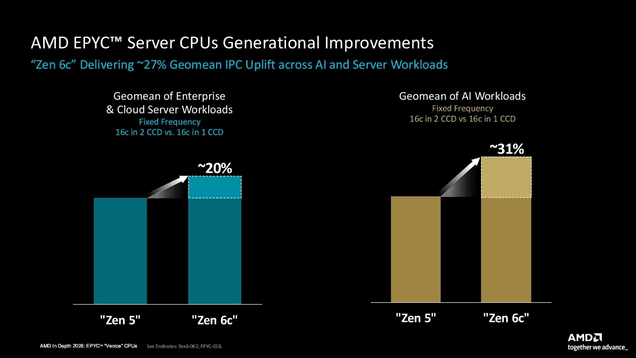
The headline IPC figure needs careful reading. AMD showed Zen 6c, the denser variant, delivering about 27 percent higher geometric-mean IPC than Zen 5 across AI and server workloads. The company itself cautioned that this number does not describe gaming performance or standard Zen 6 cores, so it should not be read as a Ryzen forecast.
What AMD Hasn’t Said About Desktop Ryzen
Almost everything a buyer would want to know is still missing. AMD has not given clock speeds, TDP, final core configurations or a launch window for desktop chips, so the timing of any Zen 6 Ryzen release is open.
Hashlytics Take
The 24-core headline is the least interesting part of this. Plenty of people have little use for 24 cores, but almost every gamer has felt the awkward trade-off in the current lineup: the best gaming chips have eight cores with 3D V-Cache, while the 12-core parts split their cores across two dies and rely on scheduling tricks to keep games on the right one. A single 12-core chiplet with stacked cache would collapse that choice into one chip. If AMD ships it at a sensible price and power draw, that is the Zen 6 story worth watching, and the 27 percent server IPC figure says little about whether it happens.
Follow Hashlytics on Bluesky, Facebook, LinkedIn , Telegram and X to Get Instant Updates