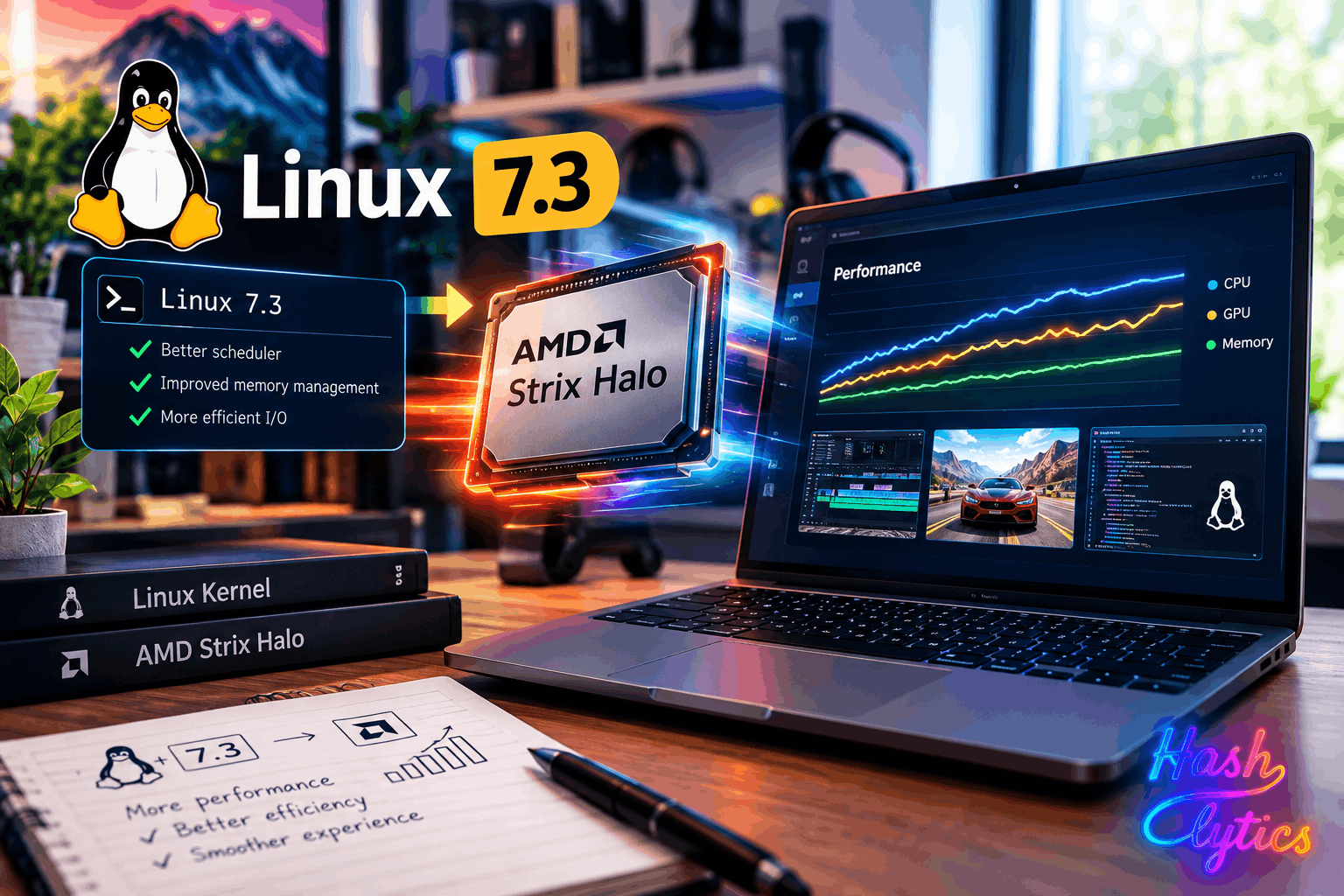
Initial benchmarks already showed strong performance for Strix Halo on Ubuntu 26.10 running the Linux 7.2 kernel, offering a noticeable uplift over Ubuntu 26.04 LTS on Linux 7.0. Canonical has since updated the default kernel for Ubuntu 26.10 to Linux 7.3, meaning this newer kernel will ship with the October release. That change prompted fresh performance comparisons for Strix Halo hardware.
What Actually Improved
Testing the AMD Ryzen AI Max+ 395 “Strix Halo” on a Framework Desktop showed specific, if modest, gains. Graphics benchmarks for the Radeon 8060S remained largely consistent between Linux 7.2 and 7.3, though some minor improvements appeared in specific applications like the DDNet platformer. Network latency also came in slightly lower on 7.3.
The standout result was NUMA performance, measured through Stress-NG, which saw a much more significant jump with Linux 7.3. That tracks with broader NUMA enhancements already seen in AMD EPYC server performance from recent kernel updates. A handful of other kernel micro-benchmarks on Strix Halo improved as well, though many real-world workloads showed little to no difference between the two kernel versions on this desktop configuration.
Beyond Strix Halo
Linux 7.3 brings plenty beyond the Strix Halo-specific gains. Development continues on AMD BC-250 and PSP enablement, while AMD has sent patches for SEV-TIO TDISP support alongside PCIe 6.0. Separately, Google is retiring its Binder C driver, which the company has called painful to maintain
, in favor of a Rust-based alternative.
What’s Coming in 7.4
AMD’s Linux development pipeline stays active well past this release. A few things already in motion:
- Patches enabling AMD’s GAIA Local AI for transcription and summarization
- An updated AMD P-State Driver tuned for Zen 6 Client CPUs
- Fixes addressing under-reported TLB sizes on Zen 5
- Preparation for Enhanced SMT Protection on EPYC virtual machines
Some early testing suggests Linux 7.4 could bring more than just AMD-specific gains. Simple file-reading optimizations could open files up to 39% faster, and kernel builds themselves may get 36% faster overall, with incremental builds seeing as much as a 70% speed increase.
Follow Hashlytics on Bluesky, Facebook, LinkedIn , Telegram and X to Get Instant Updates