best reasoning and coding model yet,and the pace of these releases signals a clear shift toward rapid, iterative updates for the Flash series rather than waiting on a single major launch.
Two Models, One Release
Gemini 3.8 arrives in two versions. The standard Gemini 3.8 Flash is built as a workhorse model for general tasks, covering software development, agentic workflows, and multi-step reasoning at the same speed and pricing as its predecessor. A specialized variant, Gemini 3.8 Flash Cyber, is aimed squarely at vulnerability detection and automated patching.
Google says 3.8 Flash builds on the momentum of 3.7 Flash, which launched just three weeks earlier, by leveraging longer running agentic loops.
Pricing Holds Steady, For Now
API access mirrors the structure Google used for 3.7 Flash. Developers get an introductory rate of $0.75 per million input tokens and $3.75 per million output tokens through the end of the year. After that, pricing doubles to $1.50 and $7.50.
Holding the line on introductory pricing while other AI labs cut their own token costs suggests Google is treating price as a retention lever rather than a place to compete on margin right now.
Where the Coding Gains Actually Show Up
Google’s benchmark numbers show 3.8 Flash competing with, and in some cases beating, larger and more expensive models. Most improvements over 3.7 Flash are marginal, but coding is the exception. The model now leads the DeepSWE leaderboard, which measures a model’s ability to solve complex software engineering problems, and it does so at the discounted introductory rate.
Computer use is a weaker spot. While 3.8 Flash improves on its predecessor in the OSWorld-2.0 test for agentic computer use, it still trails Claude Opus. GPT models struggle with this same test, so the gap isn’t unique to Google.
Flash Cyber Targets Vulnerabilities Directly
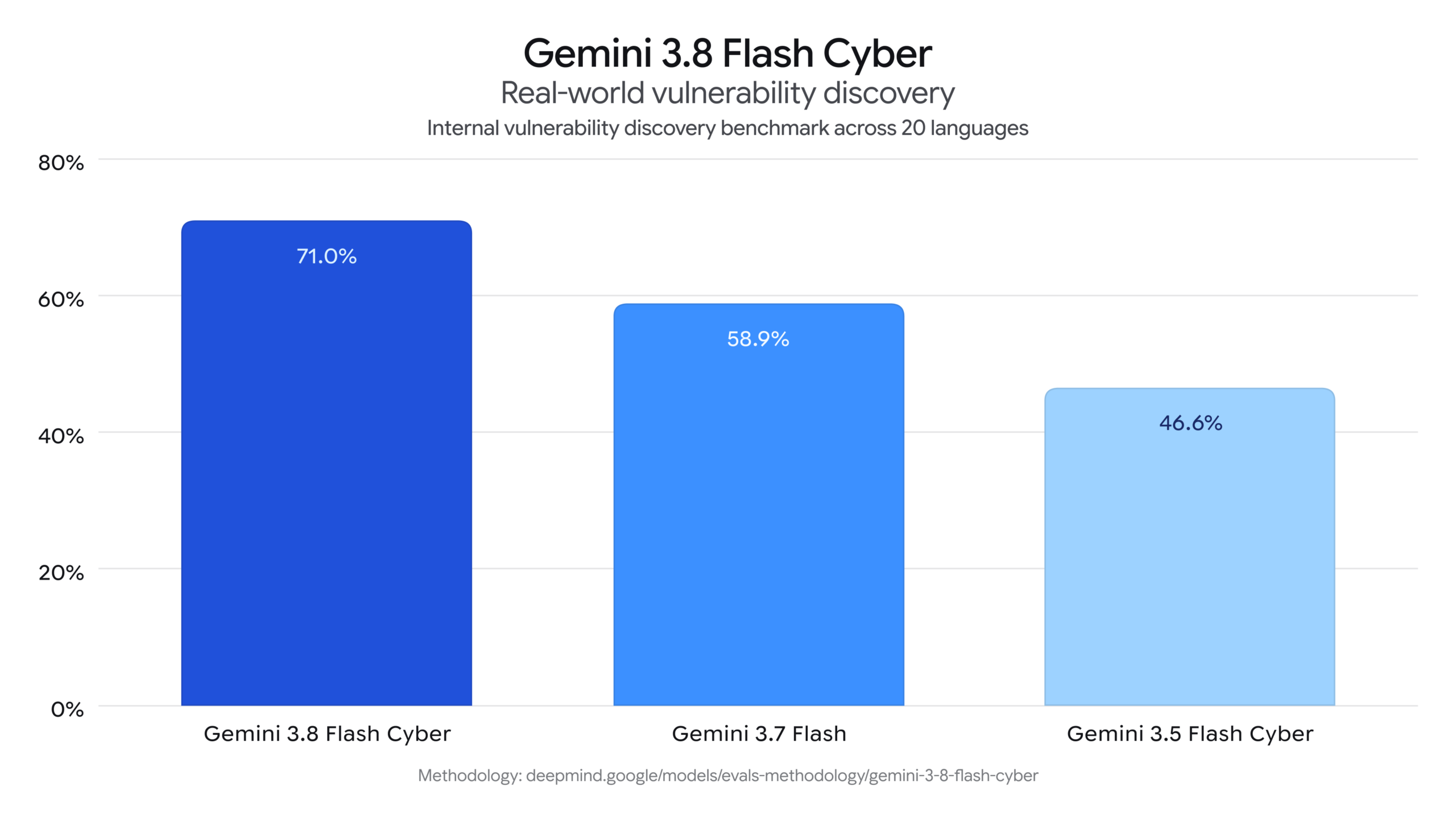
Flash Cyber replaces the 3.5 version and is built specifically for cybersecurity work. Google reports the model scored 86.2% on the CyberGym industry benchmark and 47.2% on CWE-Bench for patching accuracy. In internal testing across 20 programming languages, the model found vulnerabilities at a success rate above 70%.
The real-world numbers are what stand out most. Google’s Chrome security team saw a 2.6x increase in correct patch generation compared to larger models when testing against actual Chrome security bugs. The Cloud team reported that Flash Cyber identified a critical vulnerability in just two hours. Security partners including Wiz and Palo Alto Networks have also vouched for its capabilities.
Who Gets Access and When
- Developers: Google Antigravity, Google AI Studio, and Android Studio, with free access to tinker via AI Studio
- Enterprises: Gemini Enterprise
- Consumers: Pro and Ultra subscribers via the Gemini app, AI Mode in Search, and Gemini in Google Sheets
- Government and security partners: Flash Cyber access through Google’s Fairwind Program
Standard Gemini 3.8 Flash is live across the Google ecosystem starting today. Flash Cyber remains restricted to trusted testers, government agencies, and cybersecurity partners applying through Fairwind.
Hashlytics Take
Three model releases in six weeks isn’t a cadence, it’s a signal. Google shipped 3.6, 3.7, and now 3.8 Flash back to back while Gemini 3.5 Pro, the model that was supposed to anchor this generation, has quietly gone unmentioned since reports surfaced about its coding performance falling short internally. Iterating fast on Flash is smart competitively, but it also looks like Google found a model it could ship reliably and is leaning on it while the bigger release stays stuck. Worth watching whether 3.5 Pro ever actually lands, or whether Flash quietly becomes the flagship by default.
Follow Hashlytics on Bluesky, Facebook, LinkedIn , Telegram and X to Get Instant Updates