What Changed From 1.2
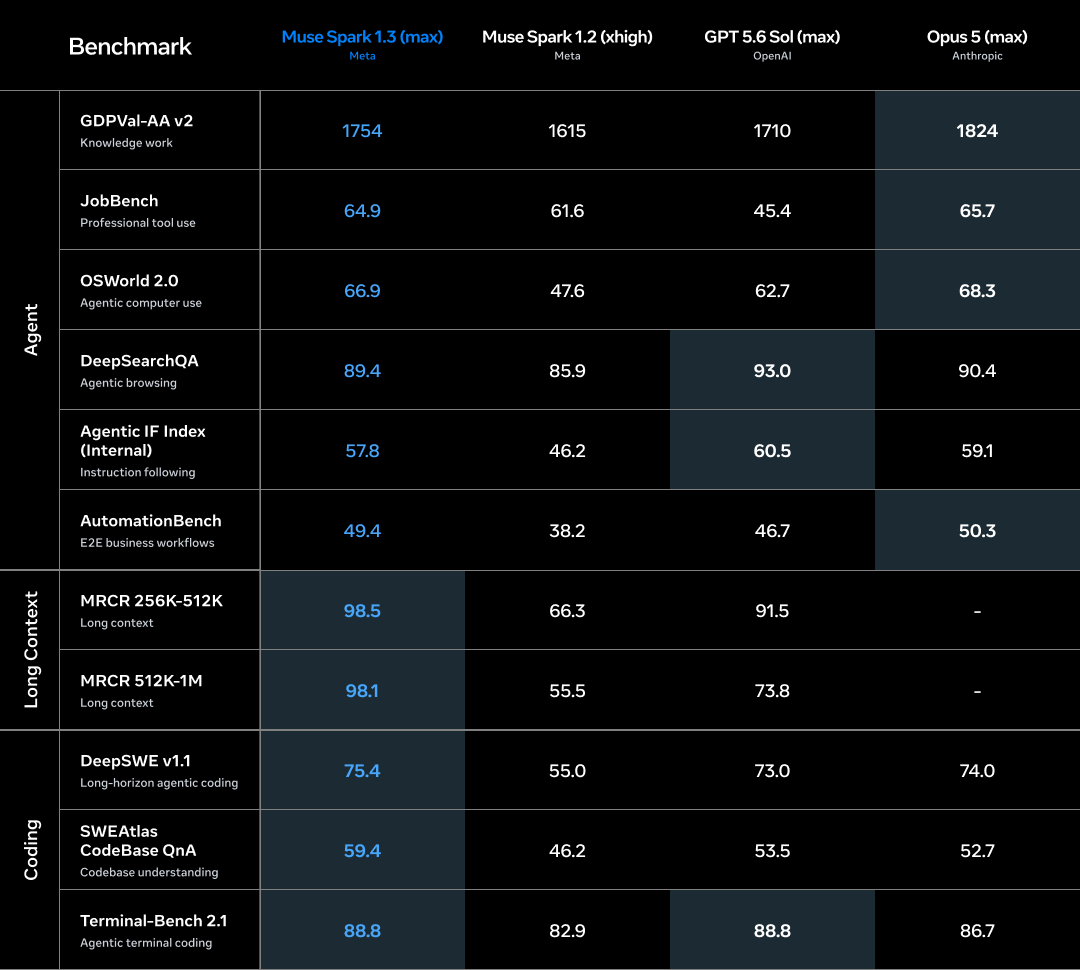
Meta says the model sustains longer-horizon work across multiple workflows in a single thread, asks clarifying questions before consequential actions, and is better calibrated about its own limits instead of hallucinating outcomes. On Meta’s internal comparisons against Muse Spark 1.2, released just four weeks earlier, the company reports roughly 20% fewer tool calls and 25% fewer tokens to complete the same coding work. Independent benchmarking from Artificial Analysis put Muse Spark 1.3 at 75.4% on DeepSWE 1.1 and 88.8% on Terminal-Bench 2.1, both gains over 1.2’s 54.9% and 82.9% respectively. Those efficiency figures come from Meta’s own internal testing rather than a third party, worth flagging given how central they are to the pricing pitch.
Pricing Against the Field
Meta kept API pricing unchanged from Muse Spark 1.2, at $1.25 per million input tokens and $4.25 per million output tokens. On Artificial Analysis’s Intelligence Index, Muse Spark 1.3’s high-end variant scores competitively with models priced well above it:
- Muse Spark 1.3 (max): score of 62, pricing not yet public for the limited-preview tier
- Gemini 3.8 Flash (high): score of 59, roughly $0.58 blended per million tokens
- GPT-5.6 Sol (max): score of 61, roughly $0.95 blended per million tokens
- Claude Opus 5 (high): score of 61, roughly $1.23 blended per million tokens
Meta’s chief AI officer Alex Wang described the pricing strategy as deliberately aggressive, and noted strong developer uptake of a “contributor tier” that lowers coding-product costs further for developers who let Meta use their work to improve future models.
The Open-Weights Promise Is Still a Promise
Zuckerberg’s post also teased bigger Muse models and an open-weights release of Muse Spark “coming soon,” language nearly identical to what Meta said when Spark 1.1 shipped in July. Muse Spark 1.3 itself remains proprietary, available only through Meta’s paid API and Muse Code, the same structure as every release in the line so far. Meta is now shipping frontier updates on a four-week cadence while the actual open-weights release keeps sliding to the next announcement, which makes it worth watching whether “coming soon” turns into a shipped model or stays a recurring line in launch posts.
Follow us on Bluesky, LinkedIn, X, and Telegram to Get Instant Updates