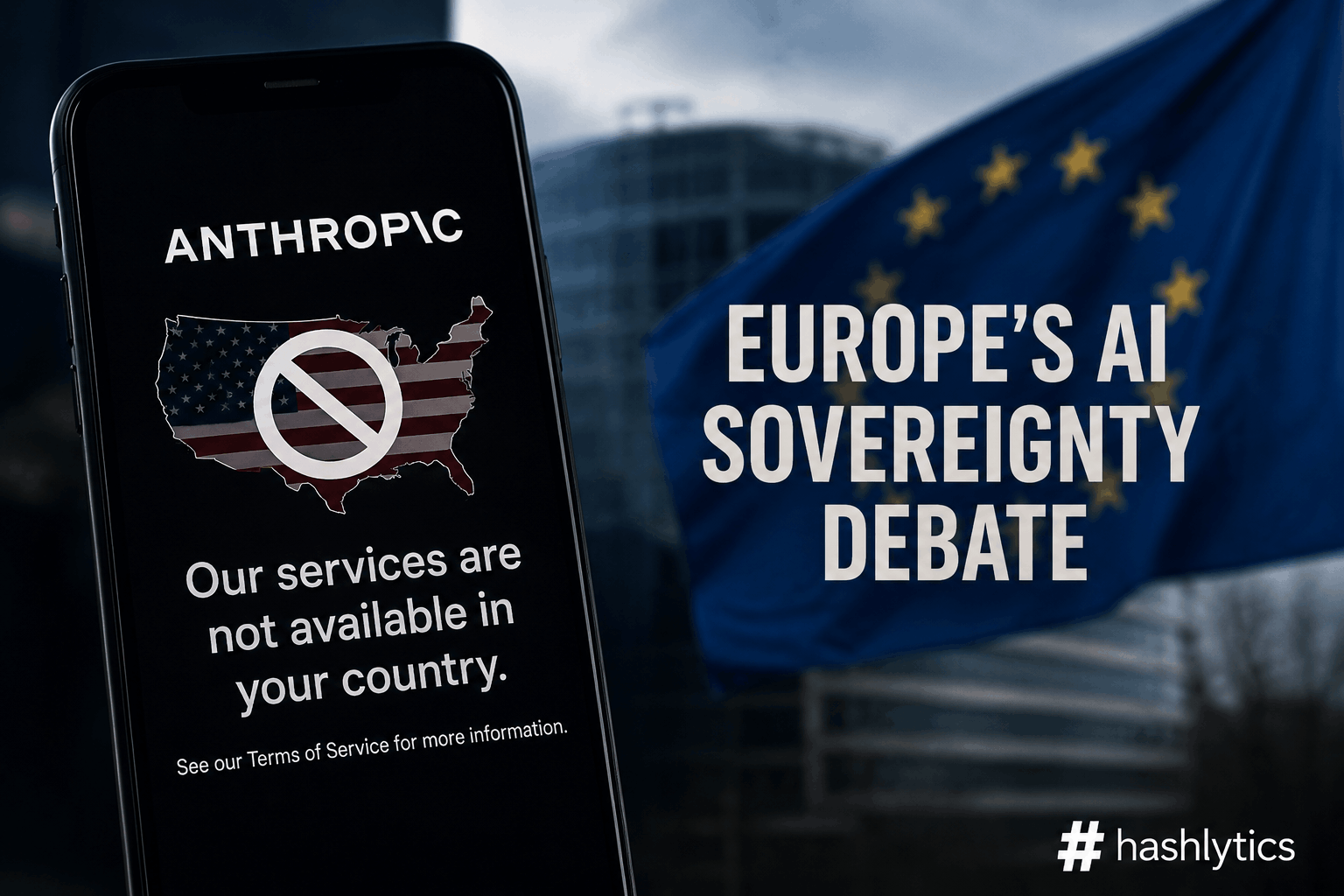
What Happened
Days after the US government imposed an export control order, Anthropic was compelled to shut down access to Fable 5 and Mythos 5 worldwide for individuals outside the United States. Talks are reportedly ongoing to restore access, but the incident has already exposed how quickly a single government decision can cut off an entire continent from critical AI infrastructure.
Anthropic CEO Dario Amodei is expected to discuss the developments with G7 leaders at a working dinner this Wednesday, a sign of how high up the diplomatic ladder this issue has climbed.
Europe’s Response
Thomas Regnier, the European Commission’s spokesperson for technological sovereignty, emphasized to Euronews that emergency measures should not be discriminatory against partners
and pointed to the need for Europe to strengthen its technological independence. The Commission’s concern is not just about this specific restriction. It is about what it reveals: that Europe’s access to frontier AI is not guaranteed.
Experts Divided on the Way Forward
European researchers are largely in agreement that this was a wake-up call. Where they disagree is on what to do about it.
Thorsten Holz of the Max Planck Institute for Security and Privacy called out the striking vulnerability of having critical technology controlled by a single foreign government, arguing that digital sovereignty means ensuring access to essential technology even in times of geopolitical tension. Konrad Rieck of TU Berlin put it plainly, warning that US models can be shut off at any time, sometimes for opaque reasons.
Gitta Kutyniok of LMU Munich went further, calling for an Airbus moment
for AI and advocating for significant joint European investment in foundational models, chip design, and energy-efficient computing.
Not everyone agrees that building from scratch is the answer. Paul Röttger of the Oxford Internet Institute argued that Europe cannot realistically compete with the US in developing models at the level of Mythos 5 or Fable 5. His alternative: secure access through contractual agreements tied to data center investments and backed by credible trade policy.
Matthias Hein of the University of Tübingen stressed the need for multiple European AI providers rather than a single champion, while Jonas Geiping of the ELLIS Institute Tübingen flagged Europe’s structural gaps, including a shortage of large-scale data centers and sufficient power generation capacity, as obstacles that cannot be ignored regardless of which path is chosen.
The Economic Stakes
The debate is not only about geopolitics. It is fundamentally about economic risk. Geiping cautioned against drawing direct parallels to nuclear weapons, noting that AI is deeply woven into everyday economic processes. A sudden restriction on advanced AI during a diplomatic conflict could damage European industry well beyond the defense sector.
The incident has forced Europe into a conversation it can no longer put off: whether to build its own frontier AI capabilities, negotiate guaranteed access through binding international agreements, or find some combination of both before the next restriction arrives without warning.
Follow Hashlytics on Bluesky, LinkedIn, Telegram and X to Get Instant Updates