+2.25%
+2.75%
+23.50%
+0.44%
+5.40%
+2.01%
Central Bank of Brazil Implements Blanket Ban
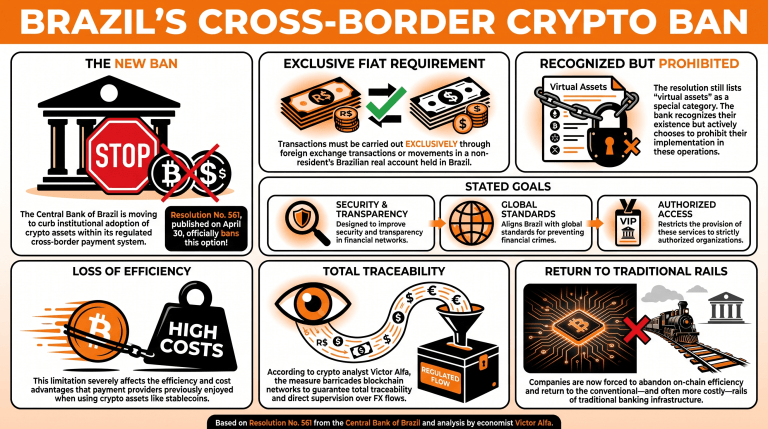
The published resolution mandates that all international payment and transfer services must rely exclusively on traditional banking rails. This policy specifically forbids the use of cryptocurrency, including bitcoin and stablecoins, within the regulated settlement framework.
According to the official document, transactions must be conducted through standard foreign exchange mechanisms or via non-resident accounts in Brazilian real. The bank has explicitly prohibited the use of virtual assets for these specific operations, even as it acknowledges their existence as a distinct category of financial data.
Regulatory Intent and Compliance Standards
The Central Bank clarified that the primary motivation behind this decision is the enhancement of national financial security. Officials aim to increase transparency and align Brazil with international standards regarding the prevention of financial crimes.
This decision follows an extensive public consultation process conducted throughout 2025. The new rules, which take effect on October 1, limit the provision of cross-border financial services strictly to organizations already authorized by the Central Bank.
Market Implications for Financial Providers
Industry observers suggest that this shift marks a significant move away from the adoption of blockchain-based settlement layers. By forcing institutions to return to legacy systems, the regulator is prioritizing oversight and traceability over the potential cost efficiencies offered by digital assets.
Economist Victor Alfa argues that this regulation effectively prevents blockchain networks from becoming parallel value transfer channels in Brazil. According to Alfa, the move forces companies to abandon on-chain efficiency in favor of the conventional and often more expensive infrastructure of traditional banking.
Future Outlook for Brazilian Fintech
As the October 1 deadline approaches, financial institutions operating in Brazil must audit their current settlement processes to ensure full compliance with the new mandate. The shift represents a major hurdle for firms that have previously invested in stablecoins to streamline their cross-border operations.
Market participants will now watch to see how this crypto ban influences the competitive landscape for international remittances. The move underscores a cautious approach by the Central Bank of Brazil toward the institutionalization of crypto assets within the country’s core financial infrastructure.
Follow Hashlytics on Bluesky, LinkedIn , Telegram and X to Get Instant Updates