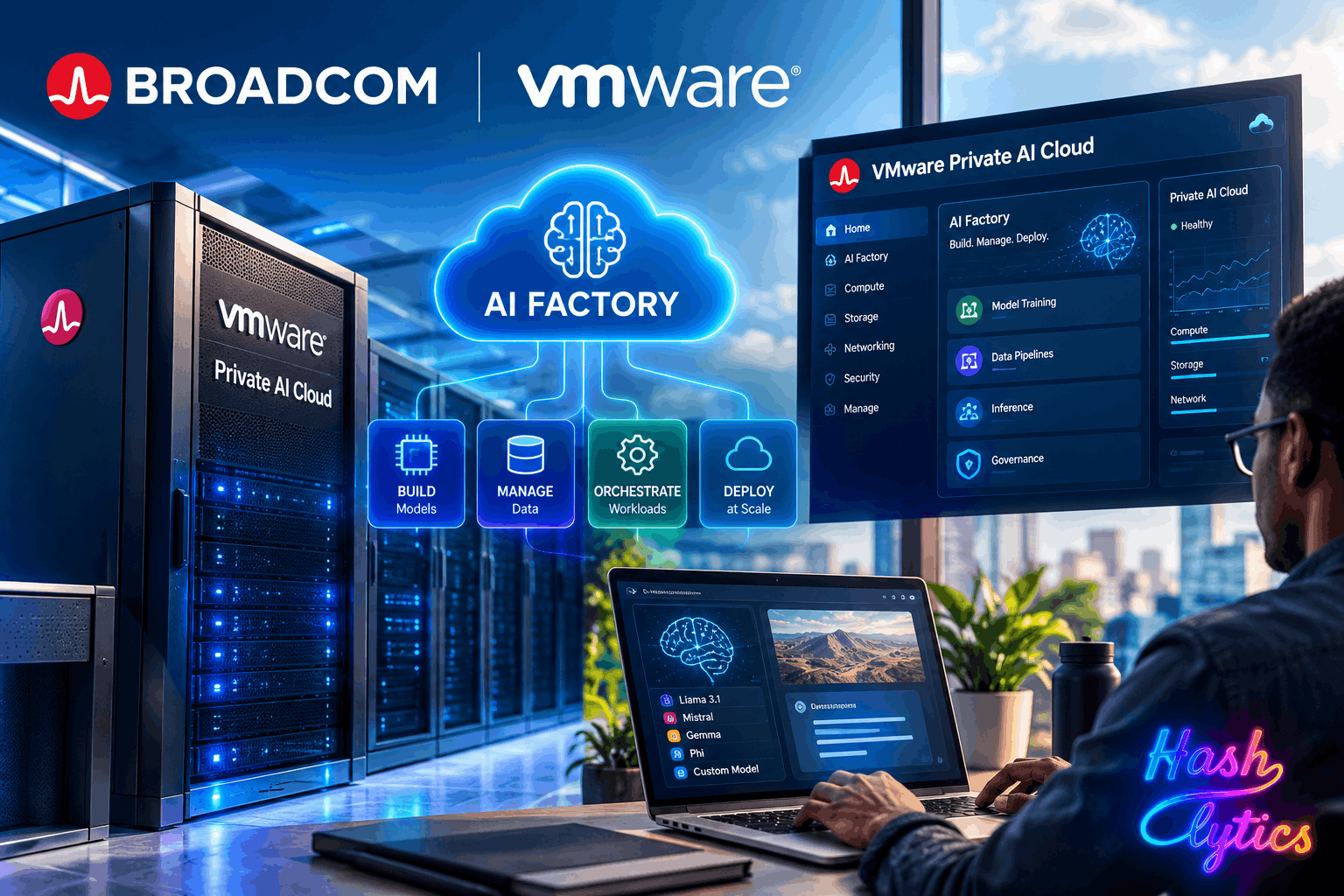
VMware AI Factory serves as the foundation for building, running, and governing AI inference workloads. It handles agentic applications alongside traditional enterprise tasks on a single private cloud platform, and supports diverse hardware, models, and accelerators so organizations can scale AI operations without locking into a single vendor stack.
Where the Cost Savings Come From
VMware Private AI Cloud targets the three cost drivers that tend to blow up enterprise AI budgets: hardware capital expenditures, operational complexity, and token economics. VMware Cloud Foundation (VCF) 9 lowers hardware costs specifically through NVMe memory tiering and cluster-wide storage deduplication.
VCF supports GPUs, CPUs, and accelerators from major vendors, along with server hardware from leading OEMs and ODMs. That flexibility lets enterprises build cost-effective heterogeneous clusters instead of overpaying for a single-vendor setup. The platform also includes:
- Token monitoring and multi-tenant model sharing
- Enhanced GPU and vGPU tracking
- An AI metrics observability dashboard for optimizing tokenomics
Security Built for AI-Specific Threats
The platform follows a defense-in-depth strategy aligned with NIST CSF 2.0, designed to protect against AI-accelerated threats while minimizing attack surfaces and maintaining continuous compliance.
VMware vDefend handles this through virtual patching and hypervisor-level microsegmentation, enforcing Zero Trust principles and blocking exploits before they spread. TrueSource by Broadcom adds another layer, offering verifiably built open-source components for secure Spring releases and other ecosystems enterprises depend on.
Keeping AI Agents on a Leash
Autonomous AI agents come with a real risk: they can act beyond their intended scope or misinterpret instructions in ways that create liability. Broadcom’s answer is AgentMinder, a central control plane that binds an agent’s authority to specific missions, tools, and resources rather than letting it operate with open-ended permissions.
AgentMinder enforces runtime policies and ensures least-privileged access, while also providing compliance-grade auditability for organizations that need to prove what their agents did and why. VMware Tanzu Platform backs this up with a deny-by-default architecture and a curated marketplace, giving enterprises a foundation for trustworthy agent deployment rather than bolting security on after the fact.
Ram Velaga, president of Broadcom’s Infrastructure Software Group, says the integration enables production inference workloads and agentic AI while delivering the data sovereignty, compliance, and cost predictability businesses actually require. Ray Sharma, an industry analyst at The Fast Mode, points to this as part of Broadcom’s continued momentum in the space.
Hashlytics Take
This is Broadcom betting that enterprises don’t want their AI workloads living entirely inside someone else’s cloud. Every piece of this release, cost controls, agent governance, security hardening, is aimed at companies that want AI capability without surrendering the sovereignty and predictability that public cloud AI services can’t fully guarantee. The AgentMinder piece specifically is worth watching. As more enterprises actually deploy autonomous agents rather than just experimenting with them, the demand for a control plane that can prove what an agent did will only grow, and right now few competitors have anything comparable.
Follow Hashlytics on Bluesky, Facebook, LinkedIn , Telegram and X to Get Instant Updates