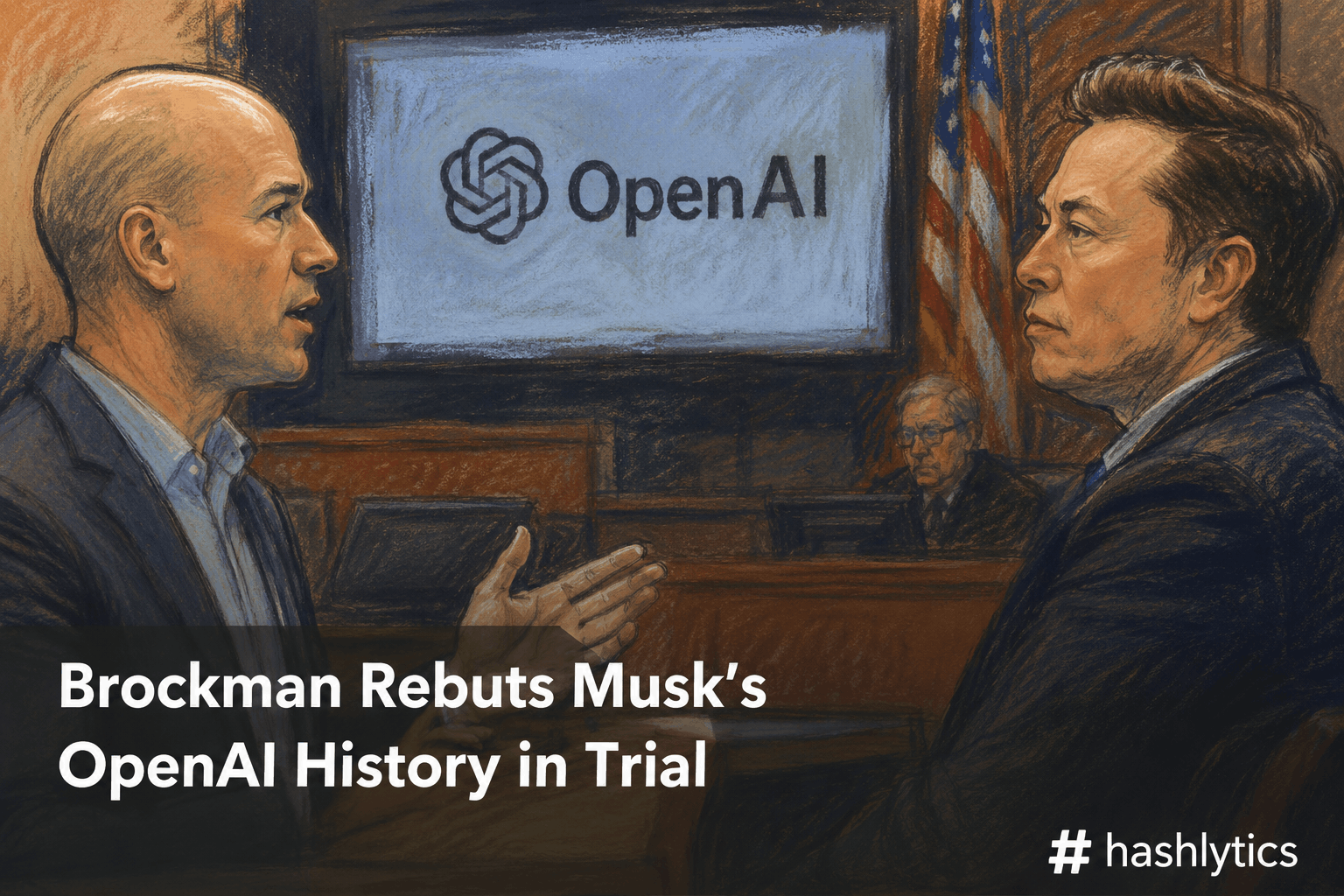
OpenAI President Greg Brockman concluded his testimony in the Musk v. Altman trial, directly challenging Elon Musk‘s account of the AI startup‘s early days and its core mission. The trial, now in its second week, centers on Musk’s claims that OpenAI violated its non-profit obligation.
Disputed Origins of OpenAI’s Mission
Brockman firmly disputed Musk’s allegations that he and Sam Altman sought to “steal a charity.” He testified he never made commitments to Musk regarding OpenAI’s corporate structure, nor did he hear others do so. Brockman affirmed that the OpenAI foundation remains a non-profit, calling it “the best-resourced nonprofit in the world.”
Further, Brockman revealed Musk allegedly enlisted several OpenAI employees for months of free work on self-driving technology at Tesla in 2017. This effort aimed to overhaul Tesla’s Autopilot team’s approach. Brockman also noted Musk was a “polarizing figure” for potential recruits and never formally required open-sourcing OpenAI’s technology, contrary to Musk’s claims.
Contentious Negotiations and Financial Stakes
Testimony included heated discussions from 2017 about a for-profit subsidiary where Musk sought an equity stake. Brockman described Musk’s demeanor shifting to anger during these negotiations. He recounted Musk allegedly tearing a painting off a wall and demanding to know when co-founders would leave, causing Brockman to fear physical confrontation.
Brockman claimed Musk desired control of OpenAI partly to finance a “city on Mars,” an $80 billion project. Regarding his own finances, Musk’s lawyer questioned Brockman about his estimated $30 billion equity stake in OpenAI’s for-profit arm and his failure to donate $100,000 to the non-profit. Brockman admitted not making the donation, stating OpenAI’s mission was his primary motivation, with fair compensation being secondary.
Broader Implications for AI Development
This ongoing trial highlights critical tensions within the artificial intelligence industry, particularly the balance between non-profit research and commercialization. The dispute over OpenAI’s founding intent could influence future AI venture structures. It underscores the challenges of merging philanthropic goals with lucrative technological advancements, a key debate as AI rapidly evolves.
The trial resumes Wednesday at 8:30 a.m. PT. Shivon Zilis, a former OpenAI board member and mother of four of Musk’s children, is scheduled to testify next. Her insights could further illuminate the early dynamics and negotiations within OpenAI.
Follow Hashlytics on Bluesky, LinkedIn , Telegram and X to Get Instant Updates