+6.37%
+4.88%
+5.89%
+3.84%
+5.27%
+3.34%
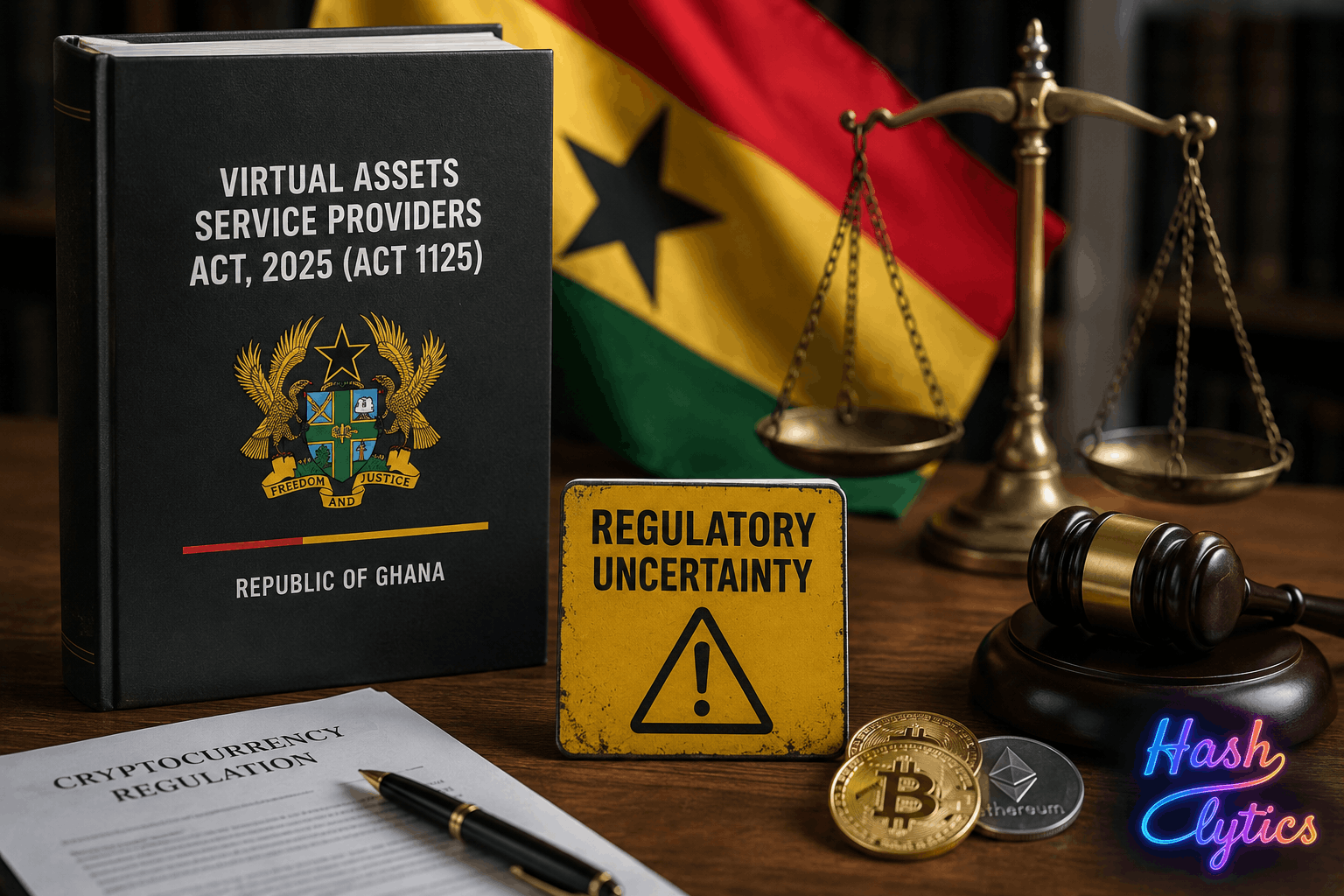
The Regulatory Dichotomy Problem
Dr. Richmond Atuahene, a financial and banking expert, points to a regulatory dichotomy
within the VASP Act that could undermine its effectiveness if agency boundaries are not clearly defined and operationalized. The primary regulators involved are the Bank of Ghana (BoG), the Securities and Exchange Commission (SEC), and the Financial Intelligence Centre (FIC).
The core risk lies in how digital tokens are classified. One regulator might view a digital token as a security, while another could classify it as a payment instrument or digital commodity. Such differing interpretations leave businesses uncertain about which regulator governs their products and what licensing standards they must meet to operate legally in Ghana.
The US Precedent: A Warning Sign
This issue mirrors structural problems encountered in the United States, where the SEC and the Commodity Futures Trading Commission (CFTC) have long debated asset classification. That dispute led to years of legal uncertainty, regulatory conflicts, and a chilling effect on crypto investment within the sector.
Dr. Atuahene cautions that Ghana risks importing similar complications unless responsibilities are clearly assigned from the outset. The lesson is clear: regulatory ambiguity is expensive for businesses trying to plan and invest.
Ghana’s Growing Crypto Market
The stakes for regulatory clarity are particularly high given Ghana’s expanding digital asset market. The country recorded over $10 billion in cryptocurrency transactions by November 2025, a notable increase from approximately $6 billion the previous year. An estimated three million Ghanaians are active participants in the crypto ecosystem.
Early implementation has already highlighted coordination challenges. In February 2026, the BoG and SEC issued a joint directive ordering all virtual asset service providers to halt public advertising, including those already in the BoG’s regulatory sandbox. The directive referenced the VASP Act but acknowledged that detailed advertising rules had not yet been published.
A Solution Exists But Isn’t Being Implemented
Ghana’s own regulators have previously proposed a solution that aligns with what Dr. Atuahene advocates. The BoG’s policy document on virtual assets suggests specific divisions of oversight: the BoG would oversee payments, custody, and activities affecting monetary policy. The SEC would oversee the offering, trading, and investment of virtual assets. The FIC would focus on anti-money laundering and counter-terrorism financing compliance, coordinating with the BoG and SEC.
While this division would address structural concerns if fully implemented, Dr. Atuahene warns that policy documents and operational practice do not always align. As of early 2026, full licensing under Act 1154 was not yet operational, with existing providers operating under transitional arrangements.
This period between law passage and full licensing implementation is when regulatory ambiguity imposes the highest costs on businesses. Companies seeking to plan and invest in Ghana’s digital economy face uncertainty about what rules will ultimately apply.
Follow Hashlytics on Bluesky, LinkedIn , Telegram and X to Get Instant Updates