Six Specialized AI Agents for Network Operations
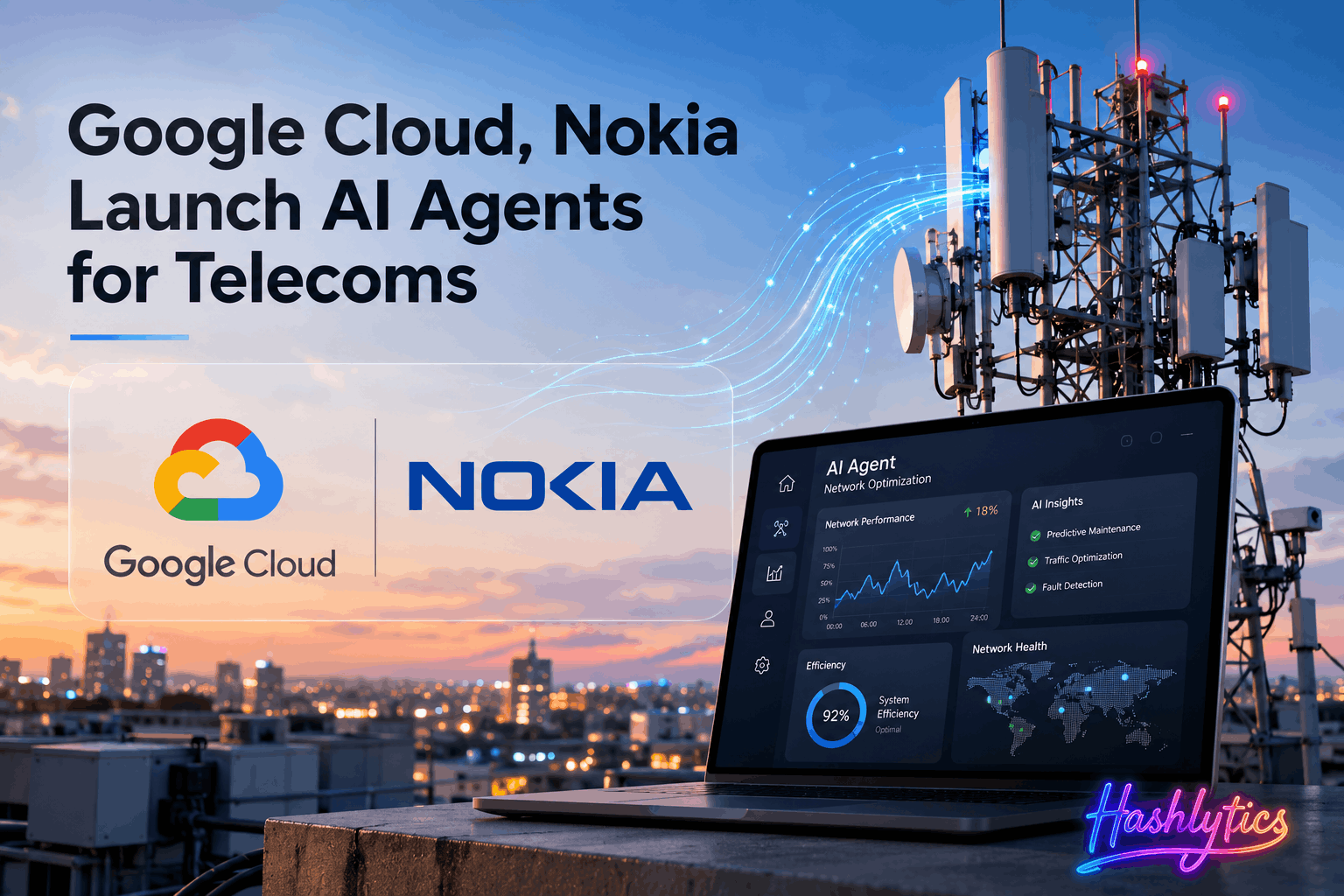
Nokia is launching six specialized AI agents designed to manage specific operational tasks within telecom networks. These agents can work independently or collaboratively to tackle complex network problems that traditionally required manual intervention and human oversight.
The development leverages Google Cloud‘s Agent Development Kit (ADK) on the Gemini Enterprise Agent Platform. This enables Nokia to create smart conversational and routing paths that use Gemini’s multimodal reasoning capabilities to understand and respond to network challenges in real time.
Cutting Problem-Solving Time by Half or More
The primary goal of this partnership is to eliminate manual troubleshooting bottlenecks that plague telecom operations. Google claims that this agent-based architecture could cut network problem-solving times by 50 to 80 percent, a massive efficiency gain that translates directly to lower operational costs and faster issue resolution for customers.
Vivek Jaiswal, senior vice president of autonomous networks at Nokia, emphasized the urgency of the shift. The AI era demands a new kind of network, one that is programmable, AI-native and able to operate at machine speed,
he said. Integrating Gemini-powered agents will help telecom providers move beyond manual operations and maximize performance while ensuring reliability across their networks.
Glass Box Autonomy Keeps Humans in Control
The multi-agent framework runs seamlessly on standard Google Cloud compute and storage, avoiding the need for complex managed services. Nokia is calling this approach glass box autonomy
, meaning actions stay transparent and auditable.
Here’s how it works in practice: an action reasoner agent provides confidence-based recommendations to human engineers. Engineers retain final approval over critical control points before any fixes are automatically executed and logged. This keeps humans in the loop for decisions that matter most, maintaining oversight while still gaining speed from automation.
Sridhar Gollapudi, global telco market lead at Google Cloud, highlighted what this shift means operationally. Agentic AI marks a fundamental shift in how telecommunications networks are managed, moving operators away from rigid templates to dynamic, goal-oriented automation.
The transition from passive monitoring to proactive, agent-based systems is expected to help operators save costs and improve network reliability.
Part of a Broader Industry Shift
This initiative aligns with a broader industry trend of companies experimenting with AI agents across sectors. Google Cloud, in particular, has committed to achieving the agentic telco
vision, where AI agents operate behind the scenes to enhance business efficiency throughout telecommunications operations.
Angelo Libertucci, Google Cloud’s global head of industry for telecom, spoke at MWC Barcelona earlier this year about the future of AI integration. He explained that 2026 marks a new era for such applications, with consumers increasingly expecting human-like, instantaneous, and tailored experiences delivered through proactive systems powered by AI.
From Manual Workflows to Self-Driving Networks
The partnership between Google Cloud and Nokia represents a concrete step toward fully autonomous networks. By applying Gemini’s multimodal reasoning capabilities to complex data streams, operators can move away from manual workflows and toward networks that operate more like self-driving systems. The payoff is lower operational costs, optimized resource allocation, and faster problem resolution on a global scale.
Follow Hashlytics on Bluesky, LinkedIn, Telegram and X to Get Instant Updates