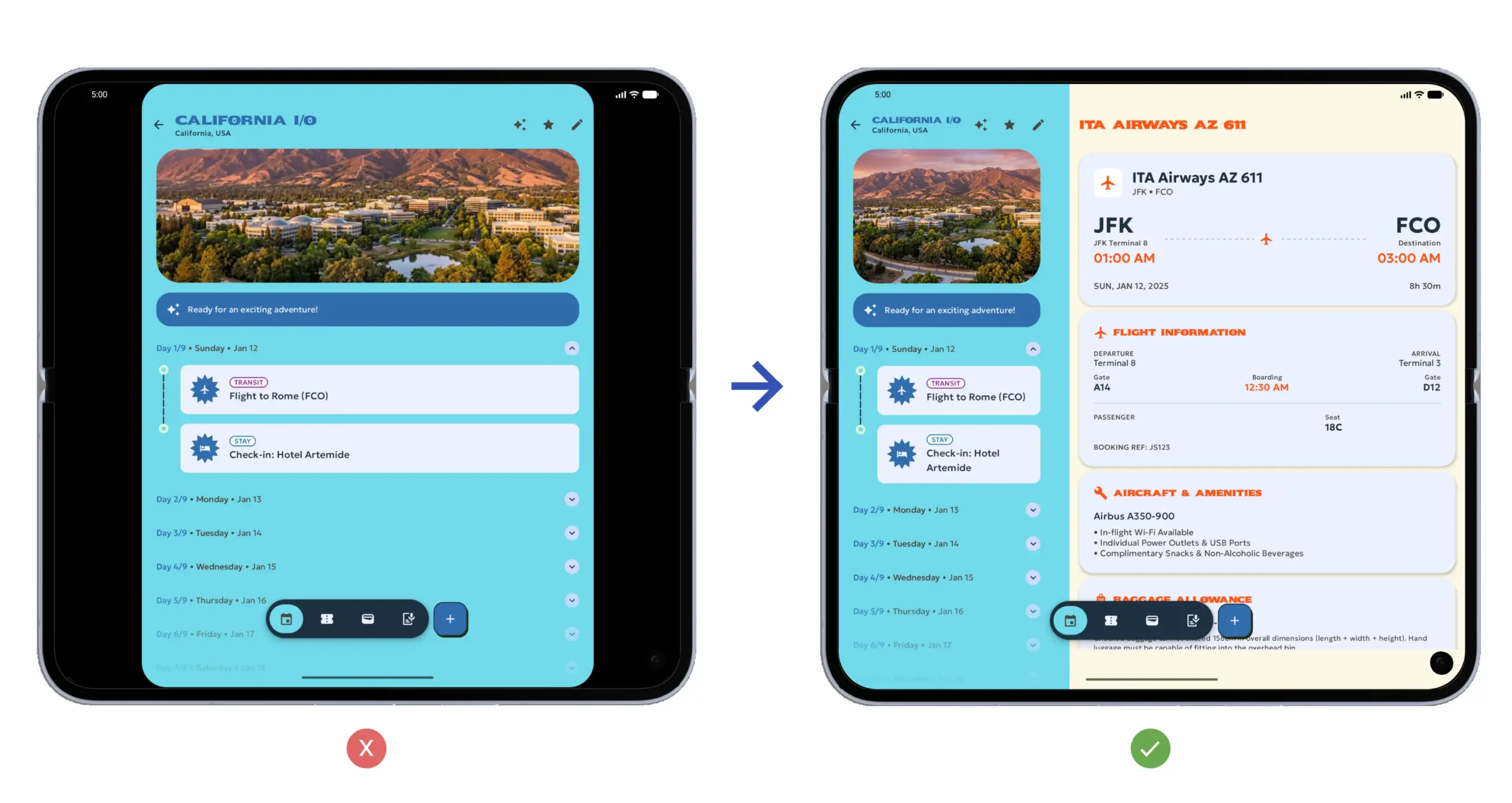
Google frames the move as a fix for user friction. Foldables and other new form factors are shifting from experiments to mainstream purchases, and apps that stretch awkwardly or sit in letterboxed compatibility modes make those devices feel unfinished. Developers on modern toolkits like Jetpack Compose can already scale layouts across screen sizes. Google Play is now adding firmer requirements on top.
Three Tiers, One Mandatory Floor
Tier 3 is the line every app has to clear. It requires apps to fill the available display and to keep state intact, including scroll position, media playback, and text input, while the device folds, unfolds, rotates, or resizes. The higher tiers are optional and reward apps that go further:
- Tier 3 (Adaptive Ready): No letterboxing, state preserved through layout changes, full multi-window support. Mandatory from April 2027.
- Tier 2 (Adaptive Optimized): Responsive multi-pane layouts, no stretched UI elements, and support for mice, trackpads, keyboards, and styluses.
- Tier 1 (Adaptive Differentiated): Tabletop and book postures, camera continuity, multi-instance support, and interactive picture-in-picture modes.
Apps that reach Tier 2 or Tier 1 can apply for enhanced merchandising and store badging, which gives developers a visibility incentive on top of the compliance stick.
Screenshots, Aspect Ratios, and the August Deadline
The store listing itself is changing too. Developers can already upload dedicated foldable screenshots to the Play Console, and doing so becomes mandatory for all new apps and store updates by April 2027. The required formats break down by device type:
| Device Category | Required Aspect Ratio | Example Hardware |
|---|---|---|
| Standard Phone | Portrait (9:16) and Landscape (16:9) | Samsung Galaxy S26, Google Pixel 11 Pro |
| Foldable Inner (1:1) | Unfolded inner screen (1:1) | Samsung Galaxy Z Fold8 Ultra, Google Pixel 11 Pro Fold |
| Foldable Inner (4:3) | Unfolded inner (4:3) and outer folded (10:16) | Samsung Galaxy Z Fold8 |
A second deadline follows four months later. By , Google Play will require new and updated apps to target API level 37 on Android 17. That change removes the legacy developer opt-outs for orientation and resizability restrictions on large screens, so developers should audit their codebases and update their deployment pipelines well before the window closes.
Hashlytics Take
April gets the attention, but August is the deadline that will hurt. Tier 3 is a quality bar an app can clear with layout work, while API 37 takes away the orientation and resizability opt-outs that let many apps stay locked to a phone-shaped window. Developers who treat April as the finish line will find that the August change breaks the shortcuts they were still relying on.
Follow Hashlytics on Bluesky, Facebook, LinkedIn , Telegram and X to Get Instant Updates