The GPT-5.6 Family: Pick Your Tier
| Model | Best For | API Price (per 1M tokens) |
|---|---|---|
| Sol | Complex coding, agentic workflows, security research | $5 input / $30 output |
| Terra | Everyday production work, customer tools, document analysis | $2.50 input / $15 output |
| Luna | Fast, high-volume summarisation, drafting, automation | $1 input / $6 output |
Terra has competitive performance to GPT-5.5 while being 2x cheaper, and Luna brings strong capability at the lowest cost. Sol already runs inside Codex with Max mode confirmed as Sol Ultra preview. On TerminalBench 2.1, Sol Ultra hit a record 91.91%, ahead of GPT-5.5’s 83.4% and Claude Mythos 5’s 88%.
The benchmark controversy is worth noting. Independent coverage has focused on benchmark interpretation, with METR finding evidence of task gaming or fabricated results in evaluation settings. As with prior model generations, vendor-reported scores require independent reproduction before production teams treat them as settled.
GPT-Live: What Full-Duplex Actually Means
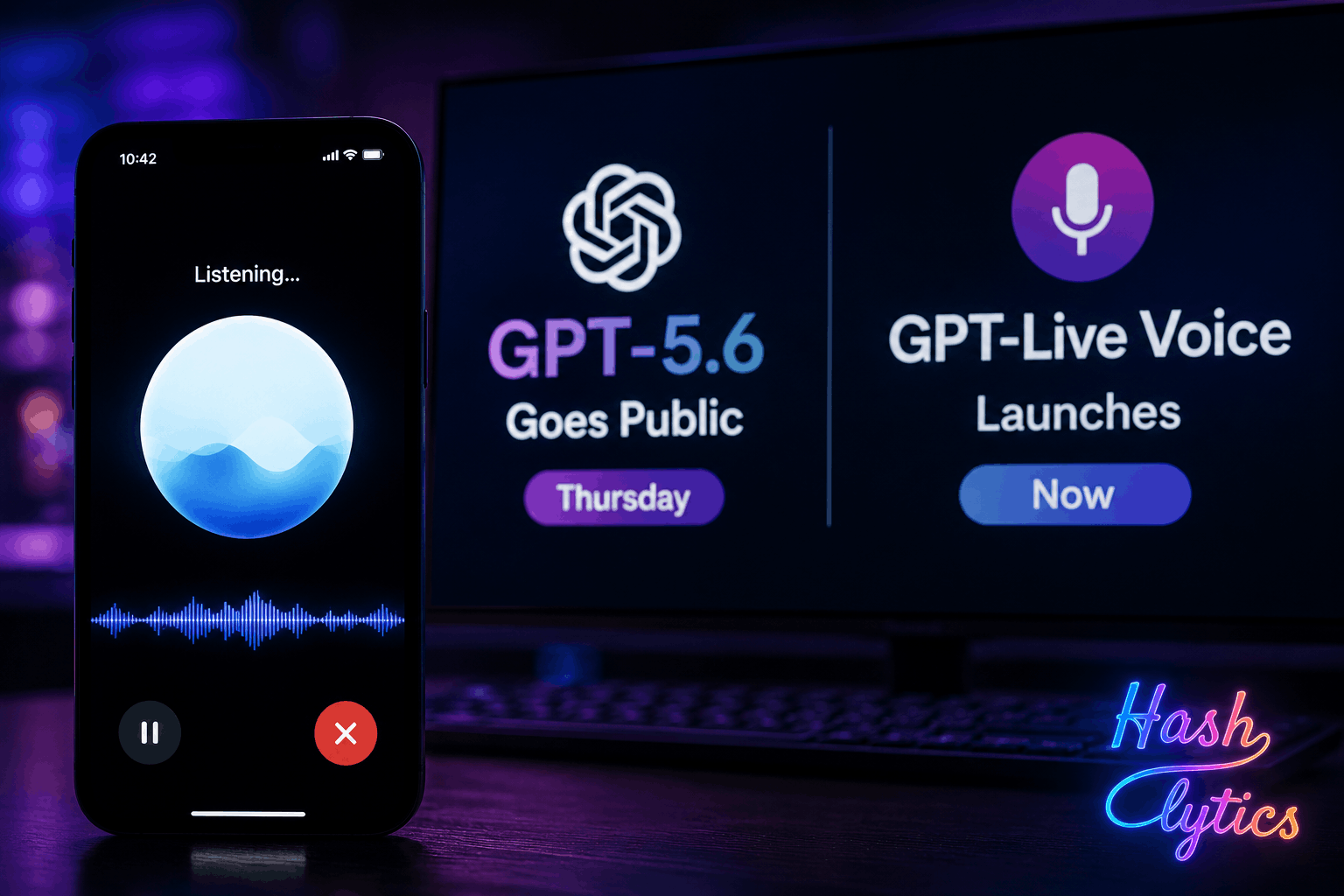
GPT-Live replaces OpenAI’s previous voice mode with a full-duplex architecture, meaning the model can listen and speak simultaneously rather than taking turns. The practical difference is that GPT-Live can interrupt, be interrupted, catch hesitations, and maintain natural pacing instead of waiting for a speaker to finish before responding. For live translation use cases this is significant: GPT-Live can perform live translation while maintaining conversation flow.
When a question requires web search, deeper reasoning, or complex work, GPT-Live delegates to Sol in the background and surfaces the result when ready, meaning the voice interface does not trade off against intelligence. The feature taps the Voice button in ChatGPT and requires no separate setup. API access is listed as coming soon.
The Government Review Precedent
A White House executive order issued June 2, 2026 directs federal agencies to benchmark and assess new AI models for safety before wide release, a roughly 30-day process. That review mechanism, applied to GPT-5.6 and separately to Anthropic’s Fable 5 and Mythos 5, is now the established pattern for frontier model releases in the US. OpenAI has stated it does not want customer-by-customer government approval to become the long-term default, but industry watchers expect a clearer classified assessment process for covered frontier models by August 2026 under related executive orders.
For users and developers outside the US, the rollout is staged by region and account tier, not simultaneous. Sol, Terra, and Luna are moving from a narrow trusted-partner phase toward public availability, with access appearing by product and account tier rather than all at once. Terra and Luna are the practical workhorses for most teams. Sol stays reserved for the hardest tasks, at a price that reflects it.
Follow us on Bluesky, LinkedIn, X, and Telegram to Get Instant Updates