+0.26%
+0.20%
-2.74%
-0.64%
+0.55%
-0.84%
Why A7 Nigeria Specifically
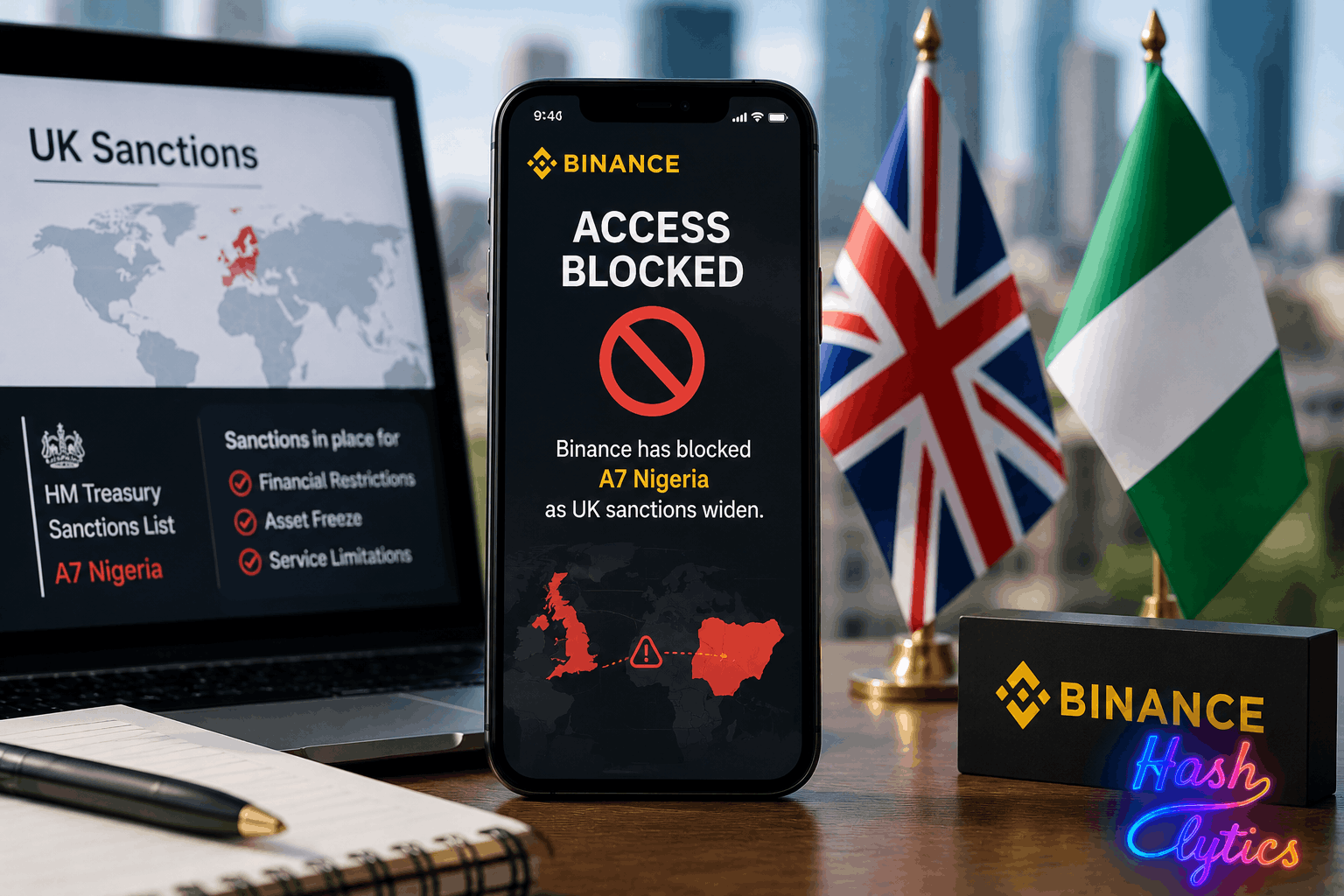
The UK’s Foreign, Commonwealth and Development Office designated 18 entities on May 26, 2026 in a package explicitly framed as targeting “the A7 network.” A7 Nigeria and A7 Africa are regional arms of that same network, alongside HTX, Rapira, BitPapa, and Aifory, all now blocked.
Blockchain analytics firm TRM Labs found flows from Huobi to successor platforms grew tenfold after an earlier enforcement action, from roughly $111 million to $1.13 billion, with the A7 network alone absorbing around $838 million of that. That is the actual reason A7’s African branches are on this list: not because Nigerian users did anything wrong, but because the network they connect to has been flagged as a sanctions-evasion route tied to Russia.
Hashlytics Take
Binance’s letter reads like routine compliance housekeeping. It is not. This is 16 platforms losing Binance connectivity in three weeks, including two exchanges most Nigerians have genuinely used for P2P trading with no idea their onramp sat inside a network under UK and EU sanctions review. Binance’s statement that it will not disclose “which regulator or sanctions regime triggered the restrictions” is doing real work here, it lets Binance look proactively compliant while leaving ordinary users to discover, days later, that their wallet history now touches a blacklisted network. The dusting-attack warning buried near the bottom of the notice is not boilerplate either. If your address received even a small, unsolicited transfer from any of these platforms in the past, association alone can trigger a compliance hold on your account, guilt by connection, not by intent.
The Nigerian angle deserves more scrutiny than it is getting. A7 Africa was not a fringe operator, it built real distribution across West African P2P markets precisely because Nigeria’s own VASP registration regime only now requires exchanges to formally register and link every account to a TIN. That regulatory gap is exactly the space networks like A7 exploited to route volume through African subsidiaries with lighter oversight than their EU or UK-facing arms. Nigerian regulators have said nothing publicly about A7 Nigeria’s designation as of this writing, which is itself worth noting: users are getting sanctions-driven deplatforming news from Binance’s compliance team before they are getting it from any domestic regulator. That asymmetry, foreign exchanges enforcing UK and EU sanctions faster than Nigerian institutions can even acknowledge them, is the real story here, not the list of 16 names.
Follow us on Bluesky, LinkedIn, X, and Telegram to Get Instant Updates