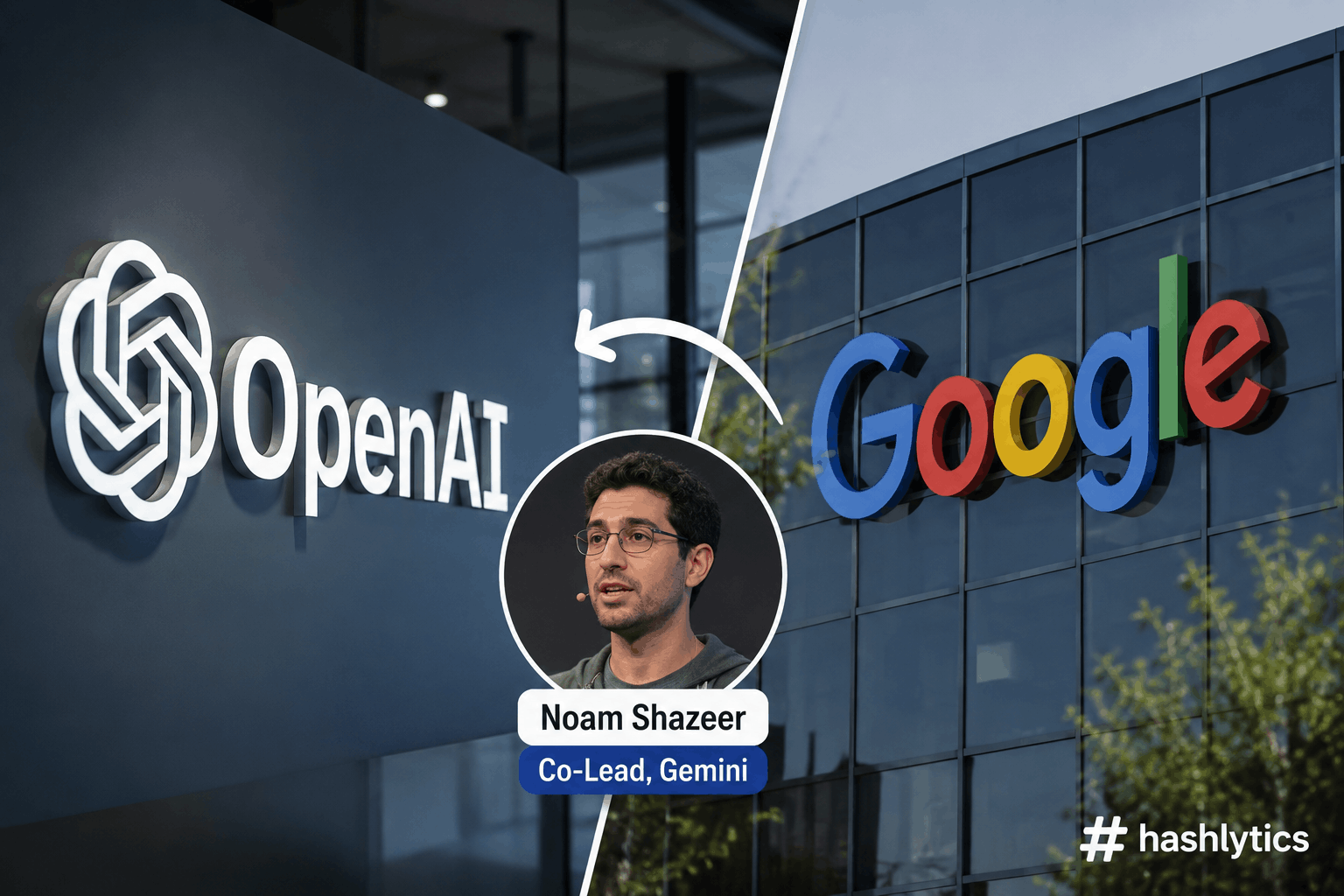
Who Is Noam Shazeer?
Shazeer is one of the most influential figures in modern AI development. He joined Google in 2000 as one of its first 100 employees and spent over two decades shaping the company’s approach to machine learning. His work is foundational to how LLMs work today. In 2017, he co-authored a seminal research paper widely credited with kickstarting the development of present-day large language models, which underpin technologies like ChatGPT and Gemini itself.
Time Magazine recognized his impact by naming him one of the 100 most influential people in AI.
A Complicated History with Google
Shazeer’s path back and forth from Google is revealing. He initially left the company in 2021 after disagreements with leadership over the public release of a chatbot he developed called Meena, which later became LaMDA. That frustration led him to found Character.AI, a startup building conversational AI systems.
Google didn’t let him stay away for long. The company brought him back through an acqui-hire deal valued at $2.7 billion in 2024, tasking him to lead key parts of the Gemini initiative. Now, less than two years later, he’s heading to OpenAI.
What This Means for OpenAI
The timing of Shazeer’s arrival is strategic. OpenAI confidentially filed for its initial public offering last month, and major talent acquisitions like this boost investor confidence. Having someone of Shazeer’s caliber on the team signals OpenAI’s technological depth heading into a public market debut.
Sam Altman, OpenAI’s co-founder and CEO, made his enthusiasm clear: Noam is one of the people I have most wanted to work with since the very beginning of OpenAI. Only took 10 years. I think it will be worth the wait.
The Broader Talent War
Shazeer’s move is part of a larger trend. Tech companies are spending enormous sums to recruit top AI talent. Meta reportedly acquired Scale AI founder Alexandr Wang for $14.3 billion last year to head its Superintelligence Lab. These kinds of deals show just how critical leadership and expertise are in the race to build the next generation of AI systems.
The competition between OpenAI and Google for talent, resources, and technological dominance is only intensifying. Shazeer’s departure raises immediate questions about Google’s Gemini development pipeline and whether other key researchers might follow. For OpenAI, his arrival strengthens their bench heading into both technical challenges and their path to the public markets.
Shazeer brings credibility, experience, and a track record of building foundational AI systems. How quickly he can contribute to OpenAI’s research and product roadmap will be closely watched. For Google, losing someone of his stature is a clear setback, even if the company still has deep pools of talent working on Gemini.
This is the kind of move that shapes the competitive landscape in tech for years to come.
Follow Hashlytics on Bluesky, LinkedIn, Telegram and X to Get Instant Updates