
Oracle (ORCL) is at a critical point, with its stock price having dropped 20% in a month after a period of significant growth driven by its AI cloud infrastructure plans. Investors are now questioning whether the upcoming fiscal Q2 2026 earnings report on December 8 will present a buying opportunity or signal that the company’s AI ambitions are faltering.
The pressure is on Oracle to deliver strong results. The company’s previous earnings report in September triggered a substantial increase in market capitalization, but those gains have since been erased, even as the broader market has continued to rise. This raises concerns about whether the initial surge was justified or simply the result of hype.
Oracle’s strategy is based on the substantial expansion of its Oracle Cloud Infrastructure (OCI). The company is projecting a 14-fold increase in OCI revenue, from approximately $10 billion in fiscal 2025 to $144 billion in fiscal 2030. If this goal is achieved, Oracle could become a leading player in the AI cloud market, potentially surpassing competitors like Amazon and Microsoft.
However, Oracle’s path to cloud dominance has not been smooth. The company initially resisted the shift to cloud computing, and it was not until the early 2010s that it began offering infrastructure-as-a-service, platform-as-a-service, and software-as-a-service solutions, with OCI launching in 2016.
For many years, Oracle was viewed as a traditional technology company, more like IBM or Cisco, and considered a dividend-paying value stock rather than a high-growth cloud innovator. While the narrative has shifted, questions remain about Oracle’s ability to fully transform itself.
The Data Center Blitz
A vital aspect of Oracle’s cloud strategy is a significant expansion of its data center footprint. In December 2023, the company announced plans to expand 66 existing data centers and build 100 new cloud data centers, citing automation, consistent hardware, and remote direct memory access (RDMA) data transfer as factors that enable rapid and cost-effective deployment.
Oracle has made considerable progress on this front. In its June 2025 quarter, the company reported building 23 multicloud data centers and announced plans for 47 more within the following 12 months. By September, Oracle had launched 34 multicloud data centers, with 37 more expected soon. This rapid expansion indicates a strong commitment to capturing cloud market share.
Oracle’s revenue targets are not solely dependent on infrastructure development; they are also driven by significant AI contracts. Recent deals with OpenAI and Meta Platforms have fueled optimism about the company’s growth prospects.
These multicloud data centers are designed to address the increasing demand from cloud providers like Amazon Web Services, Microsoft Azure, and Google Cloud. Oracle both competes and collaborates with these companies, offering data centers optimized for high-performance computing, especially for AI workloads. Additionally, OCI can be particularly appealing to customers who already use other Oracle services.
Despite the excitement surrounding Oracle’s AI initiatives, investors should be aware of potential risks. One major concern is the profitability of these AI megadeals. While Oracle’s five-year targets focus on revenue growth, operating income is also critical.
Oracle’s pricing strategy, which includes freebies and discounts, aims to attract clients and integrate them into its ecosystem. While this may be effective in gaining market share, it could compress margins and affect cash flow, potentially hindering profitability and delaying debt repayment.
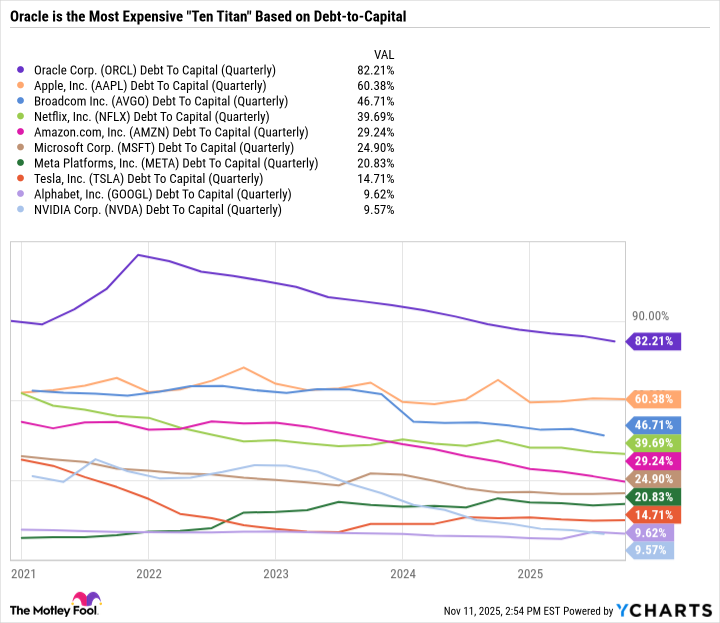
Arguably, the most significant risk to Oracle’s investment thesis is its substantial debt load. The company’s latest quarter closed with over $100 billion in net long-term debt. Unlike Amazon, Alphabet, and Microsoft, which have more cash than debt, Oracle carries a significantly higher financial burden. The other companies have more cash, cash equivalents, and marketable securities than debt.
Among the “Ten Titans,” the leading growth stocks that comprise 40% of the S&P 500, Oracle’s debt-to-capital ratio exceeds 80%. This high level of leverage requires careful management.
While companies like Apple can manage substantial debt due to consistent free cash flow, Oracle’s trailing 12-month FCF has turned negative due to rising capital expenditures. This makes the company more vulnerable to economic downturns or customer spending cuts.
Oracle’s upcoming earnings release will be a pivotal moment. The company must demonstrate that its AI investments are translating into tangible profits and that its debt is manageable. The faster OCI grows and the more effectively Oracle monetizes its AI cloud infrastructure, the higher the stock’s potential. Conversely, any stumbles could lead to further price declines.
Oracle remains a high-risk, high-reward play at the intersection of software, cloud computing, and AI. The recent stock pullback offers investors a chance to essentially acquire the five-year OCI revenue forecast at a discounted price. Whether or not this is a worthwhile gamble depends on one’s belief in Oracle’s ability to execute its ambitious vision.