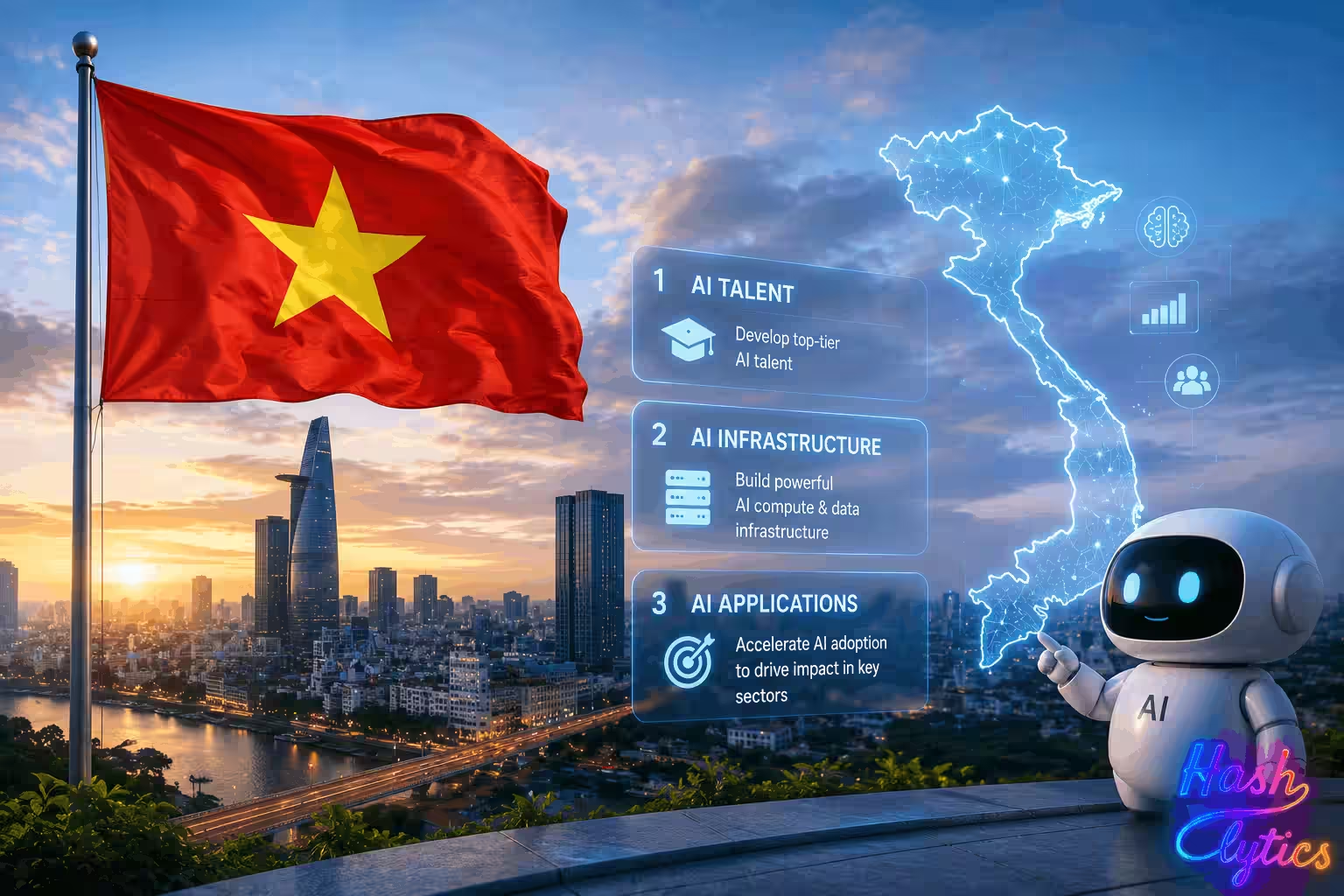
Three Core Priorities Take Shape
The Academy of Cryptography Techniques recently hosted a national scientific conference called Artificial Intelligence for Cryptography and Information Security
(AI4CRIS). Government officials, scientists, and industry experts gathered to discuss these pressing issues.
Assoc. Prof. Le Hai Binh, from the Ho Chi Minh National Academy of Politics, outlined the three priorities driving Vietnam’s approach:
- Controlling critical data to protect national interests
- Building domestic infrastructure capabilities to reduce foreign dependency
- Fostering sustainable innovation through sound governance
Quantum Computing Threatens Current Encryption
Lt. Gen. Vu Ngoc Thiem, head of the Government Cipher Committee, highlighted AI’s dual nature at the conference. AI can help design stronger cryptographic algorithms and provide early warnings against cyberattacks. At the same time, it accelerates cryptanalysis and makes side channel attacks significantly more effective.
Thiem warned that quantum computing poses an urgent challenge to current public key cryptography. Information encrypted today could be decrypted years from now once quantum computers become powerful enough. Falling behind on this front means risking national security, not just technological competitiveness.
A Decade Long Plan for Post Quantum Systems
Vietnam has approved a project to develop quantum resistant cryptographic systems covering the 2026 to 2035 period. The initiative marks a strategic step to strengthen information security capabilities and safeguard national digital sovereignty over the long term.
This is a proactive move against what security experts call the harvest now, decrypt later
threat, where adversaries collect encrypted data today with the expectation of cracking it once quantum capabilities mature.
No Single Entity Can Solve This Alone
Prof. Nguyen Thanh Thuy, chairman of the Information Technology Professorship Council, stressed the need for interdisciplinary cooperation across sectors. He argued that no single institution, whether government, academia, or private industry, can address these emerging challenges alone.
Thuy called for a broad, open collaborative network where each stakeholder plays a distinct role:
- The state creates an enabling policy environment
- Universities conduct foundational research
- Businesses bring the technology to market
Binh reinforced this point, noting that AI extends far beyond a purely technological issue. It touches institutions, governance, law, ethics, and broader social responsibility.
Deepfakes and Misinformation Add New Pressure
Binh also raised concerns about the growing spread of misinformation and AI generated deepfakes. Generative AI has made the overall information environment considerably more complex to navigate and secure.
He emphasized that protecting cyberspace requires more than technical defenses alone. Public awareness and society’s broader resilience to harmful information are just as important as any firewall or algorithm.
Building the Collaborative Infrastructure
Thiem stressed that establishing specialized scientific forums is essential for progress. These platforms connect regulators, scientists, and businesses in ways that promote genuine collaboration and knowledge sharing rather than siloed efforts.
The AI4CRIS 2026 conference aims to generate new research directions and practical solutions that support these goals. The broader initiative aligns with Vietnam’s ambition to rank among ASEAN’s top four countries in AI by 2030.
Hashlytics Take
What makes Vietnam’s approach worth watching is the sequencing. Most countries treat quantum resistant cryptography as a distant, theoretical problem. Vietnam just committed to a decade long build out starting now, years before quantum computers pose a practical threat. That is either genuinely forward thinking policy or a sign that Vietnam’s leadership is more worried about state level adversaries harvesting encrypted data today than most public statements suggest. Either way, the ASEAN AI race just got a competitor that is planning further ahead than its regional peers.
Follow Hashlytics on Bluesky, Facebook, LinkedIn , Telegram and X to Get Instant Updates