
-3.93%
-2.67%
+1.81%
-0.46%
-17.96%
-3.14%
That shift says a lot about how regulators now see crypto infrastructure. It is no longer a fringe technology to them. It is financial plumbing that moves trillions of dollars around the world.
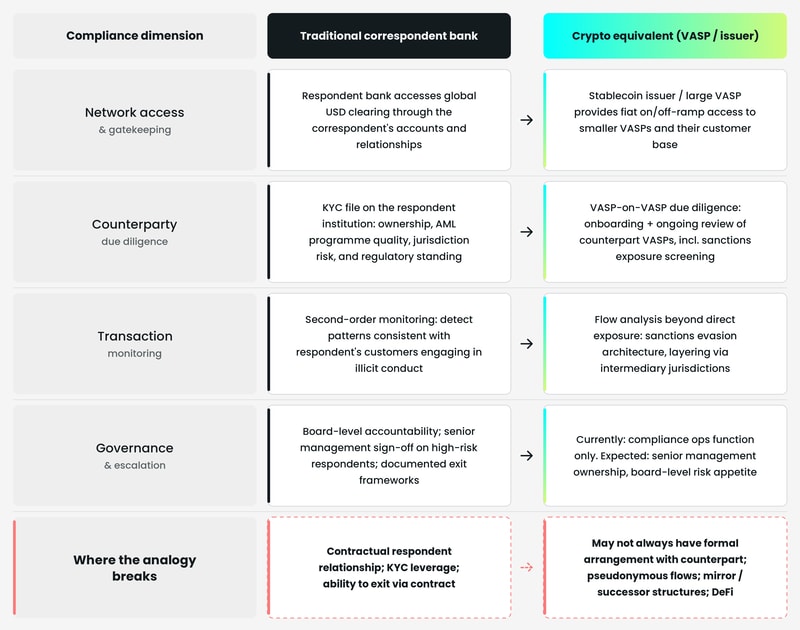
The correspondent banking comparison is deliberate. Since September 11, 2001, correspondent banking has been the chokepoint regulators use to enforce anti-money laundering, counter-terrorism financing, and sanctions rules. Large exchanges and stablecoin issuers now sit in the same structural spot: they control access to liquidity and global payment rails, they can see counterparty risk through on-chain data, and they can be held accountable for activity flowing through their systems even when they are not a direct party to a transaction.
Stablecoin Issuers Inherit the Bank Compliance Playbook
The GENIUS Act framework explicitly borrows correspondent banking controls for the stablecoin sector. Under the proposed rule, regulated issuers would need to:
- Run counterparty due diligence equivalent to what US banks perform under PATRIOT Act Section 311
- Block or reject activity covered by US sanctions in secondary markets, even where the issuer is not a direct counterparty
- Monitor the entire transaction chain and refuse service to counterparties that pose nested sanctions evasion risks
That goes well beyond standard KYC checks. The global template comes from the Financial Action Task Force (FATF), which updated Recommendation 15 in 2019 to apply anti-money laundering and counter-terrorist financing measures to virtual assets and VASPs. Under that framework, a VASP serving another VASP or financial institution is in a correspondent relationship, which could also include, for example, one VASP white-labelling its platform functionality to another VASP and also providing nested services (providing accounts to smaller VASPs for access to liquidity and trading pairs)
.
The risk is the same one correspondent banking controls were built for. A larger firm can unknowingly hand infrastructure access to sanctioned actors through the smaller intermediaries it services.
The UK Sanctions HTX, and the Target Is the Plumbing
The UK has now applied Regulation 17A of the Russia (Sanctions) (EU Exit) Regulations 2019 to cryptoasset exchanges for the first time, which sharply widens the obligations on UK VASPs dealing with sanctioned counterparties.
On , the UK government designated Huobi Global, the entity behind the HTX exchange, in a package of 18 entities targeting Russian sanctions-evasion networks. That makes HTX one of the largest crypto exchanges ever directly sanctioned by a Western government. The Treasury cited alleged links to Garantex, a previously sanctioned Russian exchange, and to the A7 network, which, according to the designation as reported by CoinDesk, moved more than $90 billion in 2025. That is roughly half of Russia’s annual military expenditure.
The Regulation 17A prohibition captures any transaction where a designated exchange appears in the payment chain, whether funds were previously processed by it or are headed to it. For firms that provide access to others, that means one sanctioned name anywhere in the chain is enough to create exposure.
Hashlytics Take
The HTX designation is the clearest sign yet that enforcement is moving from individual exchanges to the firms that provide access. The nested services model, where a large platform gives smaller VASPs accounts and trading pairs, is where this lands hardest, because the large platform now answers for what the small one does with that access. Expect bigger players to cut or tightly police those relationships, and expect smaller VASPs that depend on borrowed liquidity to feel it first.
Follow Hashlytics on Bluesky, Facebook, LinkedIn , Telegram and X to Get Instant Updates