
The Problem With a Data Center in Every Country
Many data sovereignty rules require that certain types of data be processed only within a given geographic region. The usual response is for cloud providers to replicate infrastructure country by country. That forces a trade-off between staying compliant and staying online.
Cloudflare knows the downside well. The company grew out of DDoS mitigation, where concentrating traffic in one place is exactly the wrong design. When a data center in Dubai was struck during geopolitical conflict, the weakness of localized-only systems became hard to ignore. Enterprises that insist on regional residency often find out too late that an isolated setup has no fallback when something goes wrong.
The regulatory pressure behind this is real. Brazil’s General Personal Data Protection Law (LGPD) took effect in February 2020 and sets out individual rights over personal data. Brazil has also introduced a localization amendment that would require Brazilians’ personal data to be “physically stored and maintained” inside the country. Similar mandates are spreading across Turkey, the EU, and emerging markets.
Keys That Only Open in the Right Region
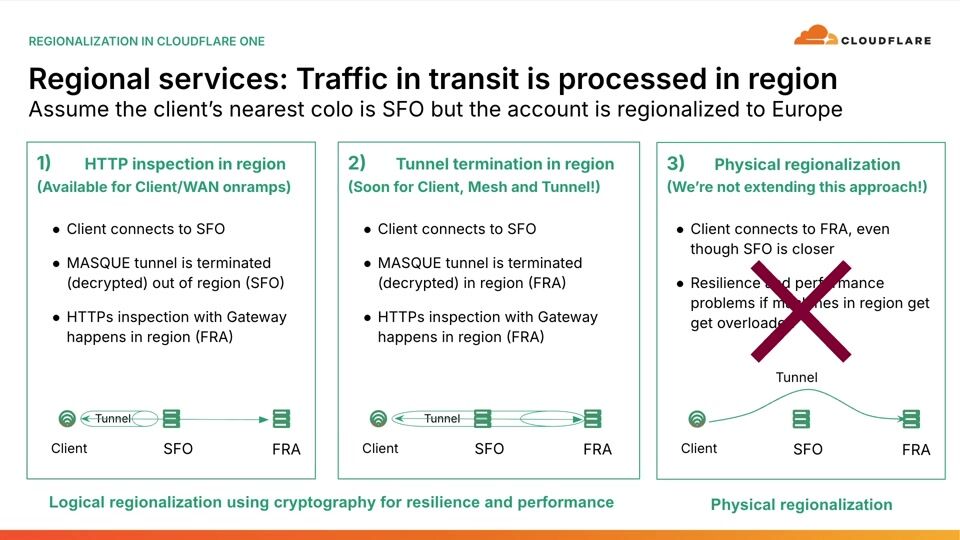
Cloudflare’s answer is the Post-Quantum GeoKey Manager, which uses NIST-standardized post-quantum cryptography to enforce geographic limits on who can access a customer’s private keys. Each customer’s encryption keys are wrapped under region-specific key material. A European enterprise’s keys, for example, can be tied to a key that exists only in Frankfurt, Geneva, or Zurich. A San Francisco data center cannot unwrap them, so traffic inspection and logging happen only where the keys live.
The difficulty is scale. High availability means replicating customer data across many servers worldwide, yet sovereignty rules say the plaintext must stay in region. Cloudflare’s solution is to keep the data end-to-end encrypted so that only servers inside the region can read it. Traffic inspection, logging, and key management are regionalized without forcing customers onto a single point of failure.
If every data center in a customer’s chosen region goes down, the system can fail over to a neighboring region, with the customer’s consent and some temporary packet loss. That escape hatch is built into the architecture, which sets it apart from approaches that pin customers to one geography and call it sovereignty.
- Availability: general availability is expected in Q1 2027
- First users: Cloudflare One customers, the company’s Zero Trust SASE platform
- Protection: quantum-resistant key wrapping aimed at “harvest now, decrypt later” attacks, where adversaries collect encrypted traffic today to decrypt it once quantum computers mature
Post-Quantum Deadlines Are Already on the Calendar
The quantum-safe design is meant to protect long-lived enterprise data while still satisfying sovereignty mandates such as GDPR and financial locality rules. The timing fits where regulators are heading. The UK’s National Cyber Security Centre expects organizations to finish cryptographic discovery and produce a costed migration plan by 2028. US federal policy sets a five-phase schedule running through 2035, with key establishment migration prioritized from 2028 to 2030 and signature migration following in 2031.
Adoption is already well underway. In early 2024, only 3% of HTTPS traffic used post-quantum algorithms. By March 2025 that figure had reached 38%, after Cloudflare turned on hybrid post-quantum Transport Layer Security by default and Chrome, Edge, and Firefox added support. Today, more than 35% of non-bot HTTPS traffic through Cloudflare is protected with post-quantum cryptography, which suggests hybrid approaches hold up at scale.
Hashlytics Take
The interesting move here is where Cloudflare puts the compliance boundary. Instead of tying sovereignty to where servers sit, it ties it to where keys can be used. That is a stronger claim than it sounds, because it only works if regulators and auditors accept key custody as evidence that data stayed in region. No amount of clever engineering settles that on its own. The first Cloudflare One deployments will test two things at once: whether regionalized key handling can keep performance intact, and whether compliance teams will sign off on it. If both answers are yes, geo-isolated data centers start to look like an expensive default rather than a requirement across cloud, CDN, and edge computing. If either is no, this stays a good engineering idea that enterprises admire and do not buy.
Follow Hashlytics on Bluesky, Facebook, LinkedIn , Telegram and X to Get Instant Updates