Oracle Data Guard Now Supports Multiple Standby Databases
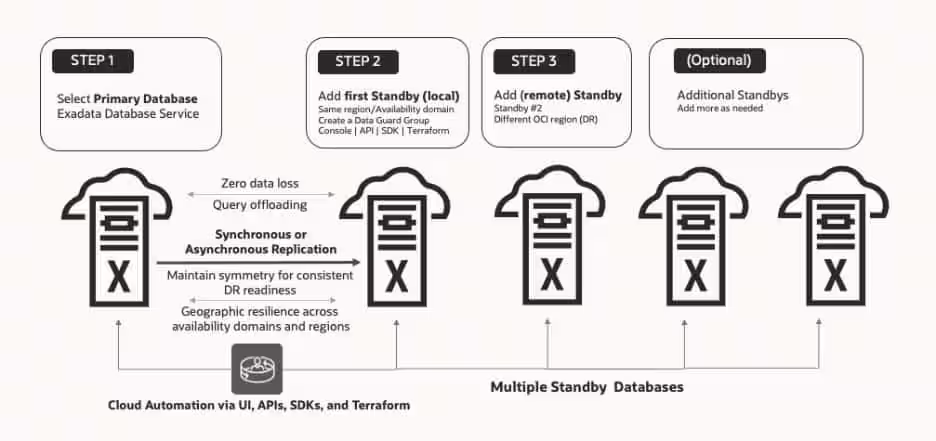
Oracle has evolved its Data Guard solution to support multiple standby databases on its Database Cloud Services. This enhancement is available for both Oracle Exadata Database Service and Base Database Service offerings. The core argument is that organizations can now move beyond a single standby, deploying several synchronized copies across diverse locations to enhance resilience against various outages. This approach aims to meet stringent Recovery Point Objective (RPO) and Recovery Time Objective (RTO) targets.
Strengthening Resilience with Distributed Standbys
The ability to deploy multiple standbys fundamentally changes how organizations can approach database resilience. A local standby, typically within the same region, offers rapid failover for common infrastructure incidents. Conversely, additional remote standby databases provide critical protection against larger, regional outages, ensuring business continuity even in widespread disruption scenarios. This distributed model allows for geographic resilience across availability domains and regions, with each standby configurable to meet specific recovery and latency requirements.
These standby databases are not merely passive copies. With Active Data Guard, customers can offload read-only workloads such as reporting, analytics, and backups to the standby. This real-time synchronization reduces the load on the primary database, allowing it to focus on critical transactional processing. This strategy improves overall efficiency and maximizes return on investment, while maintaining a separate, critical backup of the primary database.
Furthermore, multiple standbys simplify maintenance and testing procedures. Software updates can be applied to standby databases first, minimizing or eliminating downtime on the primary. The Data Guard snapshot standby feature also permits temporary conversion of a standby into a read-write environment for testing, enabling validation of changes against real data before safely reverting and resynchronizing.
Streamlined Automation on Oracle Cloud Infrastructure
Oracle Cloud enhances Data Guard with managed automation for these multiple standby databases. Customers can configure and manage both local and remote standbys through the OCI Console, as well as via APIs, SDKs, and Terraform. This automation simplifies setup and management, eliminating many manual steps traditionally associated with provisioning and operating multiple standby environments.
Multiple standby databases are organized into a Data Guard Group, an automation model that streamlines configuration and lifecycle operations. This model currently supports up to six standby databases per primary, deployable within a single region or across multiple regions. A typical configuration might include one local standby for fast recovery from infrastructure events and one remote standby for disaster recovery and regional survivability.
This comprehensive approach supports flexible role transitions for both planned and unplanned events, allowing administrators to initiate switchovers or failovers to the most appropriate standby. It also ensures consistent disaster recovery readiness across regions, as symmetric architectures mean every region can be production-ready, not just a backup. This reduces risk during regional disruptions and helps meet compliance requirements.
Elevating Database Resilience for Mission-Critical Applications
Oracle’s expansion of Data Guard to support multiple standby databases represents a significant leap in database resilience and operational flexibility. By combining high availability with efficient resource utilization and streamlined automation, this solution provides a robust foundation for modern, always-on mission-critical enterprise applications. The enhancements ensure a stronger and more flexible high availability and disaster recovery posture for customers utilizing Oracle Database on Oracle Exadata Database Service and Base Database Service, ensuring continuity even in the face of complex outage scenarios.
Follow Hashlytics on Bluesky, LinkedIn , Telegram and X to Get Instant Updates