-2.29%
-4.44%
+0.19%
-0.19%
-13.83%
+0.01%
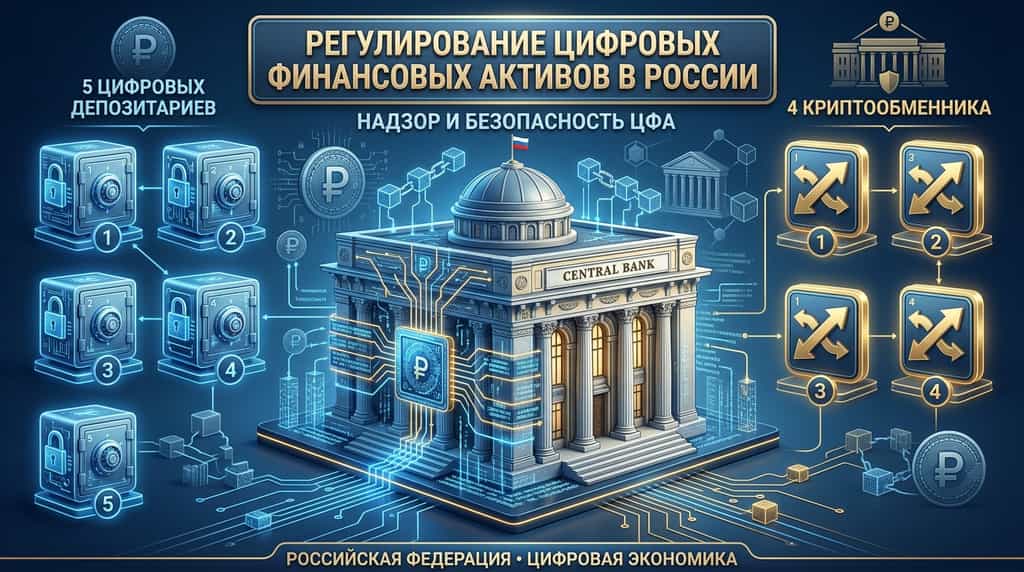
These nine approved entities are now legally authorized to manage digital currency and digital rights. They will process transactions, handle address linked customer balances, and facilitate off exchange OTC crypto trading, all under the transitional provisions of a new federal law.
The Legal Basis
The legal foundation for these approvals comes from the federal law “On Digital Currencies and Digital Rights,” which took effect September 1, 2026. The Bank of Russia’s press release confirmed the formal entry of these organizations into state registries.
Approved market participants gain immediate legal authorization for transactions involving digital currencies and digital financial assets. They must follow statutory execution and accounting rules strictly, and a grace period extends until September 1, 2027 for full compliance with permanent digital asset legislation.
What Custodians and Exchanges Actually Do
Digital custodians in Russia maintain accounting ledgers, manage rights transfers, and administer cryptographic address identifiers for digital assets. The Bank of Russia defines these entities as providing specialized infrastructure for ownership, transfer, and custody, including immutable transaction records and secure access to blockchain address identifiers.
Their role effectively replaces unregulated third party hot wallets with institutional safe keeping, and their asset accounting now aligns with central bank auditing standards. That addresses a real gap: there were previously no legally recognized, audit compliant entities for digital holdings in Russia.
The four licensed crypto exchanges work differently. They buy and sell digital currencies from their own balance sheets as principal market makers, dealing directly with clients outside organized order books. Their functions include proprietary trading and direct fiat settlements, including Ruble conversions, with mandatory reporting of operational metrics and customer identification going straight to regulators.
Custodians vs. Exchanges
| Metric | Digital Custodians | Crypto Exchanges |
|---|---|---|
| Approved Count | 5 entities | 4 entities |
| Primary Function | Asset accounting, rights registration, address management | Buying and selling digital currencies |
| Execution Model | Non-trading, custodial ledger tracking | Off-exchange (OTC) principal trading |
| Balance Sheet Risk | Low, holds client assets in custody | High, trades using proprietary balance sheet |
| Client Interaction | Secure vault access and token accounting | Directly quotes buy/sell prices to users |
| Primary User Base | Institutions, token issuers, asset managers | Individual traders, corporate settlement users |
| Compliance Deadline | September 1, 2027 | September 1, 2027 |
Why This Matters for Cross-Border Settlement
This approval gives domestic market participants authorized infrastructure for cross-border settlements without relying on unvetted offshore platforms. Corporate entities now have legal pathways for international trade settlements using digital currencies, while institutional investors get access to licensed domestic custodians instead of unverified offshore exchanges.
- Regulated OTC desks offer transparent pricing for Ruble to crypto conversions
- Centralized monitoring of exchange flows lets regulators trace capital movements
- Standardized fiat to crypto bridges support broader cryptocurrency adoption
What Still Needs to Happen
Full market integration faces real operational hurdles. Registered entities must undergo extensive technical, security, and administrative compliance audits over the next 12 months, leading up to the September 2027 deadline.
Integrating technical infrastructure between banking systems and distributed ledgers remains a core challenge. Compliance obligations are evolving quickly enough that firms need adaptive risk management software for sanctions filtering, and liquidity depth at the approved OTC desks still needs work. These entities must hold sufficient capital to handle large institutional orders without disruption.
Hashlytics Take
The framing here matters more than the headline. This isn’t Russia warming up to crypto in the way Western coverage sometimes implies. It’s Russia building state supervised rails for digital asset flows at a moment when conventional financial channels remain heavily sanctioned. A licensed custodian and a regulated OTC desk that reports customer identification directly to the central bank is not a liberalization story, it’s a control story. The real test by September 2027 isn’t whether these nine entities pass their audits. It’s whether this framework becomes the primary channel Russian institutions use to settle trade outside the dollar system.
Follow Hashlytics on Bluesky, Facebook, LinkedIn , Telegram and X to Get Instant Updates