-0.04%
-0.51%
+26.80%
-0.77%
+0.62%
+1.20%
The Numbers Behind the Decline
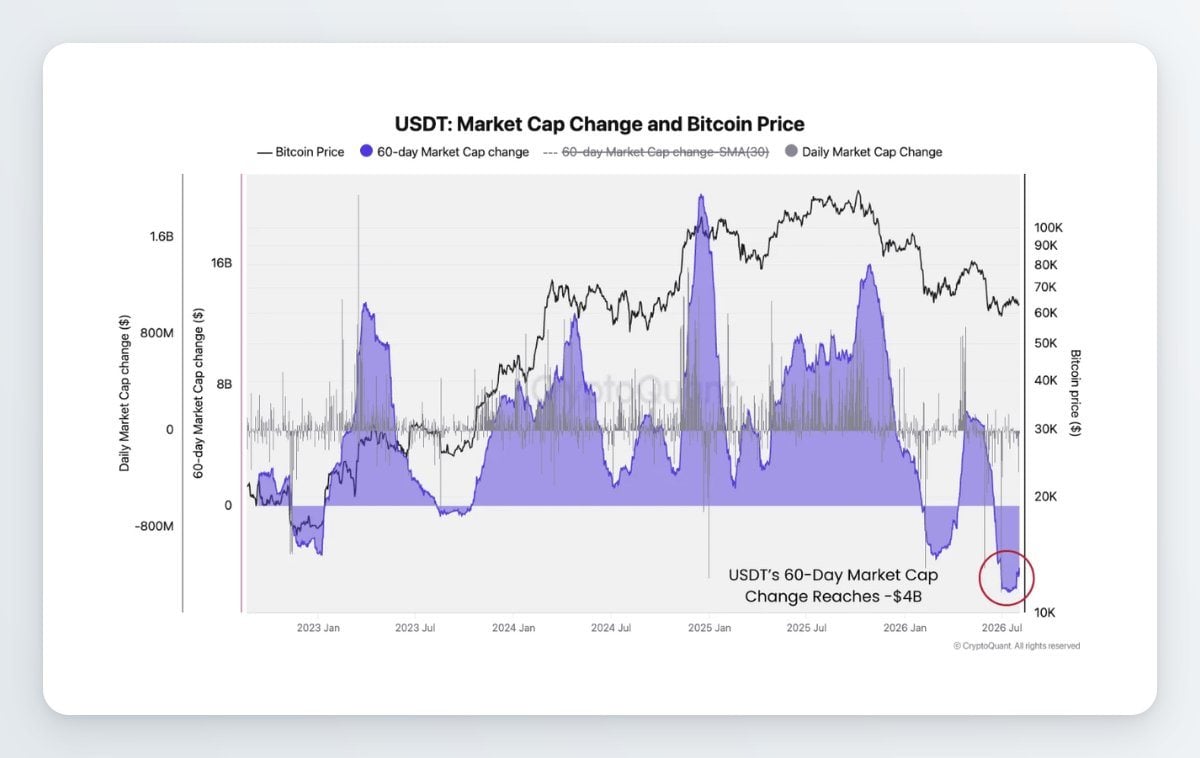
The total supply of Tether’s USDT has fallen significantly. Cryptoquant data shows a roughly $4 billion decrease on a 60 day rolling basis, marking a notable contraction after years of consistent growth for the stablecoin.
Over the last 11 days alone, $870 million of that supply evaporated. Despite the drop, USDT still maintains its dominant position with about $184 billion in circulation, representing an estimated 60% of the total stablecoin market.
Where the Capital Is Going
Analysts point to several overlapping factors behind the shrinking supply. Investors may be moving capital out of crypto entirely and back into traditional fiat currencies, a trend that follows Bitcoin’s retreat from its 2025 peak.
Analyst Stacy Muur put it plainly: Some investors are redeeming stablecoins for fiat and leaving crypto entirely.
Weaker speculative demand is also playing a role, along with changing incentives across the stablecoin market.
One detail complicates the simple “capital rotation” theory. USDC supply has also seen a sharp decline recently, which weakens the argument that money is just moving between competing stablecoins rather than leaving crypto altogether.
Muur described the situation as a mix of things, citing:
- Some capital chasing yield elsewhere
- Some capital rotating back into fiat currency
- Less overall demand for stablecoins as speculative activity cools
Tron and Ethereum Still Dominate
Despite the overall supply reduction, USDT remains heavily concentrated on two networks. Tron and Ethereum each host roughly $90 billion of Tether, together accounting for approximately 97% of USDT’s circulating supply.
Tron has actually led stablecoin growth this year. Its stablecoin market capitalization increased by about $10.8 billion, according to Token Terminal, outpacing HyperEVM and X Layer, which saw $5.2 billion and $1.7 billion increases respectively.
What This Means for Market Liquidity
Stablecoin supply often serves as a proxy for deployable crypto liquidity. A broad decline across major stablecoin issuers can signal capital exiting digital asset markets entirely, which is a meaningfully different story than capital simply waiting on the sidelines for the next opportunity.
The broader picture remains mixed. Tether is deeply integrated into crypto payments, trading, and emerging market dollar demand. Its aggregate supply, though, is no longer expanding in a straight line. For investors, the real question now is whether shrinking stablecoin balances translate into weaker trading activity and reduced liquidity across the board.
Hashlytics Take
The USDC decline running parallel to USDT’s drop is the detail worth sitting with here. If this were simple rotation, one stablecoin’s loss would be another’s gain. It isn’t. When the two largest dollar-pegged tokens shrink together, that’s not portfolio rebalancing, that’s capital actually leaving the ecosystem. Watch Tron’s continued growth closely though. If speculative capital is cooling while a specific network keeps absorbing stablecoin share, that tells you where the remaining activity is concentrating, and it’s a better signal than the aggregate supply number alone.
Follow Hashlytics on Bluesky, Facebook, LinkedIn , Telegram and X to Get Instant Updates