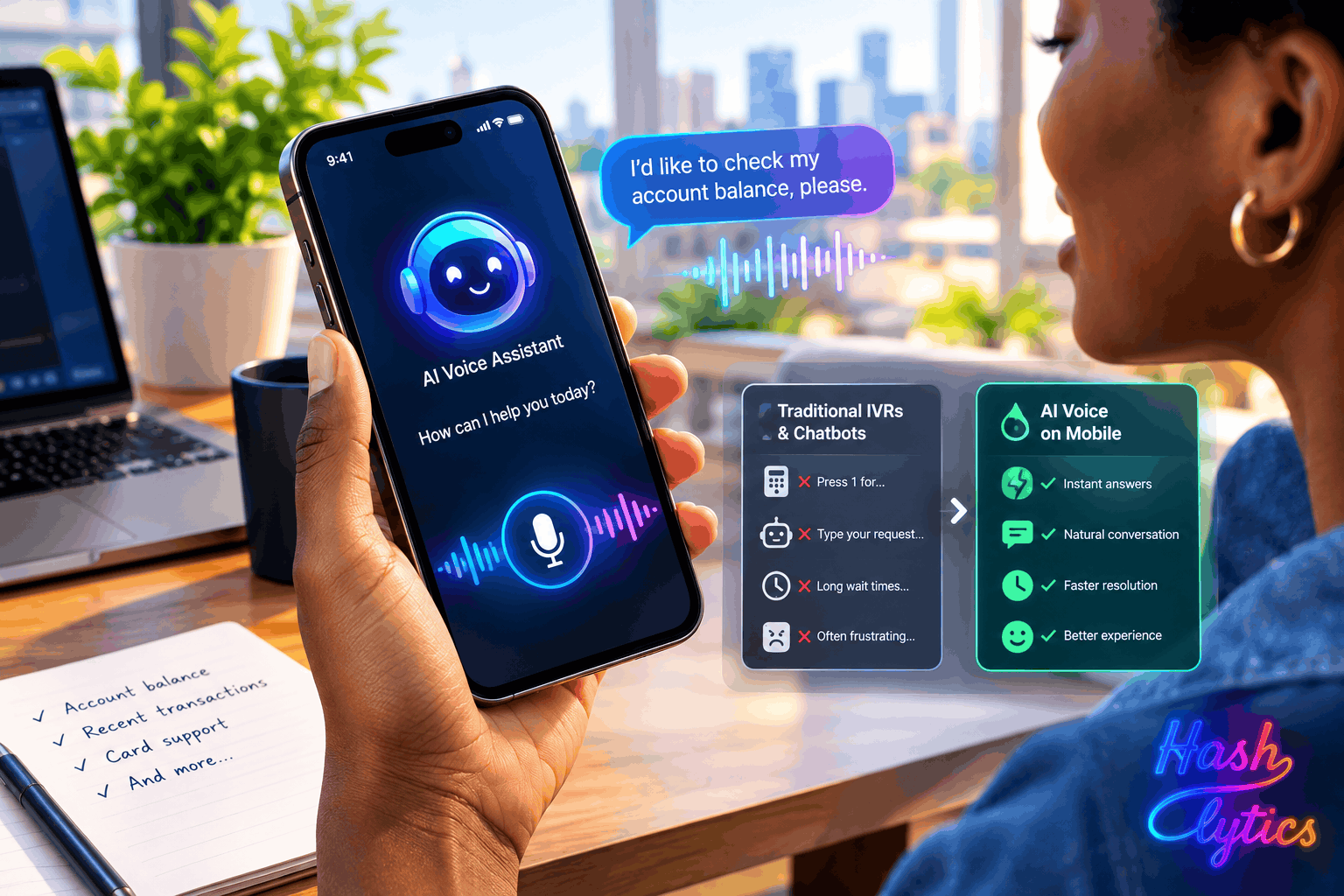
The economics always favored automation. Gartner projected in 2022 that conversational AI would reduce contact center labor costs by $80 billion by 2026. At the time, only 1.6% of agent interactions were automated. The projection for 2026 was one in ten. What has changed since then is not the incentive but the quality of the product. Two years ago synthetic speech was easy to detect: wrong pacing, flat tone, no rhythm. Modern AI voice systems are trained on large libraries of recorded human speech, learning stress, tempo, and the micro-pauses that make language sound natural. The result is something that no longer signals “this is a machine” in the first sentence.
Why Mobile Changes the Equation
A voice agent running inside a mobile app starts from a different position than a phone tree. The app already knows who the user is, what they have ordered, and what appointment they are about to miss. The agent skips the identification questions that made IVR calls feel like interrogations. It also handles interruptions: the user can cut in mid-sentence and the agent adjusts rather than starting the response over.
ElevenLabs, one of the better-known AI voice companies, launched a dedicated iOS app after observing that large numbers of its users were already accessing the platform through mobile browsers. That is a product decision that follows user behavior rather than leading it. The broader market is following the same signal. Grand View Research estimates the AI voice generators market at $3.6 billion in 2023, projecting it will reach $21.8 billion by 2030, a compound annual growth rate of 29.5%.
What a Usable Voice Agent Actually Requires
The technical bar for a voice agent that does not frustrate users is specific. Response latency has to be low enough that the pause before the agent speaks does not register as hesitation. The system has to recognize when it has been interrupted and stop talking rather than finishing its sentence over the user. Language coverage matters beyond just translation: in markets like India, an agent that cannot handle Hindi, English, and Hinglish switching within a single sentence will fail in practice. And the handoff to a human agent, when it happens, needs to carry the full conversation history so the user does not repeat themselves.
Disclosure is also on that list, not as a courtesy but as a design requirement. Users who discover midway through a call that they were not speaking to a person tend to exit the experience entirely, which defeats the purpose. The agents that are replacing IVRs well are the ones that lead with what they are.
Hashlytics Take
The standard pitch on AI voice agents focuses on cost savings and customer experience improvement, and both are real. But the story the industry is not telling as clearly is about consent. Mobile apps carry persistent identity, behavioral history, and in some cases location. A voice agent drawing on all of that to skip introductory questions is useful until it is not, and users rarely see a disclosure about what context the agent is working from. The IVR was impersonal but transparent. The new generation is personal and, so far, much less transparent about how personal it actually is. That gap is where the next round of complaints will come from, and companies that build in clear disclosure now will be ahead of the ones that wait to be asked.
Follow Hashlytics on Bluesky, Facebook, LinkedIn , Telegram and X to Get Instant Updates