Wonder Full Ranks Second, Behind Only Claude Opus
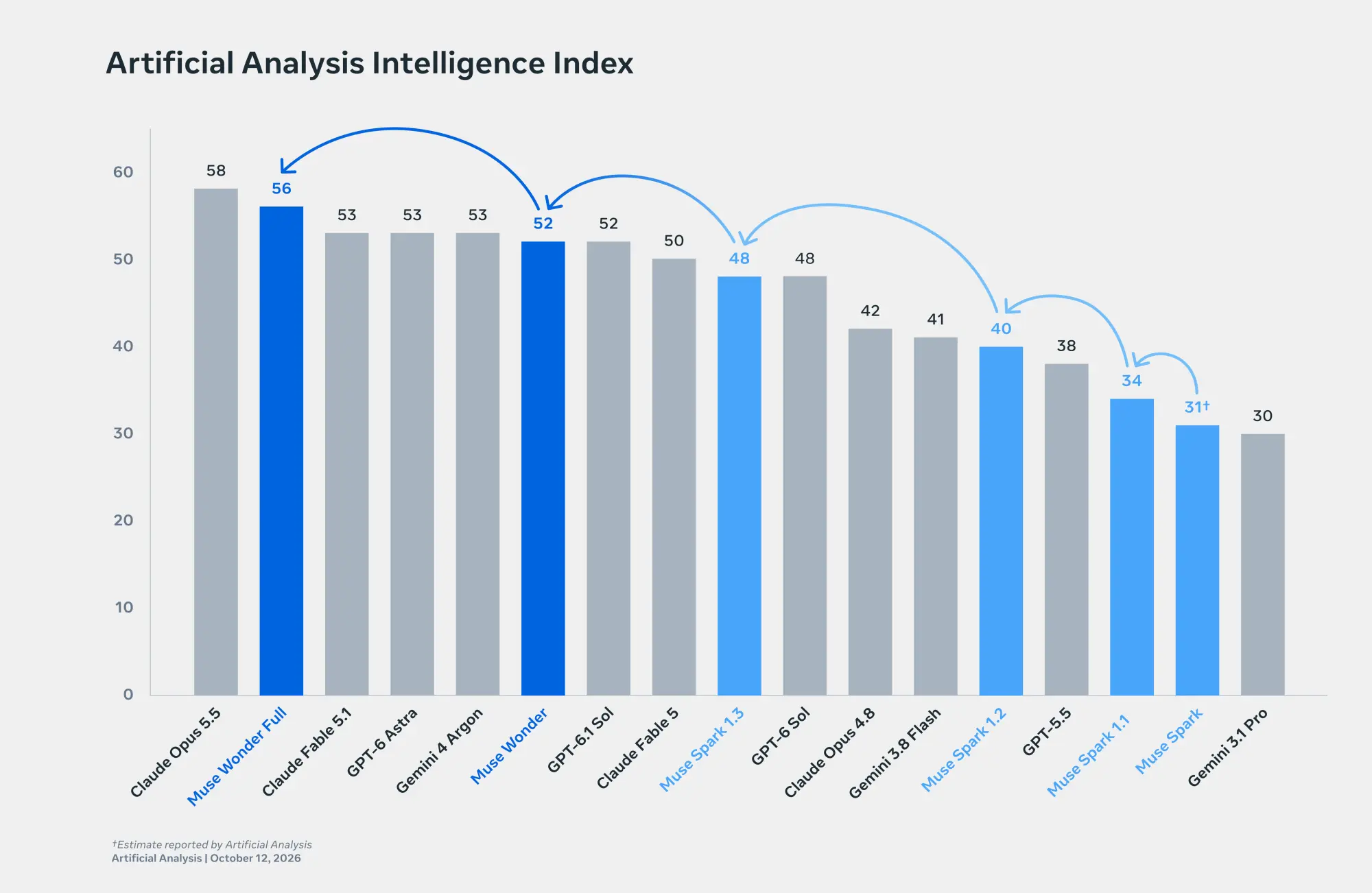
Independent testing group Artificial Analysis placed Muse Wonder Full second overall on its Intelligence Index, a weighted composite benchmark. It trails Claude Opus 5.5 Max and ties with Claude Sonnet 5.5 Max, putting it ahead of OpenAI’s GPT-Astra, Anthropic’s Fable 5, and Google’s Gemini 4. Meta also points to its own MemoryBench results, claiming Muse Wonder scores higher on long-term recall than Fable, Opus, or Astra. Research scientist Kavya Kopparapu said the team put significant effort into making the model remember what’s important to a user over days, weeks, months, and beyond.
Built Around Active Focus and Active Memory
The Wonder models were trained at Meta’s Prometheus data center in central Ohio, which came online earlier this year, and are built around two features aimed at agentic use:
- Active Focus lets agents persist through difficult, long-running tasks, recover from errors, and check in with users before acting rather than barreling ahead
- Active Memory lets the model retain and synthesize details across conversations, so it can recall relevant context on later tasks without being re-prompted
Meta says the models will avoid sharing private information without permission and will refuse harmful requests, with a full safety evaluation report described only as “available soon.”
Two Ways In, Two Different Prices
Access depends on which model and how much you want to pay:
- Muse Wonder (standard) is available now through the Meta Model API, priced at $4 per million input tokens and $20 per million output tokens, putting it in the same range as GPT-6 Sol or Opus 5.5
- Muse Wonder Full is restricted to Muse Code subscribers and isn’t available through the API at all
- Both models are set to power the Muse agent, which has passed 5 million downloads, though CNBC reports that access there will require a paid subscription expected to run $20 or $100 a month
Meta hasn’t confirmed public pricing tiers or a general availability date beyond what’s already live for developers.
The Safety Report Is Still Pending
A second-place finish on a credible third-party benchmark is a real result, and it’s fair to call Muse Wonder Meta’s strongest model yet. But the MemoryBench comparisons are Meta’s own numbers, not independently verified, and the loudest claims in the announcement, “major leap toward superintelligence” among them, are doing a lot of work for a model whose safety evaluation hasn’t actually been published yet. Pairing bold framing with a “coming soon” safety report and a paywalled Full version is a pattern worth watching rather than taking at face value.
Follow Hashlytics on Bluesky, Facebook, LinkedIn, Telegram and X to Get Instant Updates